

On this page
You ask a chatbot to explain heat capacity and it heats water from 68 °F, measures a car in miles per hour and ends with a practice question in a format your board has never set. Nothing in it is exactly wrong, but none of it matches the textbook you will be examined on. Here is why, and a prompt and checklist that fix most of it.
Why do AI examples not match the Indian syllabus?
Large language models pick up a default setting from the text they learn from, and that setting is usually not an Indian classroom. A 2024 study in PNAS Nexus by Yan Tao, Olga Viberg, Ryan Baker and René Kizilcec compared five OpenAI models with nationally representative survey data and found that all of them showed cultural values resembling English-speaking and Protestant European countries.
India-specific work points the same way. In Fluent but Foreign, researchers tested six Indic and six global models and ran a study with 115 Indian users: both kinds of model gave Westernised or exoticised writing suggestions. The SANSKRITI benchmark, with 21,853 questions covering 28 states and 8 union territories, found many models struggling with region-specific questions.
None of these studies tested NCERT physics questions directly. They show that a model's default context is not yours, and in a science answer that default shows up as foreign units, examples and question styles.
What goes wrong in a physics or chemistry answer?
Units: °F, miles, feet, pounds and gallons instead of SI. The International System of Units has seven base units, including the metre, kilogram, second and kelvin, and Indian textbooks work in it.
Examples: baseball, snow days and dollars where cricket, the monsoon, a local train or rupees would make the idea stick.
Numbers: millions and billions when your textbook and newspaper say lakh and crore.
Format: a long American-style essay answer when your board wants a short derivation, or a method that is outside your syllabus.
Source: JPL's 1999 release.
Worked example: one heating problem, two answers
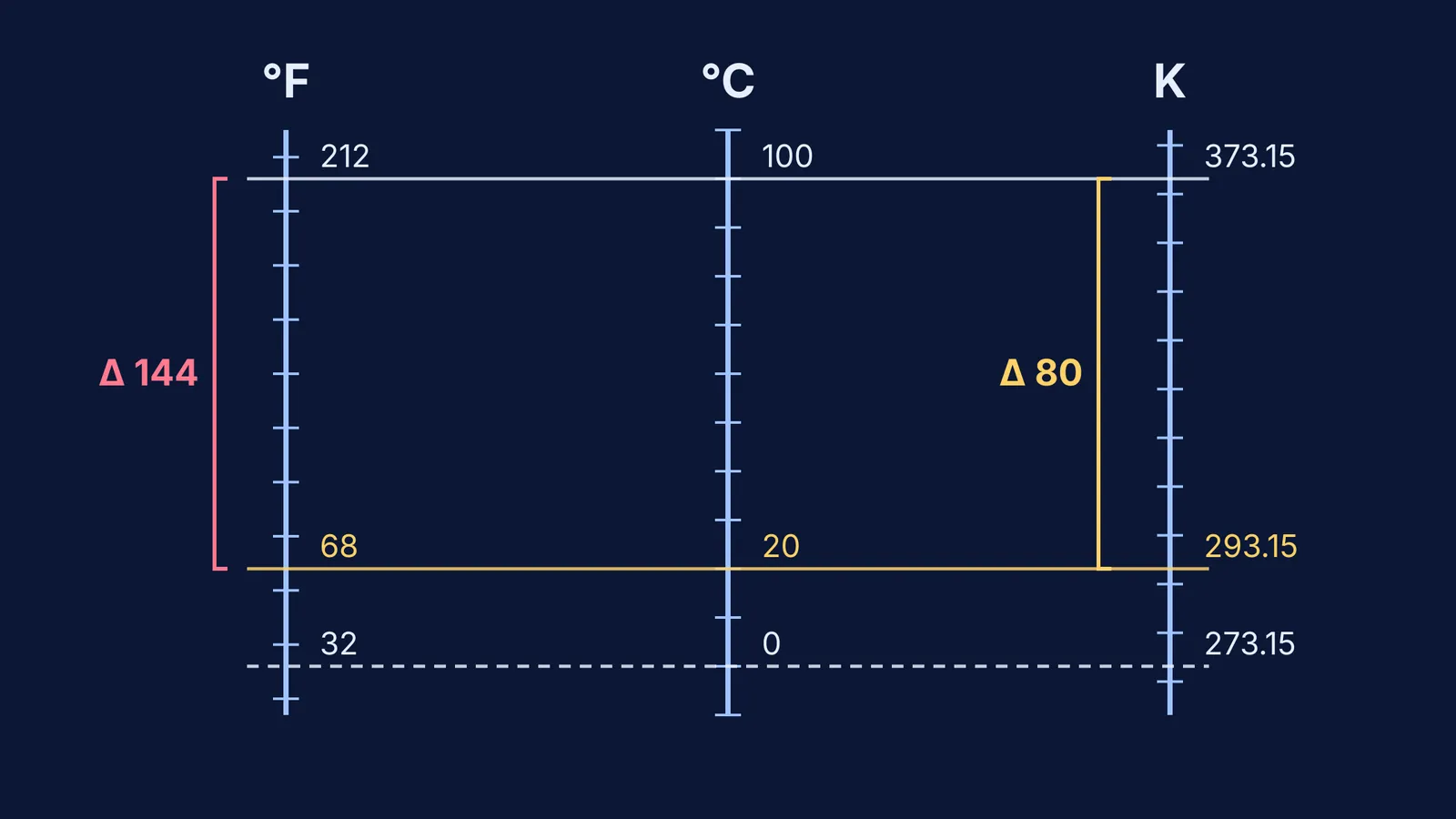
Say the AI writes: "Water is heated from 68 °F to 212 °F, so the temperature rise is 144 degrees." Then it uses Q = mcΔT.
Using the NIST conversion formulas, K = (°F − 32) / 1.8 + 273.15:
68 °F becomes 20 °C, which is 293.15 K.
212 °F becomes 100 °C, which is 373.15 K.
The rise is 373.15 − 293.15 = 80 K. A change of 1 K equals a change of 1 °C, so it is also 80 °C.
If you take the AI's 144 and plug it into Q = mcΔT with c in J kg⁻¹ K⁻¹, your answer comes out 1.8 times too large. The physics was fine. The unit was not.
What should you type to get NCERT-style answers?
Tell the model who you are before you ask. The PNAS Nexus team called this cultural prompting; for GPT-4, 4-turbo and 4o it improved alignment for 71–81% of countries and territories. Copy this and edit the brackets:
"I am a Class [11] [CBSE] student in India preparing for [JEE Main]. Answer the way an NCERT textbook would: Given, To find, Formula, Solution, Answer. Use SI units only and show every unit conversion. Use Indian examples such as cricket, trains, the monsoon or rupees. Write large numbers in lakh and crore. If any method you use is outside the NCERT syllabus, say so."
If later replies drift, paste it again.
How do you check the AI's answer?
Run these five checks before you copy anything into your notes:
Units on every line. Each quantity should carry an SI unit, and every conversion should be shown.
Dimensions. Check that both sides of the final formula have the same dimensions, the method from the Units and Measurement chapter.
Textbook match. Open the NCERT chapter. Are the symbols, sign conventions and definitions the same?
Syllabus fit. Did it use a method or shortcut your class has not covered? Ask for the NCERT method.
Explain it back. Close the chat and solve it again on paper. If you cannot, it is not yours yet.
Parents can help without knowing physics: ask your child to point to the unit conversion and say why it is needed.
If the problem is a wrong method rather than a wrong unit, the Fermi Problem Library has worked problems with a step-by-step solver that explains the reasoning rather than printing an answer. And if you are not sure where to start, Fermi's AI tutor works out what you already know and builds a plan for the session, checking understanding as it goes.
Whichever tool you use, start your next session with the prompt above and run the five checks on the first answer.


