On this page
Proof by induction is the chapter where you can follow every worked example and still freeze at a blank page. AI can help, but only if you use it to test your thinking, not to write the proof for you. Here is a plan, the prompts to type, and a worked gap hunt.
What does a proof by induction actually need?
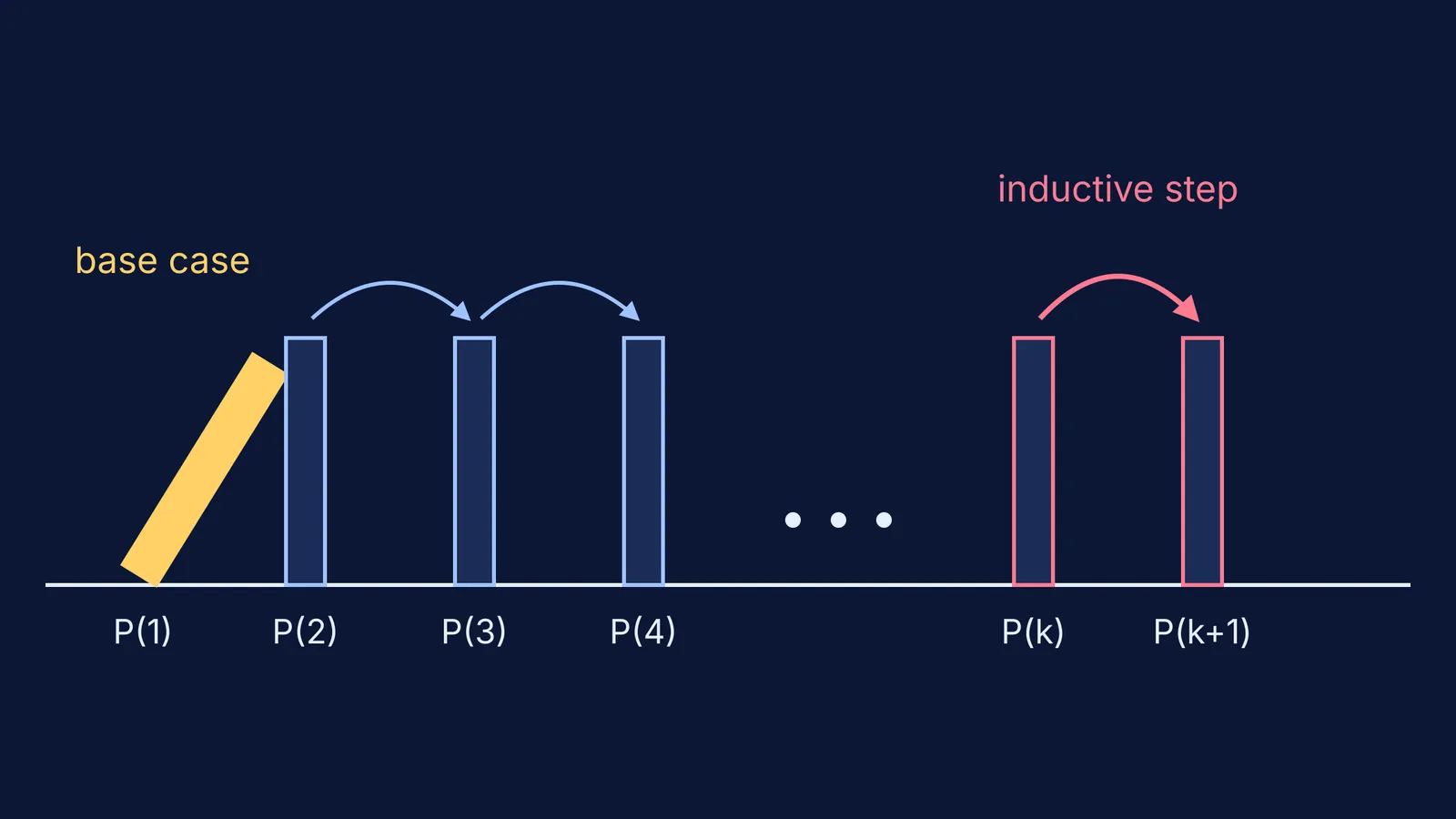
The principle of induction says: if P(0) is true, and P(n) implies P(n+1) for every nonnegative integer n, then P(m) is true for every nonnegative integer m (Mathematics for Computer Science, Chapter 3, MIT OpenCourseWare).
The first part is the base case: check the starting value. The second is the inductive step: assume the statement for n (the induction hypothesis) and use it to prove the statement for n+1. School problems often start at n = 1; the logic is identical.
The same chapter advises you to label both parts explicitly, because it lowers the chance that you forget a key step such as checking the base case. The two parts go wrong in different ways, so it pays to study them separately.
Why not just ask AI to write the proof?
Because you learn less. In a field experiment published in PNAS, researchers gave nearly a thousand high school maths students access to GPT-4 tutors: either a standard chat interface or one with prompts designed to safeguard learning (Bastani et al., 2025).
With GPT-4 access during practice, grades rose 48% with the standard chat and 127% with the safeguarded tutor. When access was taken away, students who had used the standard chat scored 17% lower than students who never had access. Without guardrails, the authors write, students tried to use GPT-4 as a "crutch"; the safeguards largely mitigated that harm.
AI also makes maths mistakes; see why AI chatbots get maths wrong, with a five-step way to check.
How do I use AI to learn induction step by step?
Take one statement, for example "n³ − n is divisible by 3 for every n ≥ 1", and work through it in five rounds.
Base case only. Type: "I'm learning proof by induction. Don't solve anything. Ask me what I would check for the base case of this statement, then tell me whether my check is enough."
Inductive step only. Type: "What am I allowed to assume, and what exactly must I prove? Make me write P(k+1) myself before you say anything else."
Close the chat and write the full proof on paper, with both parts labelled.
Paste your proof and type: "Act as a strict examiner. Do not rewrite my proof. Quote every line where a step is not justified, where I assumed what I was proving, or where my base case does not match the starting value, and ask me one question about each."
Fix the gaps yourself, then ask for one similar statement and prove it with AI closed.
For the example, your inductive step should show that (k+1)³ − (k+1) = (k³ − k) + 3k² + 3k, a multiple of 3 plus a multiple of 3.
That habit is the self-explanation effect at work; see how to study worked examples by explaining them to yourself.
What does an AI gap hunt look like?
Spot the planted gap before reading on.
Claim: n² + n is odd for every natural number n. Proof: assume k² + k is odd. Then (k+1)² + (k+1) = (k² + k) + 2(k+1), which is odd plus even, so it is odd. Hence the claim holds for all n.
The inductive step's algebra is correct. The gap: there is no base case, and n = 1 gives 1 + 1 = 2, which is even. In fact n² + n = n(n+1), a product of consecutive integers, so it is always even. The dominoes never start falling.
A useful gap-hunting reply points straight at the missing base case. If the AI only praises the algebra, it has missed the point; check the starting value yourself.
The other common gap is circular reasoning: writing out P(k+1), simplifying both sides until you reach something true, and calling that a proof. Name it in your prompt so the AI looks for it.
How do I know I have really learned it?
You can state P(n) in words before writing anything.
Your base case uses the same starting value as the claim (n = 0, n = 1, or n = 5 for a claim about n ≥ 5).
You can point to the exact line where you used the induction hypothesis.
You can prove a fresh statement with AI closed.
If the idea of induction itself is shaky, the Fermi Concept Library has a lesson for every concept in mathematics, each with its place in the map. And if you want help that holds back the answer, Fermi's AI tutor is built to teach rather than answer: it notices where you are stuck and decides whether to explain, ask or show.
Preparing for olympiads? Read how INMO proof solutions are marked, then put tonight's proof through the five rounds above.