

On this page
Where does AI marking agree with teachers?
When students submit essays or structured answers to an automated evaluation tool, the software and human examiners frequently reach similar conclusions on mechanical structure. In a 2024 study evaluating secondary school writing across three student corpora, Tamara Tate and colleagues found that holistic scores from large language models achieved substantial statistical agreement with trained human raters.
Automated grading systems excel on explicit, rules-based criteria. They reliably check syntax, spelling, paragraph organisation, vocabulary range, and required technical terms. Unlike human examiners, automated tools do not suffer from fatigue after reviewing stacks of scripts, nor are they influenced by handwriting neatness or reading order. For CBSE board questions in English, social science, or biology where marks depend on specific keywords and value points, AI tools can rapidly confirm whether a student included the essential facts.
Why is AI grading too lenient or too harsh?
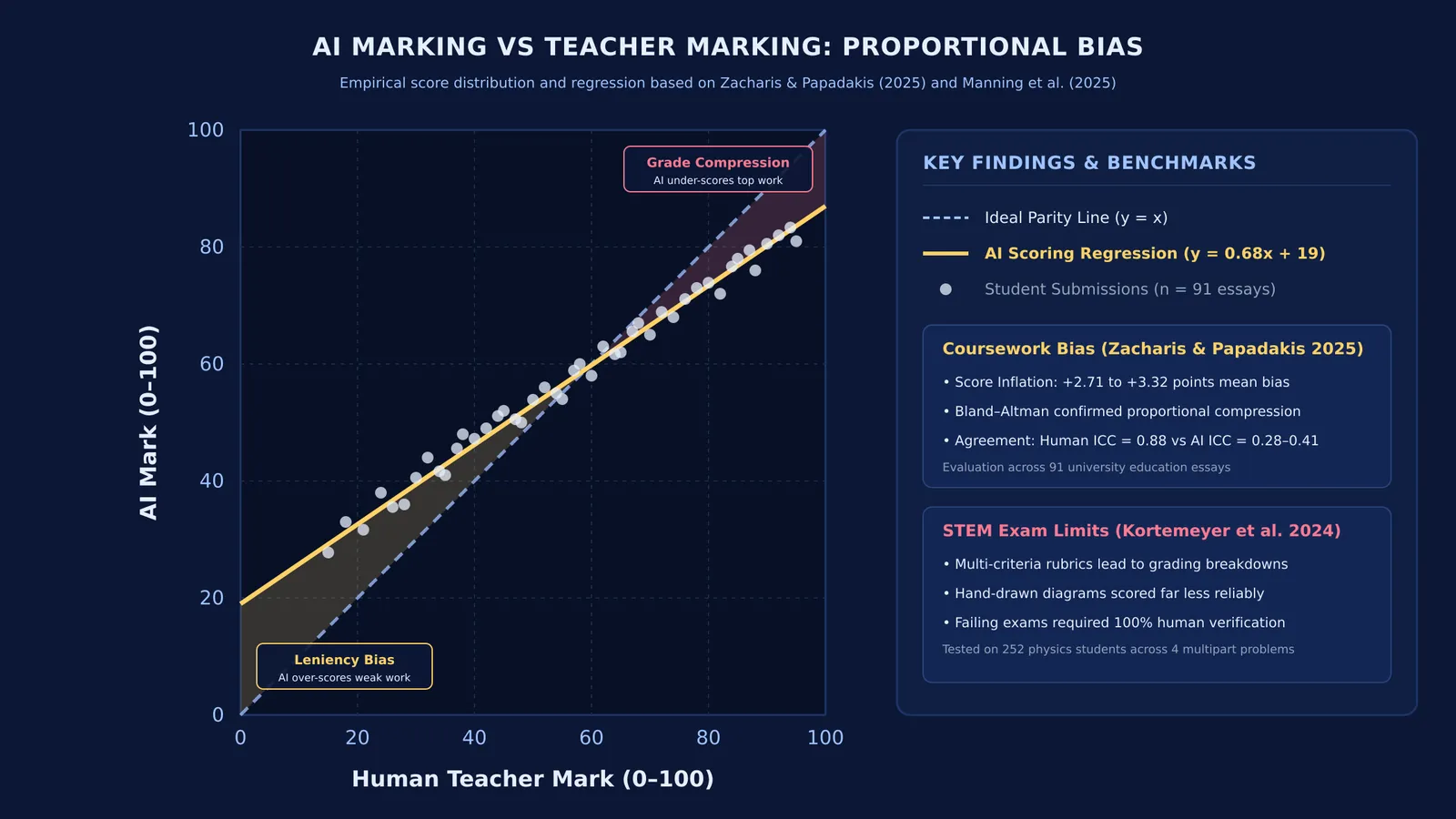
Despite surface agreement, psychometric analyses reveal systematic distortions in automated scoring. The most common distortion is algorithmic leniency. In a 2025 study evaluating 50 student writing samples over three grading rounds, Jennifer Manning and co-authors observed that large language models consistently awarded higher marks than human instructors, frequently granting passing grades to substandard submissions. Because conversational models are trained to be agreeable assistants, they default to generous interpretations rather than critical academic skepticism.
A second distortion is proportional bias, which compresses the grade spectrum. In a 2025 study analysing 91 student coursework essays, Georgios Zacharis and Stamatios Papadakis discovered that an AI grader consistently inflated scores by an average of 2.71 to 3.32 points compared to human faculty, while Bland–Altman analysis confirmed systematic proportional bias—over-scoring weaker essays and under-scoring stronger submissions. The AI compressed student performance toward the mean, struggling to separate barely passing answers from exceptional analysis.
Automated graders also display verbosity bias, rewarding length and repetitive jargon over concise clarity. Conversely, automated systems can become overly harsh on unconventional thinking. When a student uses an unexpected algebraic step or creative analogy, the system often marks it incorrect because it deviates from standard training patterns.
Can AI accurately grade step-by-step math and physics?
The divide between automated marking and teacher assessment widens in STEM subjects, where marks depend on multi-step reasoning. In a 2024 study on a university thermodynamics examination involving 252 students across four multipart problems, Gerd Kortemeyer and co-authors found that AI successfully verified isolated mathematical derivations against narrow rubrics, but broke down whenever rubrics required tracking more than a handful of simultaneous grading criteria.
The study also showed that AI struggled to assess hand-drawn physics diagrams, such as thermodynamic cycles. While the model identified passing exams reliably, papers with failing marks still required human teacher grading because the AI could not decipher messy handwriting or determine whether an error was a minor slip or a fundamental conceptual misunderstanding.
For students working through multi-step problem sets, turning handwritten work into digital feedback carries technical hurdles; our guide on evaluating handwritten solutions highlights how image clarity and layout affect accuracy. Getting reliable guidance requires interactive diagnosis rather than a simple score, as examined in our guide on AI feedback on step-by-step solutions.
This is why tutoring architecture must differ from simple chatbot grading. Fermi's AI tutor is designed to hold a line of reasoning across a session, noticing where a student is stuck and deciding whether to explain, ask, or show rather than merely stamping an uncalibrated grade. When practicing numerical problem-solving, the Fermi Problem Library offers worked problems with a step-by-step solver that explains the reasoning rather than printing an answer.
How can students and teachers combine both?
Because AI marking is fast but prone to grade compression, the best approach is a hybrid workflow combining automated speed with human judgment:
Use AI for immediate mechanical diagnostics. During daily practice, run answers through automated tools to check grammar, step completeness, and arithmetic slips.
Audit automated scores against official marking schemes. Check whether an automated tool gave credit for vague filler that official board marking schemes would discard.
Fix underlying conceptual gaps. When automated feedback reveals a mistake, do not simply copy a suggested correction. Explore the Fermi Concept Library to review the underlying theory and rebuild your derivation from first principles.
Take unconventional methods to a teacher. Whenever you use an alternative proof, draw an intricate diagram, or disagree with an automated score, ask your teacher or mentor for human moderation.
As explored in our analysis of how teachers use AI feedback, automated tools deliver the greatest benefit when they handle routine first-pass checks, freeing teachers to focus on personalised mentoring.


