

On this page
Why read lists when you can verify them?
The biology syllabus is full of long lists. In chapters like Microbes in Human Welfare, you must match names such as *Trichoderma polysporum* to products like cyclosporin A, and remember whether they are fungi, bacteria or yeasts. Reading the textbook over and over is a passive strategy that often fails to stick. A landmark 2014 meta-analysis in PNAS found that undergraduate students in traditional, passive lecture courses were 1.5 times more likely to fail than those engaged in active learning.
Active learning forces you to retrieve information and spot errors. You can use an AI assistant to generate a structured review sheet of microbes grouped by their applications—food, industry, sewage treatment and biofertilisers—and then treat its output as a draft you must verify.
How to prompt the AI for microbe groups?
To get a useful study aid, ask the AI to organise the facts into clear categories. Try using this exact script as your prompt:
> "List the microorganisms used in human welfare, grouped by: 1) Food products, 2) Industrial products, 3) Sewage treatment, and 4) Biofertilisers. For each, give the scientific name, the type of microbe (bacterium, fungus, yeast), and its specific product or role."
The AI will generate a structured list. For instance, under industrial products, it will likely name *Monascus purpureus* (a yeast) and state that it produces statins. Under food, it should list *Lactobacillus* for curd and *Saccharomyces cerevisiae* for baking bread.
How to verify organism product names?
AI models sometimes hallucinate or use outdated classifications. Verifying the AI's list against your syllabus is where the actual learning happens. When you check the facts, you are actively retrieving the knowledge.
Check the spelling and italics: Scientific names must be accurate. Ensure *Propionibacterium shermanii* is spelled correctly and associated with the large holes in Swiss cheese.
Verify the microbe type: Is *Aspergillus niger* a bacterium or a fungus? (It is a fungus used to produce citric acid). Catching the AI if it wrongly calls it a bacterium is a powerful memory anchor.
Confirm the exact product or role: If the AI says methanogens like *Methanobacterium* produce biogas, check your book to confirm they grow anaerobically on cellulosic material to produce methane, carbon dioxide and hydrogen.
Review sewage treatment roles: If the AI lists flocs (masses of bacteria associated with fungal filaments), ensure you can explain their role in secondary sewage treatment. They consume the major part of the organic matter in the effluent, significantly reducing its biochemical oxygen demand (BOD) before the water is released into natural bodies.
Cross-check biofertilisers: Confirm that the AI correctly identifies *Rhizobium* in the root nodules of leguminous plants, and free-living nitrogen fixers like *Azospirillum* and *Azotobacter*. Verify that *Glomus* and cyanobacteria like *Anabaena* and *Nostoc* are also accurately grouped under biofertilisers.
If you are using Fermi's AI tutor to explore these topics, you can ask it follow-up questions about the underlying processes, such as the mechanism by which statins act as blood-cholesterol lowering agents.
A worked example: checking industrial microbes
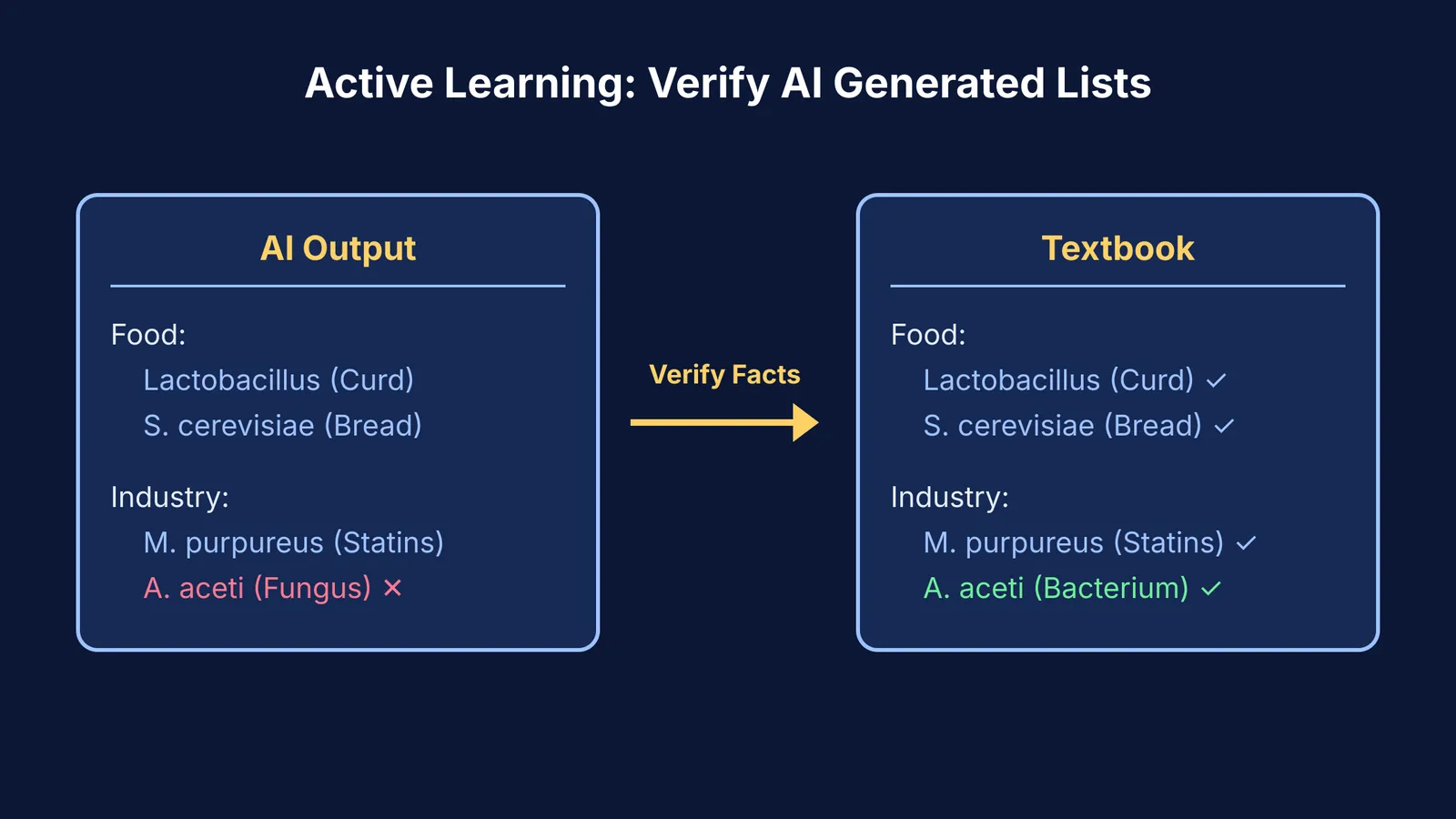
Imagine the AI gives you this list for industrial enzymes and bioactive molecules:
*Streptococcus*: produces streptokinase, used as a clot buster.
*Trichoderma polysporum*: produces cyclosporin A, an immunosuppressive agent.
*Acetobacter aceti*: a fungus that produces acetic acid.
When you verify this against the standard curriculum, you will find that the first two are perfectly correct. However, *Acetobacter aceti* is a bacterium, not a fungus. Correcting this error in your notes physically engages your brain, making you far more likely to remember it in an exam than if you had simply read a perfect table.
This active verification transforms AI from a shortcut into a rigorous study tool, helping you master complex biological applications from recombinant insulin production to the roles of viruses, viroids and lichens. By the time you have gone through every category and confirmed the facts, you will have built a much stronger mental framework for the exam. The simple act of comparing an AI draft to a trusted textbook turns an otherwise tedious memorisation task into an engaging puzzle.


