On this page
When you struggle with a geometry proof, pasting the problem into a chatbot for a quick answer is a tempting shortcut. A multi-step solution appears, you copy it down, and the homework is done. But on an exam with rotated labels or an unfamiliar transversal, that borrowed logic dissolves. Passive reading creates an illusion of understanding that vanishes the moment you must deduce each step yourself.
Geometry proofs test your ability to chain deductive claims where every step rests on an established mathematical truth. Under boards like the CBSE secondary mathematics curriculum, proofs use step-wise marking. Evaluators deduct 0.5 to 1 mark for any claim—such as asserting two angles are equal—that lacks an explicit theorem in brackets beside it. To build real competence, you need a practice routine that preserves your effort while flagging broken reasoning.
Why do students lose marks on geometry angle proofs?
The gap between seeing a geometric pattern and writing a formal proof is wide. In a study of 1,520 secondary geometry students published in *The Mathematics Teacher*, researcher Sharon L. Senk (doi:10.5951/mt.78.6.0448) found that only about 30% reached a 75% mastery level in writing formal proofs, while approximately 29% could not write a single correct proof.
Senk found that students rarely failed from calculation errors. Instead, they stumbled into perceptual bias and missing justifications. Under perceptual bias, a student assumes two angles are equal simply because they look equal, citing no theorem. Others write valid claims but leave reasons blank, or argue in circles. Standard chatbots worsen these habits: language models predict plausible text rather than verify logic, often silently patching your gaps. Understanding why AI chatbots make maths mistakes highlights why models need explicit constraints to enforce rigor.
How can you prompt AI to audit your angle proof?
Instead of asking AI to solve the problem, instruct it to act as an auditor. Write each step in statement-and-reason format, and prompt the model to evaluate only your justifications:
"Act as a strict geometry proof auditor. I will provide a problem and my statement-and-reason proof. Do not solve the problem or write the correct steps. For each line, check: (1) Did I state an established theorem, axiom, or definition? (2) Does that reason correctly justify the deduction from prior steps? If any step has a missing, circular, or incorrect reason, flag that line, explain why it fails, and prompt me to identify the correct theorem."
This prompt enforces three constraints:
It prevents the model from giving away the solution.
It requires a named theorem for each claim, reinforcing core lines and angles theorems.
It treats missing reasons as errors, matching exam grading.
What does an audited angle proof look like in practice?
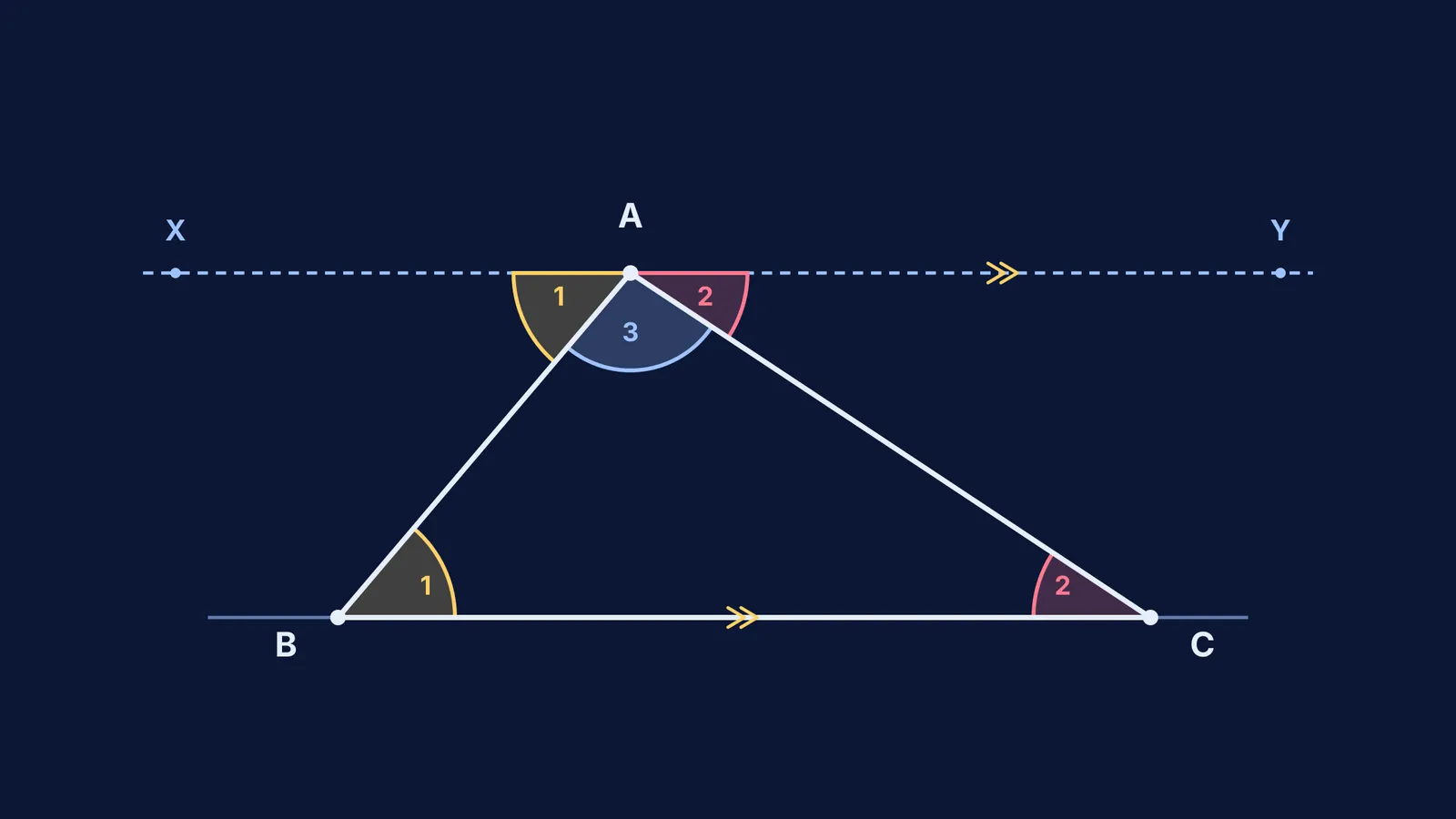
Consider proving that the interior angles of triangle ABC sum to 180°.
Suppose you draft this proof:
Construction: Draw straight line XAY through vertex A parallel to side BC.
Step 1: ∠XAB = ∠ABC [Reason: Alternate interior angles for parallel lines XY and BC with transversal AB]
Step 2: ∠YAC = ∠ACB [Reason: Alternate interior angles for parallel lines XY and BC with transversal AC]
Step 3: ∠BAC = 60° [Reason: Triangle ABC looks equilateral]
Step 4: ∠XAB + ∠BAC + ∠YAC = 180° [Reason: Angles on a straight line add to 180°]
Step 5: ∠ABC + ∠BAC + ∠ACB = 180° [Reason: Substituting Step 1 and Step 2 into Step 4]
When submitted, the auditor flags Step 3: "Step 3 is flagged for an invalid reason. You assumed angle BAC is 60° based on appearance, but triangle ABC was not specified as equilateral. How can you complete Steps 4 and 5 without fixing the measure of angle BAC?"
This feedback catches the perceptual error immediately. Angle BAC is an arbitrary angle needing no fixed numerical value. Deleting Step 3 leaves a valid, general proof.
How does step-by-step auditing improve mathematical intuition?
This method is rooted in cognitive science. In *Cognitive Science*, Vincent Aleven and Kenneth R. Koedinger (doi:10.1207/s15516709cog2602_1) found in two classroom experiments with the Geometry Cognitive Tutor that students required to justify each step acquired less shallow procedural knowledge and transferred better to new problems than those entering answers without explanation. Earlier research by Michelene T. H. Chi and colleagues (doi:10.1207/s15516709cog1302_1) demonstrated that self-explanation—explaining why each step works—directly repairs incomplete mental models. Stating reasons trains the deductive discipline required for writing rigorous mathematical proofs.
This interactive reasoning guides our own tools. Fermi's AI tutor is designed so that the tutor teaches rather than answers: it holds a line of reasoning across a session, notices where a student is stuck, and decides whether to explain, ask, or show. For problem practice, the Fermi Problem Library offers worked problems with a step-by-step solver that explains the reasoning rather than printing an answer. To review an unfamiliar theorem before writing a proof, the Fermi Concept Library maps every concept in mathematics, each with its own lesson and place in the map.
Before submitting your next angle proof, write down your justifications and let AI flag the lines where your reasons are missing.