

On this page
When you are reviewing complex alkene addition or oxidation reactions, the quickest way to get unstuck seems obvious. You type the reactants into an AI and ask, "What is the major product?"
But this approach short-circuits the most important part of mastering organic chemistry: mechanistic reasoning. If you skip straight to the product, you miss the structural logic—like electronic effects, hyperconjugation, and steric hindrance—that explains *why* the reaction happens. Worse, relying on AI for final products can be highly misleading and detrimental to your long-term retention of the subject.
Why does "predict the product" fail with AI?
Large Language Models are built to generate convincing text, not to mentally rotate 3D molecules or systematically apply quantum mechanical rules. When prompted for a reaction's outcome, an AI will often generate a plausible-sounding mechanism to justify a hallucinated product.
A 2024 study published in the Journal of Chemical Education analysed 255 ChatGPT-generated mechanism explanations and found that only 25% were fully accurate. Despite the low accuracy, the AI used expert-like language—correctly identifying nucleophiles and electrophiles—making its errors very hard to spot. If you ask an AI for the product of a complex addition reaction, it might confidently hand you a chemically impossible result, complete with a beautifully written but entirely fabricated electron-pushing mechanism.
What is the "too much information" effect?
Asking an AI for the final product does not just invite hallucinations; it actively harms your problem-solving process.
A 2019 study published in Chemistry Education Research and Practice observed what happens when students are given the final product of an organic reaction before they work out the mechanism. Without the product, students applied chemical reasoning based on reactant properties. However, when given the product, they shifted to a "means-ends analysis" focused solely on reaching the final state. The researchers called this the "TMI (Too much information) effect."
The TMI effect is a phenomenon where seeing the final product causes students to stop applying chemical logic and instead work backwards to justify the final structure. In many cases, students who would have correctly predicted the regiochemistry on their own changed their reasoning to fit a flawed assumption, replacing correct mechanistic steps with incorrect ones just because the product was sitting in front of them. When you use an AI as an answer machine, you replicate this TMI effect. You train yourself to justify answers rather than to predict them.
How do you use a regio-first prompt?
Instead of asking for the final product, you can use a workflow called "regiochemistry before product." This strategy forces you (and the AI) to break the problem into its fundamental steps.
When you are working through a problem, prompt the AI like this:
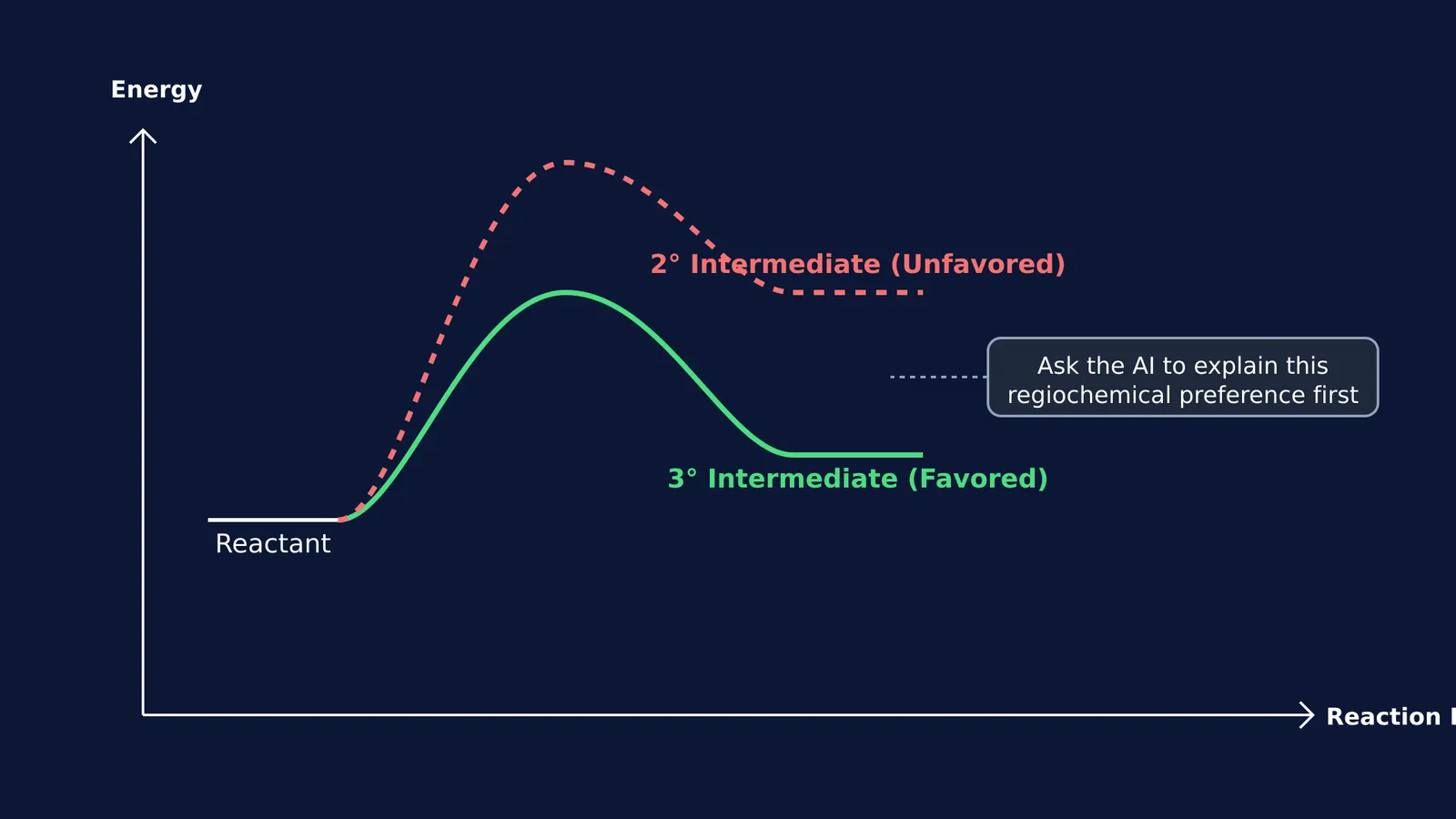
> "Before giving me the final product, explain the regiochemical preference of this reaction. Which intermediate is formed, and why is it the most stable?"
If you are stuck on why a particular regiochemistry applies, Fermi's AI tutor teaches rather than answers. It works out what you already know about intermediates and builds a plan for the session, holding a line of reasoning until you can predict the product yourself.
How can you check the AI's chemical logic?
By forcing the AI to explain the regiochemistry first, you can evaluate its chemical logic before you even look at a structure. This gives you a chance to catch AI errors early. Take the acid-catalyzed hydration of 1-methylcyclohexene as a practical example.
Ask for the intermediate: Instead of asking for the final alcohol, ask what forms first. The AI should correctly state that the proton from the acid catalyst adds to the less substituted carbon (C2). This forms a tertiary carbocation at C1, the carbon with the methyl group.
Verify stability rules: You know from your textbook that carbocation stability runs tertiary > secondary > primary. If the AI suggests a secondary carbocation is favored over a tertiary one, you immediately know it has hallucinated the mechanism, and you can reject its reasoning.
Predict the product yourself: Once the intermediate is established using Markovnikov's rule, you know exactly what happens next. The nucleophile (water) will attack the positively charged tertiary carbocation, yielding 1-methylcyclohexanol. You just predicted the product without the AI giving you the answer.
By focusing on the regiochemistry, you stop using AI as a flawed answer key. Try prompting your AI for the intermediate next time, and start predicting the products yourself.


