

On this page
Every time you ask a chatbot to explain a numerical, computers in a data centre do real physical work, using electricity and often cooling water. The honest answer to 'how much?' is a range. Here is what has been measured, why figures disagree, and how to check any number you meet.
How much energy does one AI chatbot question use?
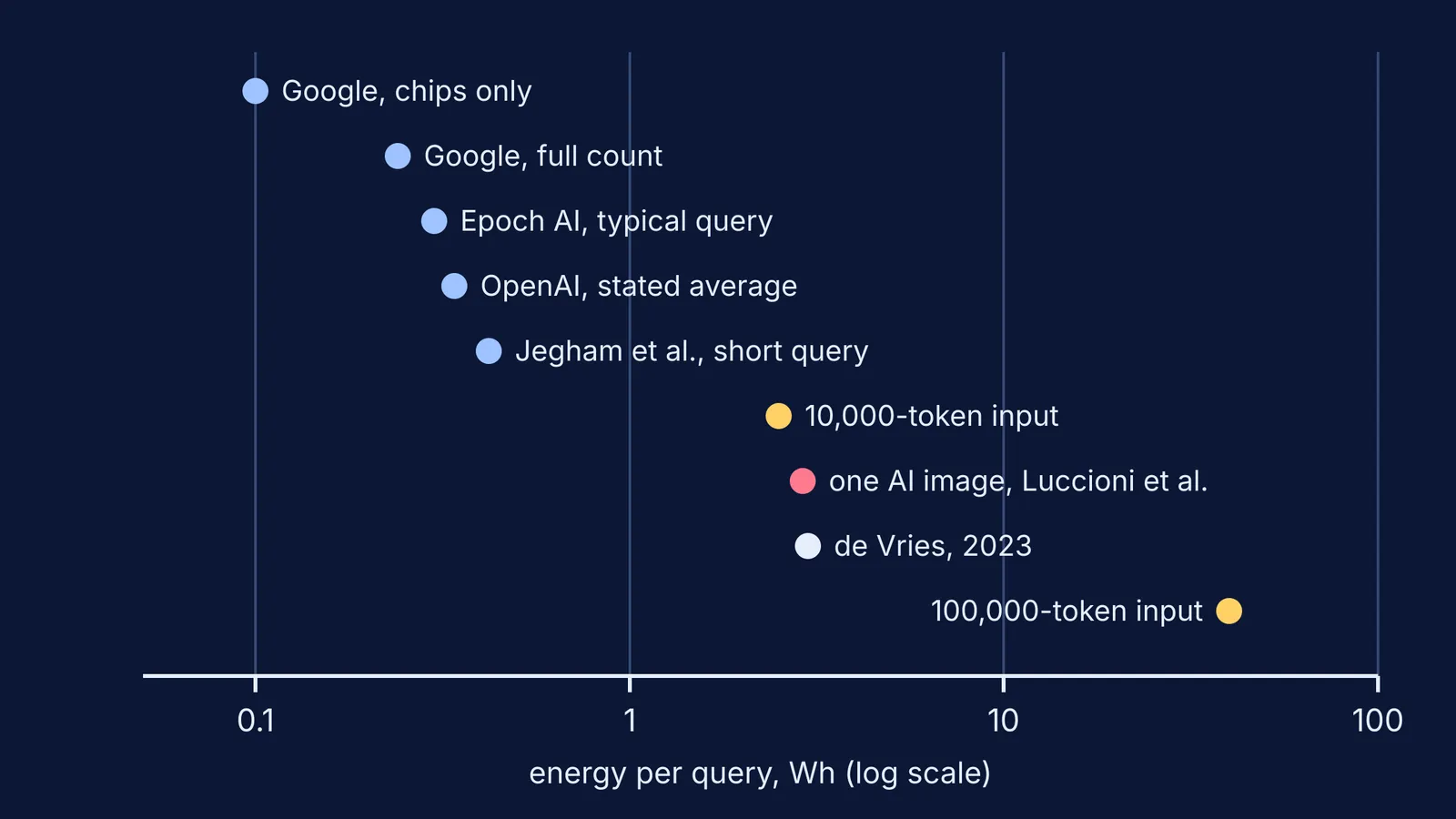
The most detailed measurement so far comes from Google. In an August 2025 paper, Google engineers reported that the median Gemini Apps text prompt uses 0.24 watt-hours (Wh) of energy (Elsworth et al., 2025). The same paper says that prompt consumes 0.26 mL of water, about five drops, and that energy per median prompt fell 33-fold over one year.
Other estimates land close by. Epoch AI estimated about 0.3 Wh for a typical GPT-4o query with a reply of roughly 400 words (Epoch AI). OpenAI's chief executive Sam Altman wrote in June 2025 that the average ChatGPT query uses about 0.34 Wh, without giving a method (The Gentle Singularity). A benchmark of 30 models by Nidhal Jegham and colleagues put a short query at about 0.42 Wh (Jegham et al., 2025).
Why do estimates vary so much?
Older articles often quote about 3 Wh per ChatGPT request. That figure traces to a 2023 commentary by Alex de Vries in the journal Joule (de Vries, 2023). Epoch AI points out that the estimate de Vries relied on assumed long exchanges of 4,000 input and 2,000 output tokens, and less efficient hardware (Epoch AI). Four things move the number:
What is counted. Counting only Google's active AI chips gives 0.10 Wh per prompt; adding idle backup machines, host computers and cooling gives 0.24 Wh (Google Cloud).
How long the input is. Epoch AI estimates that a 10,000-token input, such as a long PDF, takes a query to about 2.5 Wh, and a 100,000-token input to about 40 Wh.
Which model. Jegham and colleagues found the most energy-intensive models exceed 29 Wh per long prompt, over 65 times the most efficient ones (Jegham et al., 2025).
Text or pictures. Sasha Luccioni and colleagues found image generation averaged 2.9 kWh per 1,000 images, over 60 times their text-generation average (Luccioni et al., 2024).
What is unknown matters as much. Most companies publish no per-query figures or methods. Google's number is a median for serving Gemini Apps text prompts, not for training the model (Elsworth et al., 2025).
How much water does an AI chatbot use?
Water figures spread even wider, because people count different water. Pengfei Li, Shaolei Ren and colleagues define water consumption as water withdrawn minus water discharged, mostly what evaporates (Li et al.). They estimated that GPT-3 consumes a 500 mL bottle for roughly 10 to 50 medium-length responses, depending on when and where it runs. That includes cooling water and water used at power stations making the electricity.
So their estimate is 10 to 50 mL per response, against Google's 0.26 mL, which counts only data-centre cooling water (Google Cloud). Mistral AI's life-cycle study put the extra water for one 400-token reply from its Le Chat assistant at 45 mL (Mistral AI).
Is AI's total energy use big or small?
One question is tiny; billions add up. The International Energy Agency estimates data centres used about 415 terawatt-hours (TWh) in 2024, around 1.5% of the world's electricity, and projects about 945 TWh by 2030, with AI the most important driver of growth (IEA, Energy and AI). Data centres also run streaming, banking and email, so not all of that is AI. The total is growing fast enough that power grids must plan for it.
How can you reason about the numbers yourself?
When you see an AI footprint figure, ask four questions:
What is inside the boundary: chips only, the whole data centre, the power station, training?
What kind of request: a short text question, a long document, an image?
Which model, which year, and is it a median or an average?
Who measured it, and did they publish the method?
Then compare it with something you know. Suppose you ask 30 short questions a day at about 0.3 Wh each (Epoch AI). That is 9 Wh a day, the same as a 9 W LED bulb left on for one hour. Over a year it comes to about 3.3 kWh, a little over three units on your electricity bill. If 10 of them carry a long PDF at about 2.5 Wh each, the day becomes 20 x 0.3 + 10 x 2.5 = 31 Wh, over three times as much.
This is order-of-magnitude reasoning, the same skill as in Fermi problems: how physicists estimate and check answers. For the units, see heating effect of current: power, energy bills and fuses. If power and energy still blur together, the Fermi Concept Library has a lesson for every concept in physics.
We build Fermi's AI tutor, so these questions apply to tools like ours too. Whatever you use, keep questions focused and paste only the pages you need: long inputs cost the most.


