

On this page
When learning 3D geometry, verifying whether a point lies on a given line or plane is a foundational skill. It is easy to just check the back of the book or ask a calculator for a yes or no. But learning happens in the steps.
A 2025 randomised controlled trial from Harvard University published in *Scientific Reports* found that students using a purpose-built AI tutor achieved median learning gains more than double those of students in an active learning classroom, finishing the material in 49 minutes instead of 75. The key was that the AI provided step-by-step guidance rather than just the final answer.
Here is how to structure your prompt to an AI tutor so it helps you verify points on lines and planes, along with a script you can use.
How do you check if a point lies on a line or plane?
Before you ask the AI, you need to know what you are looking for. Understanding the underlying geometry makes the algebra much easier to follow. A point lying on a line or a plane means its coordinates satisfy the mathematical condition that defines that shape in three-dimensional space.
For a line (Symmetric form): The equation looks like (x - x₁) / a = (y - y₁) / b = (z - z₁) / c. This form tells us that the vector from a known point on the line to your point must be parallel to the line's direction vector. If you substitute your point (x, y, z) into this, all three ratios must be equal. If you get 2 = 2 = 2, the point is on the line. If you get 2 = 2 = 5, it is not.
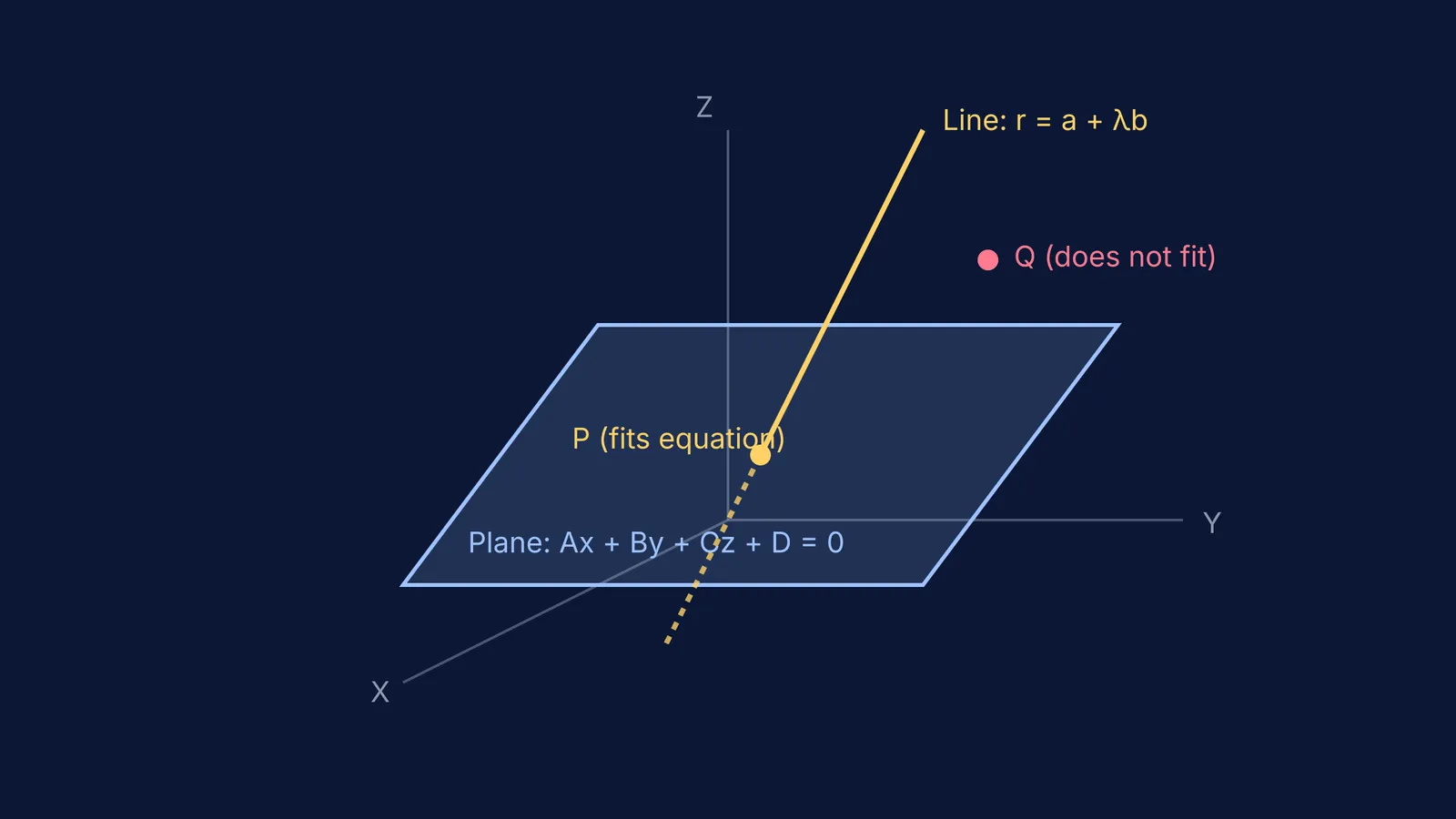
For a plane (Cartesian form): The equation looks like Ax + By + Cz + D = 0. The equation represents a flat surface extending infinitely. The terms A, B and C come from the plane's normal vector, which points straight out of the surface. When you plug in the coordinates of the point, the left side must equal exactly zero, proving the point sits exactly on that flat surface.
What is the best prompt to ask the AI tutor?
To learn the method properly, do not just ask, "Is (1, 2, 3) on this line?" Give the AI a role. Paste this script:
"I am learning 3D geometry. I need to check if point P lies on the given line (or plane). Do not just give me the final answer. Instead, substitute the coordinates step by step. Explain what you are calculating at each step. Then, invent a second point Q that does not fit the equation, and show me the substitution for that point so I can see what a failure looks like."
How do you check a point on a line?
Suppose you want to check if the point P(2, 5, 8) lies on the line (x - 1) / 1 = (y - 3) / 2 = (z - 5) / 3.
When you use the script, the AI will walk you through the substitution:
Check x: Substitute x = 2 into (x - 1) / 1. This gives (2 - 1) / 1 = 1.
Check y: Substitute y = 5 into (y - 3) / 2. This gives (5 - 3) / 2 = 2 / 2 = 1.
Check z: Substitute z = 8 into (z - 5) / 3. This gives (8 - 5) / 3 = 3 / 3 = 1.
Since 1 = 1 = 1, all three ratios are equal. The point lies exactly on the line.
Then, as requested, the AI will test a point that fails, like Q(3, 5, 8):
Check x: (3 - 1) / 1 = 2.
Check y: (5 - 3) / 2 = 1.
Check z: (8 - 5) / 3 = 1.
Here, 2 does not equal 1. The ratios are inconsistent, proving Q does not lie on the line. If the algebra gets complicated with more difficult coordinates, you can read how to use AI to break a hard JEE problem into steps.
How do you check a point on a plane?
Now test the plane equation 2x - y + 3z - 9 = 0 with the point P(1, 2, 3).
The AI will show the substitution:
Plug in x = 1, y = 2, z = 3: 2(1) - (2) + 3(3) - 9.
Multiply out: 2 - 2 + 9 - 9.
Add them up: 0.
Because the result is exactly 0, the point is on the plane.
To show a failure, it might test Q(1, 2, 4):
Plug in: 2(1) - (2) + 3(4) - 9.
Multiply out: 2 - 2 + 12 - 9 = 3.
Since 3 is not equal to 0, point Q is not on the plane. By seeing both the success and the failure, you learn how to interpret the algebra. Once you have verified the steps, you might wonder how to check your NCERT exercise answers with AI to keep practising.
Most learning tools answer questions. Fermi's AI tutor teaches — it holds a line of reasoning across a whole session, notices where a student is stuck, and decides whether to explain, ask, or show. The Fermi Problem Library has worked problems with a step-by-step solver that explains the reasoning rather than printing an answer, making it easy to practise this routine on any 3D geometry question.


