

On this page
Assertion-reason questions are a regular fixture in competitive examinations like NEET-UG, JEE Main, and CBSE board papers. On paper, their format looks simple: an exam sheet gives you an Assertion statement and a Reason statement, then asks whether both are true and whether the reason correctly explains the assertion. Yet students and automated language models stumble on them constantly.
Why do assertion-reason questions trip AI models up?
Standard language models operate by predicting the most statistically probable next words based on patterns in their training data. When an AI evaluates an assertion and a reason, it gauges how closely the concepts in both sentences co-occur across textbooks and scientific papers. If both sentences mention related concepts, the model perceives high semantic affinity.
However, high topical relatedness is not mechanical causation. In the Corr2Cause study presented at the International Conference on Learning Representations (ICLR 2024), researchers evaluated 17 large language models across more than 200,000 samples to test pure causal deduction. The researchers found that zero-shot models performed near-randomly when determining whether correlation implied causation, acting as "causal parrots" rather than logical engines.
When an AI chatbot encounters an assertion-reason question, it frequently hallucinates a causal bridge simply because the two statements sound plausible together. If you have noticed this breakdown when AI gets physics wrong, the root failure is an inability to verify whether one event physically forces the other to occur.
Why do true statements create a false explanation trap?
The most punishing option on any assertion-reason paper is Option B: both statements are true, but the reason is not the correct explanation of the assertion.
Language models struggle severely with this distinction. In the ParamBench benchmark, researchers evaluated more than 16 open-source language models across 17,275 questions spanning 21 subjects, including complex assertion-reason pairs. Even the highest-performing model, Gemma3-27B, achieved only 56.4% overall accuracy.
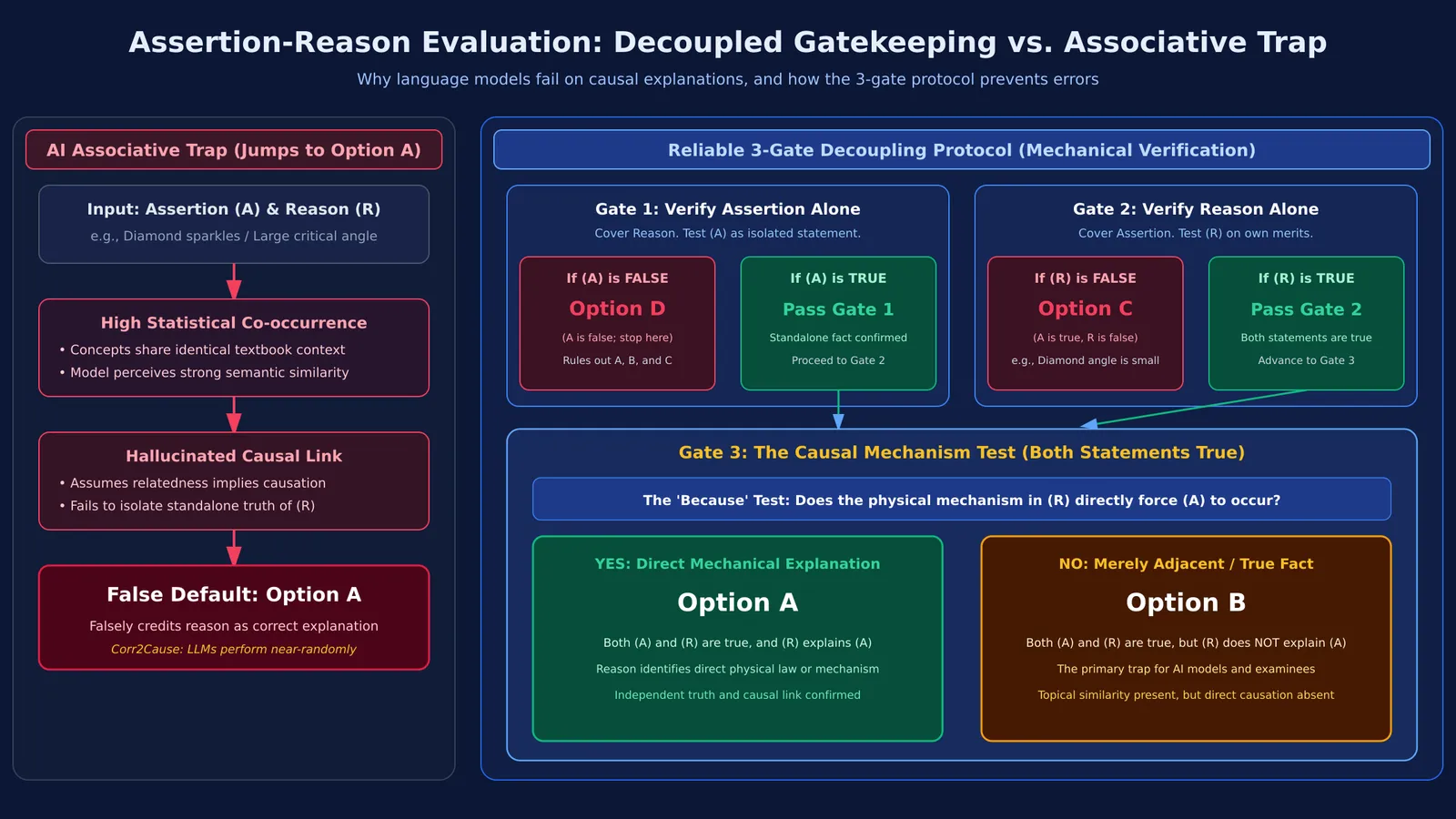
In his study published in *Assessment & Evaluation in Higher Education*, researcher Jeremy B. Williams showed that assertion-reason items test deep analytical learning precisely because they demand two separate cognitive tasks: first verifying whether each proposition is an independent truth, and only then analyzing the explanatory link between them. When both statements are true, an AI sees high semantic familiarity and defaults to Option A, falsely crediting the reason as the cause.
How should you decouple your checks step by step?
To solve assertion-reason questions without falling into the association trap, you must break the question into three isolated gates:
Gate 1: Check the assertion alone. Cover the reason with a sheet of paper or your hand. Read the assertion as an isolated true-or-false statement. If it is false, you can immediately rule out Options A, B, and C; in standard NEET-UG and CBSE formats, the answer is Option D.
Gate 2: Check the reason alone. Cover the assertion. Read the reason on its own scientific merits, ignoring what the assertion claimed. If the assertion was true but the reason is false, you are immediately done: the answer is Option C.
Gate 3: The causal mechanism test. Only if both statements pass Gate 1 and Gate 2 as independently true do you test the connection: does the reason physically cause the assertion (Option A), or is it merely an adjacent true fact (Option B)?
This gatekeeping process prevents the halo effect, where a true reason makes a false assertion sound convincing, or where two true facts trick you into assuming a causal link. Just as you can check why AI chatbots get maths wrong, decoupling each claim keeps unearned intuition from bypassing critical checks.
Rather than relying on chatbots that guess answers directly, Fermi's AI tutor teaches you to hold a line of reasoning across a session, noticing where you get stuck and checking your understanding as you work through each step.
Can you test the causal mechanism with a worked example?
As educational researcher Luke B. Connelly observed in his evaluation of assertion-reason testing, success hinges on isolating individual truth conditions before evaluating explanatory synthesis.
Consider a classic optics question from Class 12 physics:
Assertion: A diamond sparkles with brilliant flashes of light when cut properly.
Reason: Diamond has an exceptionally large critical angle for total internal reflection.
Here is how the decoupling method reveals the answer:
Step 1 (Assertion): Does a properly cut diamond sparkle brilliantly? Yes, light undergoes multiple internal reflections and disperses into spectral colours. The assertion is true.
Step 2 (Reason): Does diamond have a large critical angle? Diamond has a high refractive index of approximately 2.42. Because the critical angle θ satisfies sin θ = 1/n, the critical angle for diamond is approximately 24.4°, which is very small, not large. Therefore, the reason is factually FALSE.
Conclusion: The assertion is true, but the reason is false (Option C).
An AI chatbot reading "diamond", "sparkle", "critical angle", and "total internal reflection" often selects Option A. It recognizes all the vocabulary from the same chapter, hallucinating that the reason is both correct and explanatory.
When practicing multi-step items, the Fermi Problem Library provides worked problems with a step-by-step solver that explains the reasoning rather than just printing an answer key.
Before bubbling your answer sheet, run this final three-point checklist:
Did I verify the assertion with the reason completely hidden?
Did I verify the reason with the assertion completely hidden?
Does the reason identify the direct physical mechanism of the assertion, or is it merely an adjacent fact?


