

On this page
If you place a clean, sharpened pencil upright on its tip, the setup is rotationally symmetric: gravity pulls down and the table has no preferred direction. Yet once released, the pencil falls in one specific direction. The laws of nature remain symmetric, but the state of the pencil becomes lopsided.
This contrast between symmetric laws and asymmetric outcomes is the core of spontaneous symmetry breaking. In modern physics, it explains why the universe contains diverse particles and forces rather than an undifferentiated void. Theoretical physicist Yoichiro Nambu was the first to bring this concept into subatomic physics.
What is spontaneous symmetry breaking in physics?
A physical symmetry means that equations stay unchanged under transformations such as spatial rotation. As established in Emmy Noether's theorem on symmetry and conservation, continuous symmetries yield conserved quantities like momentum and electric charge.
Symmetry breaking happens in two ways:
Explicit symmetry breaking: The equations of motion contain an asymmetric term from the start.
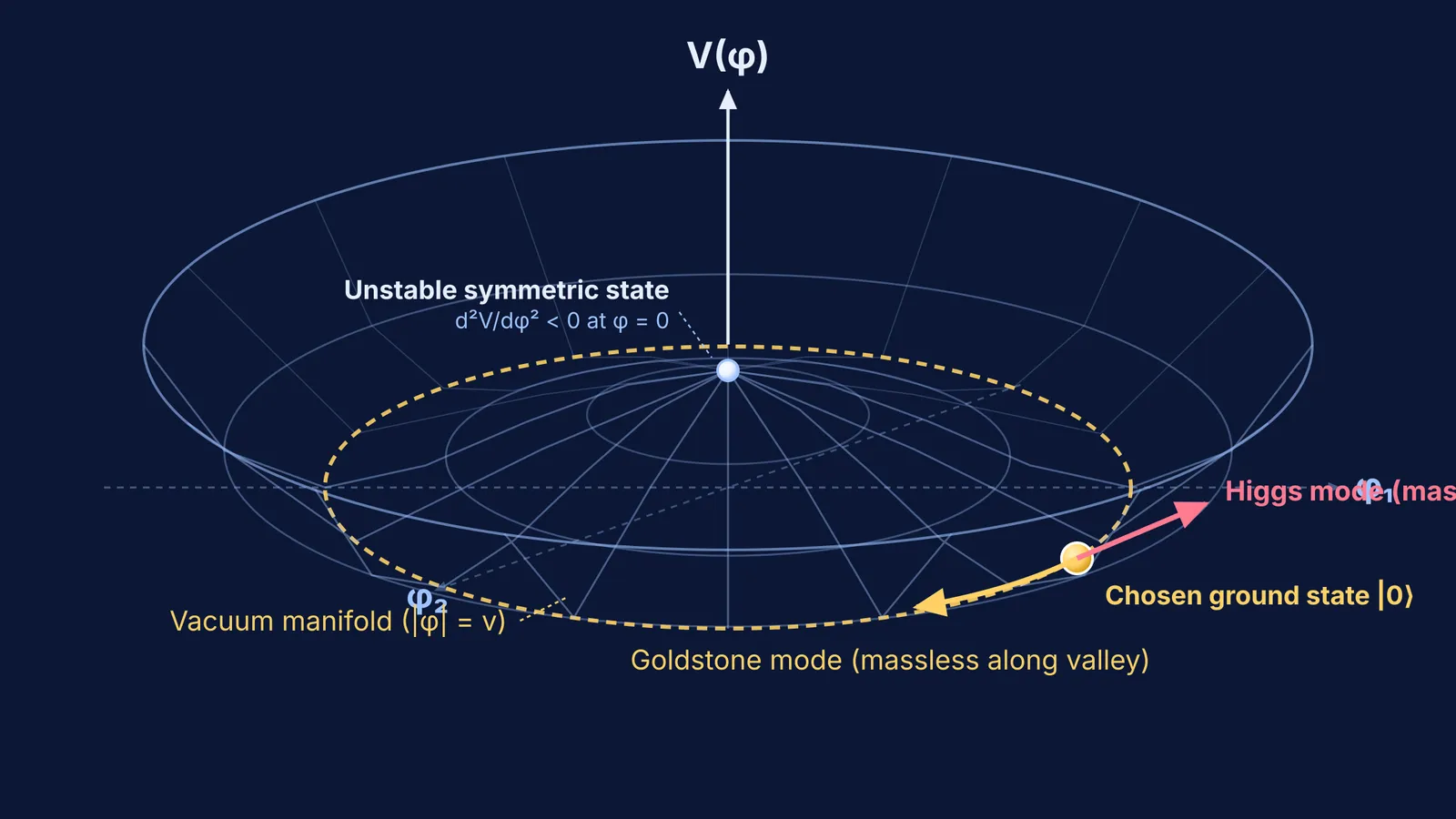
Spontaneous symmetry breaking: The equations remain symmetric, but the ground state of lowest energy is asymmetric.
In his 1960 particle physics research, Yoichiro Nambu proved that nature can hide its underlying order beneath an asymmetric surface, as detailed by the Nobel Foundation. When a system settles into its lowest-energy state, it selects one specific ground state out of many symmetric possibilities.
How did superconductivity inspire Yoichiro Nambu?
Nambu arrived at this insight through condensed matter physics. In 1957, John Bardeen, Leon Cooper, and J. Robert Schrieffer introduced the BCS theory of superconductivity, explaining how metals lose electrical resistance and expel magnetic fields, an effect explored in our guide on Walther Meissner and superconductors expelling fields.
In superconductors, electrons form Cooper pairs, producing an energy gap that appeared to violate electromagnetic gauge invariance. In February 1960, Nambu published "Quasi-Particles and Gauge Invariance in the Theory of Superconductivity" in *Physical Review*. He showed that gauge invariance is conserved by collective excitations of the electron sea. Crucially, Nambu realized that the energy gap Δ in a superconductor is mathematically identical to the mass of an elementary fermion.
Why does the vacuum give particles their mass?
In April 1960, Nambu published "Axial Vector Current Conservation in Weak Interactions" in *Physical Review Letters*, followed in 1961 by a two-part paper with Giovanni Jona-Lasinio, "Dynamical Model of Elementary Particles Based on an Analogy with Superconductivity" in *Physical Review*.
They proposed that the vacuum is not empty space, but a medium filled with a condensate of fermion pairs. In the governing equations, fermions can start massless with chiral symmetry, treating left-handed and right-handed states equally. When the vacuum condenses, chiral symmetry spontaneously breaks, endowing nucleons with dynamical mass.
Breaking a continuous global symmetry creates a massless spin-0 particle called a Nambu-Goldstone boson. In strong interactions, the pi meson (pion)—whose discovery is traced in our story on Cesar Lattes and the discovery of the pi meson—is remarkably light because small quark masses make it a pseudo-Goldstone boson.
How does broken symmetry lead to the Higgs boson?
While Nambu explored global symmetries, theorists including Robert Brout, François Englert, and Peter Higgs extended these principles to local gauge symmetries in 1964, as outlined by the Nobel Foundation. In local gauge theories, would-be Goldstone bosons combine with gauge fields, giving mass to force carriers: in the electroweak model, spontaneous symmetry breaking generates the masses of the heavy W and Z bosons while leaving the photon massless.
In 2008, Nambu received one-half of the Nobel Prize in Physics, as recorded by the Nobel Foundation, for discovering the mechanism of spontaneous broken symmetry in subatomic physics.
How can you test for symmetry breaking in physics problems?
For competitive examinations like JEE Advanced, analyzing whether a symmetric potential produces an asymmetric state follows four steps:
Check potential symmetry: Test whether the potential satisfies V(x) = V(−x) or V(θ) = V(θ + α).
Find equilibria: Set dV/dx = 0 to identify all stationary points.
Test curvature: Evaluate d²V/dx². If d²V/dx² < 0 at x = 0, the symmetric point is unstable.
Identify ground states: Find non-zero minima where d²V/dx² > 0 at x = ±x₀, where the system settles and breaks symmetry.
Visualising energy landscapes helps make stability intuitive. In the Fermi Simulation Lab, you can explore interactive simulations for ideas that are easier to see than to read. For students mastering core principles, the Fermi Concept Library maps every concept in physics, chemistry, biology, mathematics and computing, each with its own lesson and its place in the map.


