

On this page
In 1913, German psychologist Wolfgang Köhler arrived at a research station on the island of Tenerife to study chimpanzees. His stay was extended by five years due to the outbreak of the First World War (Wikipedia). During this time, he watched how his chimpanzees—particularly a male named Sultan—solved problems to reach food (Wikipedia)). His observations, first published in 1917 and translated into English in 1925 as *The Mentality of Apes*, changed how we think about learning.
Before Köhler's work, many psychologists believed that animals learned purely through trial and error: doing things randomly until something worked. Köhler's chimpanzees showed something different. When faced with a banana hanging out of reach, they did not just jump blindly. They would often stop, look at the objects around them, and then suddenly execute a complex plan.
How did Sultan reach the bananas?
In one famous experiment, a banana was placed outside Sultan's cage, beyond his arm's reach. Inside the cage were two short bamboo sticks, neither long enough to reach the fruit alone. Sultan tried reaching with his arm, and then with one stick, but failed.
Instead of continuing to try randomly, he exhibited what Köhler described as a perceptual stage—stopping to look around. He then joined the two hollow bamboo sticks together to make a single long tool, ran to the bars, and pulled the banana toward himself (Wikipedia)).
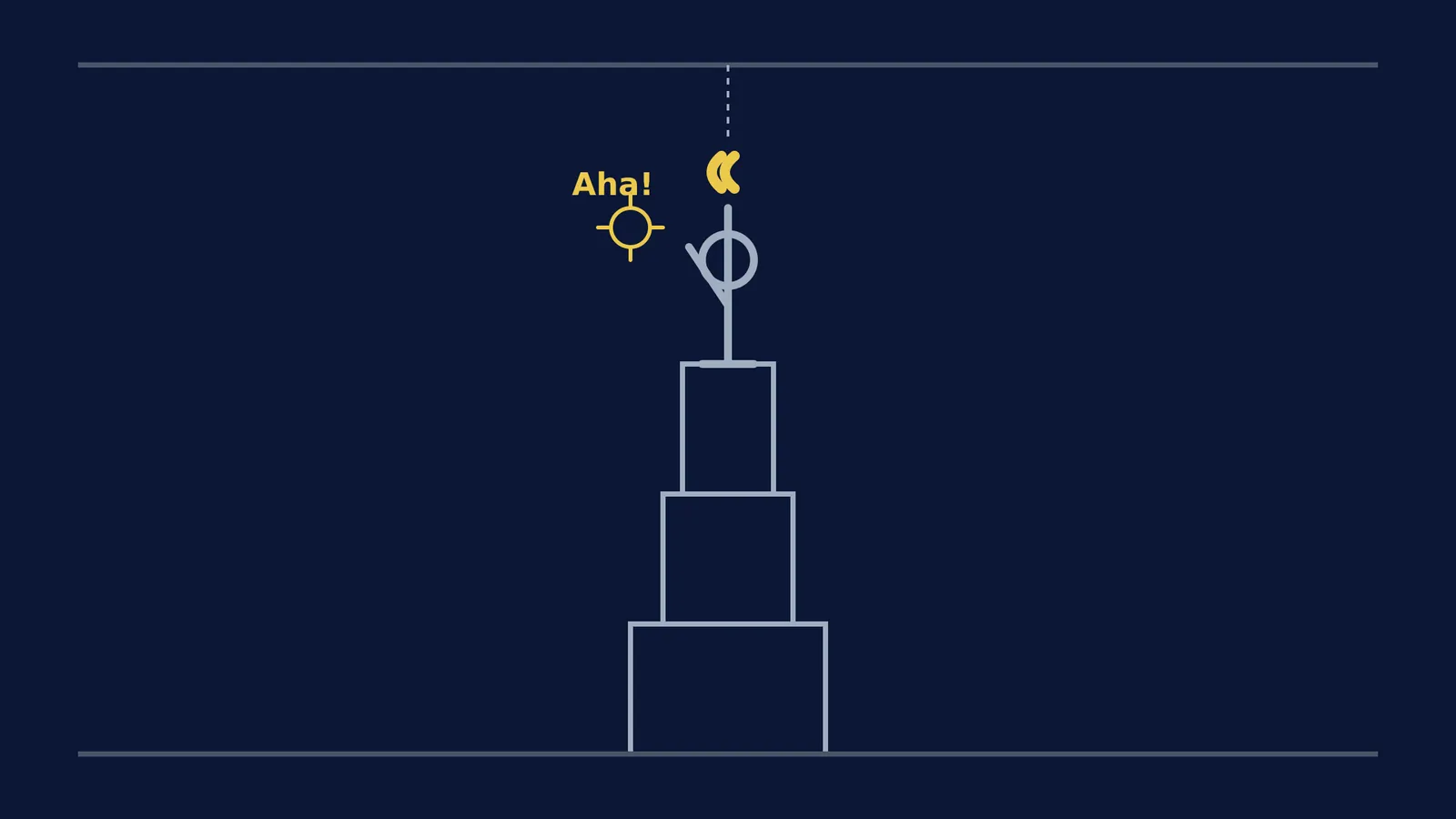
In another setup, bananas were hung from the ceiling of a room, too high to jump for. Sultan and the other chimpanzees figured out how to stack wooden crates on top of each other, climbing the unstable tower to grab their reward. They had experienced what we now call an "Aha!" moment—or *Aha-Erlebnis* in German—where the solution to a problem becomes clear all at once (Wikipedia).
What is insight learning?
Insight learning is the sudden discovery of a correct solution following incorrect attempts. Unlike rote learning or trial and error, it involves seeing the problem in a new, larger context.
When you study for an exam, you often use both methods. Staring at a difficult physics problem and plugging numbers into random formulas is trial and error. Stepping back, drawing a diagram, and suddenly seeing how the forces balance is insight. The research of scientists like Niko Tinbergen and Wolfgang Köhler showed that understanding the "why" and "how" is a distinct cognitive leap, not just a learned habit.
Brain scans show that right before an insight occurs, there is high electrical activity in the right hemisphere of the brain, specifically in the alpha and gamma bands (Wikipedia). It is a biological shift in attention. If you find yourself stuck in the trial-and-error loop, the Fermi Problem Library is built to help. It has worked problems with a step-by-step solver that explains the reasoning rather than printing an answer, helping you build the context you need for your own insight moments.
How to trigger your own insight?
Psychologists have identified a four-stage model of insight that you can use as a framework for your own exam prep:
Preparation: You cannot have a flash of insight without raw material. Study the basics, learn the definitions, and try a few problems.
Incubation: If you get stuck, step away. Reviews of study techniques show that taking a break allows your brain to process the problem in the background. A short break of 4 minutes can improve your performance on insight problems just as much as a 12-minute break. Sleep is also a powerful incubator; studies show that people who sleep for eight hours perform twice as well on insight problems compared to those who stay awake (Wikipedia).
Illumination: The "Aha!" moment arrives. The pieces fall into place, and you see the solution.
Verification: Check your work. Did the formula actually yield the right units? Does the answer make sense?
You cannot force an insight, but you can build the conditions for one. The next time you are stuck, gather your tools, look at the problem from a new angle, and give yourself a moment to think.


