

On this page
In 1950, Japanese manufacturing was struggling to rebuild after the Second World War. The Union of Japanese Scientists and Engineers (JUSE) invited American statistician W. Edwards Deming to deliver a series of lectures on statistical quality control (ASQ).
Deming told Japanese leaders that they could become a global power within five years if they adopted statistical methods. They achieved this in four, flooding the world with high-quality, reliable products. To honour his contribution, JUSE established the Deming Prize in 1951, which remains one of the world's most prestigious awards for quality management.
His message to executives was simple: you cannot inspect quality into a product at the end of the line. You have to build it into the process. This shift in thinking helped launch the Japanese economic miracle. But Deming's ideas about manufacturing map perfectly onto how students learn. If you feel stuck on a plateau despite taking test after test, you are relying too heavily on "inspection." Here is how to apply his methods to your exam preparation.
What did W. Edwards Deming do for quality control in Japan?
Before Deming, many factories relied on mass inspection. Workers would build a product, and at the end of the line, an inspector would check if it worked. If it failed, it was thrown away or reworked. This was slow, expensive, and wasteful.
In his "14 Points for Management," Deming laid out a different philosophy. His third point was clear: "Cease dependence on inspection to achieve quality. Eliminate the need for inspection on a mass basis by building quality into the product in the first place" (Deming Institute).
He taught Japanese engineers to use control charts and data to spot when a machine or process was drifting out of alignment, fixing the root cause before defective parts were ever made.
Why do students rely too much on "inspection"?
When preparing for competitive exams, many students follow a factory model of mass inspection. You study a chapter, attempt a 50-question mock test (the inspection), and check your score.
If the score is low, the standard advice is to "study harder" and take another test. But testing is just inspection. It tells you that the product—in this case, your understanding—is defective, but it does not tell you where the process broke down. Did you misread the question, use the wrong formula, or make an arithmetic error?
Taking another mock test without changing how you study is like running a broken machine faster and hoping for better parts. You have to stop inspecting and start improving the process.
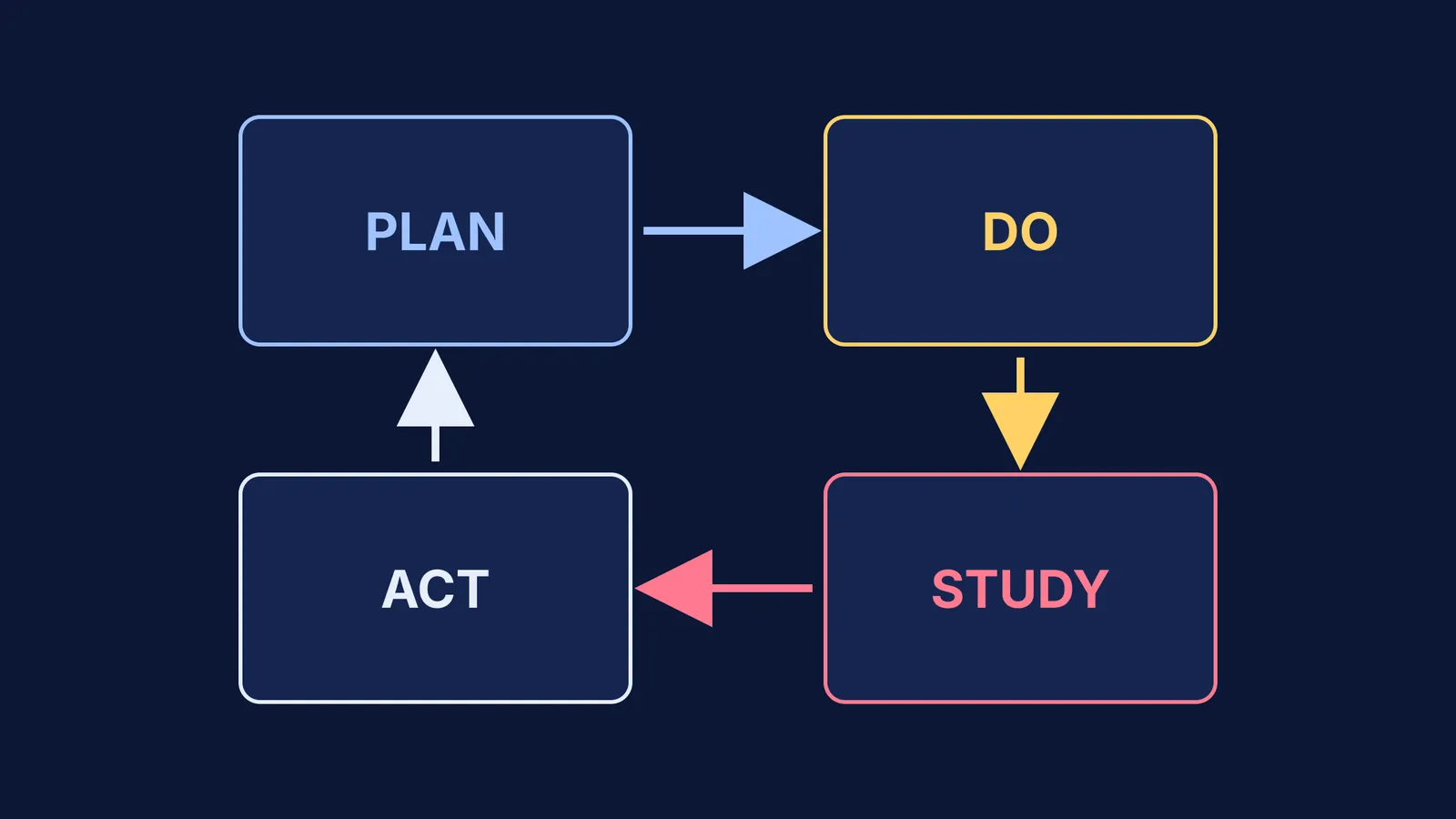
How does the Plan-Do-Study-Act cycle work?
To improve the process, Deming championed a four-step framework for continuous improvement, now known as the Plan-Do-Study-Act (PDSA) cycle. Here is how to use it in your daily routine, perhaps integrating it into The 45-Minute Plan for Studying With an AI Tutor.
Plan: Set a goal and predict the outcome
Do not just sit down to "study physics." Have a specific, measurable objective. For example, "I will solve 10 problems on rotational motion in 30 minutes." Crucially, make a prediction before you start. Which concepts do you expect to find hard? What score do you expect to achieve?
Do: Attempt the work and collect data
Work through the problems under exam conditions. Record exactly what you did. If you got stuck, note the exact step that stopped you. If you guessed an answer, mark it with a star. This is the raw data you will use to improve.
Study: Analyse the data
This is the step most students skip, but it is where all the learning happens. When you check your answers, do not just count the ticks and crosses. Compare the result to your prediction, and Use AI to Understand Mistakes, Not Get Answers.
If you find yourself stuck, this is where Fermi's AI tutor can help. Instead of just giving you the final answer, the tutor works out what you know and builds a plan for the session. It teaches rather than answers, holding a line of reasoning to help you spot the exact step where your logic drifted.
Act: Fix the process
What changes are you going to make before the next cycle? If you found that you kept forgetting the sign convention in optics, your "Act" step is to write down the convention and draw three ray diagrams before you attempt another problem. Reviewing How to solve physics problems step by step, with a worked example can give you a framework to adopt.
By focusing on the process—how you learn and solve problems—rather than just the final score, you build quality into your understanding. When exam day arrives, it is no longer an inspection to fear, but a final check on a reliable, well-tested system.


