

On this page
In 1946 Vincent Schaefer, a researcher at the General Electric Research Laboratory in Schenectady, New York, made ice crystals appear inside a freezer. He was working with Irving Langmuir, the surface chemist, on how ice forms on aircraft, and his cold chamber would not make ice at all, until he added dry ice. Within months he was dropping dry ice from a plane into a real cloud. That was the start of cloud seeding.
What did Vincent Schaefer discover in 1946?
According to EBSCO's history of the first cloud seeding, Schaefer and Langmuir were studying, for the US Army, how rime ice builds up on aircraft. To copy a cloud in the lab, Schaefer used a four-cubic-foot freezer lined with black velvet and lit inside. When he breathed into it, the moisture condensed into a tiny cloud of droplets.
The puzzle was that the droplets stayed liquid even below 0 °C. He tried many substances to make them freeze, and none worked. Then, wanting to make the box colder, he put in dry ice, and the air instantly filled with ice crystals.
He wrote it up in Science as The Production of Ice Crystals in a Cloud of Supercooled Water Droplets, published on 15 November 1946, two days after his first seeding flight.
Why did dry ice make ice crystals form?
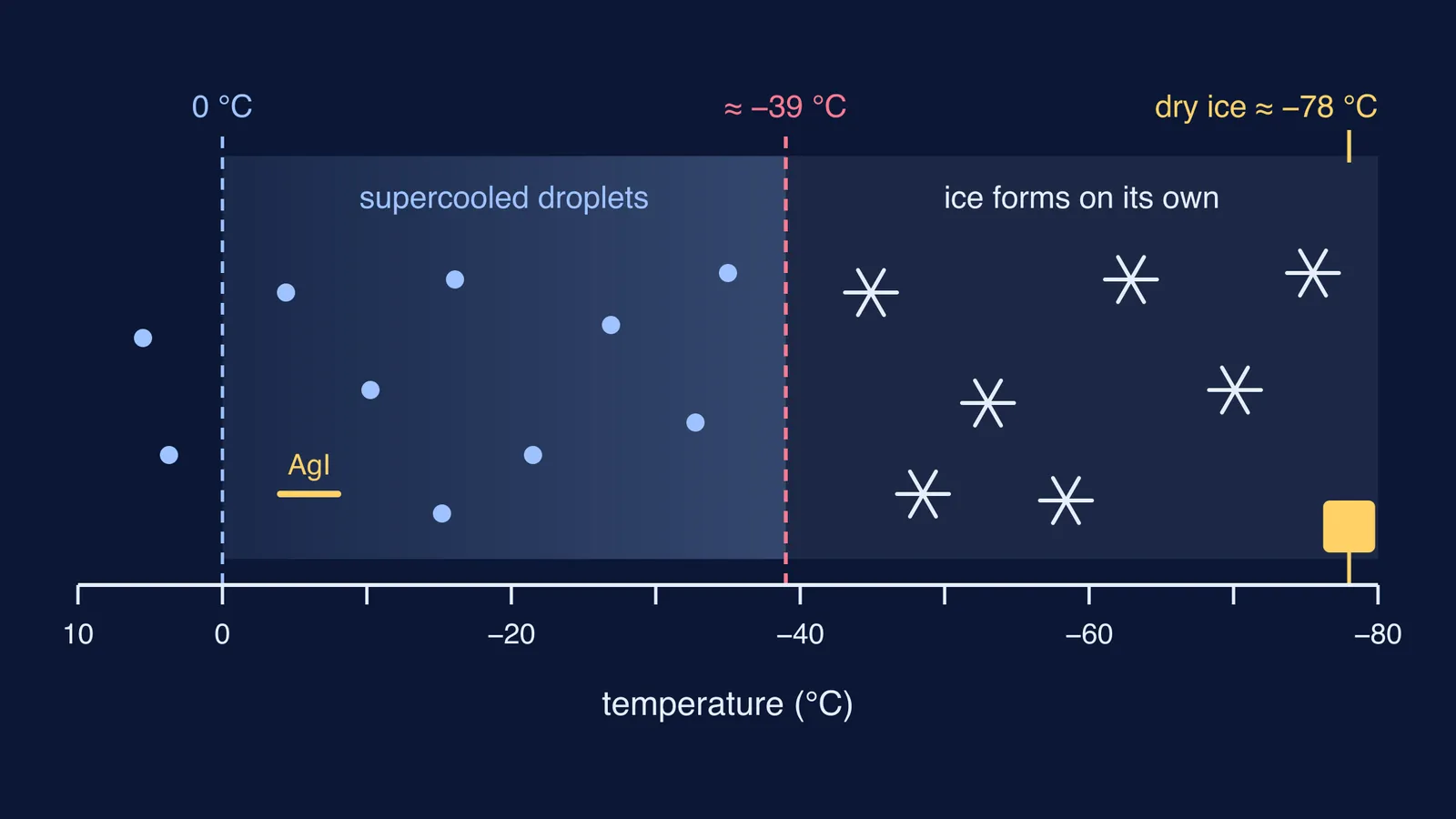
Supercooled water is liquid water colder than 0 °C that has not yet frozen, because a droplet needs a starting point, a nucleus, before ice can grow.
Schaefer found that about −39 °C was needed for ice crystals to form on their own, as EBSCO's account records. The same account notes his conclusion: the drop in temperature, not the dry ice itself, made the crystals.
Dry ice is solid carbon dioxide, and it sublimes at −109 °F, about −78 °C, according to the NIOSH Pocket Guide. So the air right next to a dry ice pellet is far colder than −39 °C. Droplets there freeze, and each new ice crystal then grows at the expense of the supercooled droplets around it. That growth is the ice-crystal process explained in our post on Tor Bergeron and how ice crystals make rain.
The second route came from Schaefer's GE colleague Bernard Vonnegut. His 1947 paper in the Journal of Applied Physics reported that silver iodide is an effective nucleus "because it very closely resembles ice in crystal structure", and that particles one micron across start ice at temperatures as warm as about −4 °C.
What happened on 13 November 1946?
On 13 November 1946 Schaefer made the first cloud-seeding flight, east of Schenectady, EBSCO's history says. Curtis Talbot flew the small plane while Schaefer scattered three pounds of dry ice into a three-mile line of supercooled stratus cloud. The cloud drops turned to ice crystals within five minutes. By February 1947 the US Signal Corps had started seeding experiments called Project Cirrus.
Does cloud seeding actually work today?
Sometimes, under the right conditions, and by modest amounts. The WMO Statement on Weather Modification (June 2025) says wintertime glaciogenic seeding of mountain clouds now shows "an evidence-based causal relationship", but also that "results from one trial cannot be directly applied to a different environment".
India has its own evidence. In the CAIPEEX-IV experiment, scientists compared seeded and unseeded monsoon clouds over a rain-shadow region of the Western Ghats in 2018 and 2019, as reported in the Bulletin of the American Meteorological Society. According to a PTI report on the study, which credits scientists from the Indian Institute of Tropical Meteorology and other institutes, hygroscopic seeding, with particles that attract water, gave an 18% relative rise in rainfall over 100 square kilometres downwind of the seeding site in Solapur, Maharashtra. Glaciogenic seeding showed no significant difference at the seeding location.
How can you think like Schaefer about cloud seeding?
Use the 1946 experiment as a worked example. When you meet a claim about making rain, run four checks:
Is the cloud supercooled? Dry ice and silver iodide only help where liquid droplets sit below 0 °C.
What is the trigger? Cooling (dry ice) or an ice-like nucleus (silver iodide) suits cold clouds; in Solapur, water-attracting particles did better on monsoon clouds.
Was there a control? Schaefer's box showed the same cloud before and after; CAIPEEX compared seeded clouds with unseeded ones.
How big is the effect? An 18% rise over one patch of land, as PTI reported, is useful, but it is not rain on demand.
If supercooling or nucleation still feels slippery, the Fermi Concept Library gives each concept in physics and chemistry its own lesson, and the Fermi Simulation Lab has interactive simulations for ideas that are easier to see than to read.
Next time a story promises to "make rain", ask first what kind of cloud it was.


