

On this page
Have you ever looked up at a dark summer storm cloud and wondered where the heavy rain comes from? Surprisingly, even in the middle of a hot summer, the rain falling on your head likely started as snow high up in the atmosphere.
The mechanism behind this is known as the Wegener–Bergeron–Findeisen process (often shortened to the Bergeron process). It describes a fundamental meteorological phenomenon where ice crystals grow at the expense of supercooled liquid droplets in a cloud, eventually becoming heavy enough to fall.
What is the Bergeron process?
The theory traces its roots to 1911 when German scientist Alfred Wegener first suggested the concept while studying frost. However, it was in 1933, at a scientific meeting in Lisbon, that the Swedish meteorologist Tor Bergeron presented the theory that fully explained precipitation in cold clouds. Walter Findeisen later added experimental proof, completing the trio.
Bergeron proposed that inside "mixed-phase" clouds, water exists in two states simultaneously: as solid ice crystals and as supercooled liquid water.
Supercooled water is liquid water that remains unfrozen even though its temperature has dropped well below 0 °C. As Wikipedia notes in its article on the Wegener–Bergeron–Findeisen process, water droplets in high-altitude clouds can remain liquid all the way down to −35 °C before homogeneous nucleation forces them to freeze automatically.
Bergeron realised that the presence of both ice and supercooled water side by side creates a fierce thermodynamic competition for water vapour—and ice always wins.
Why do ice crystals grow while droplets shrink?
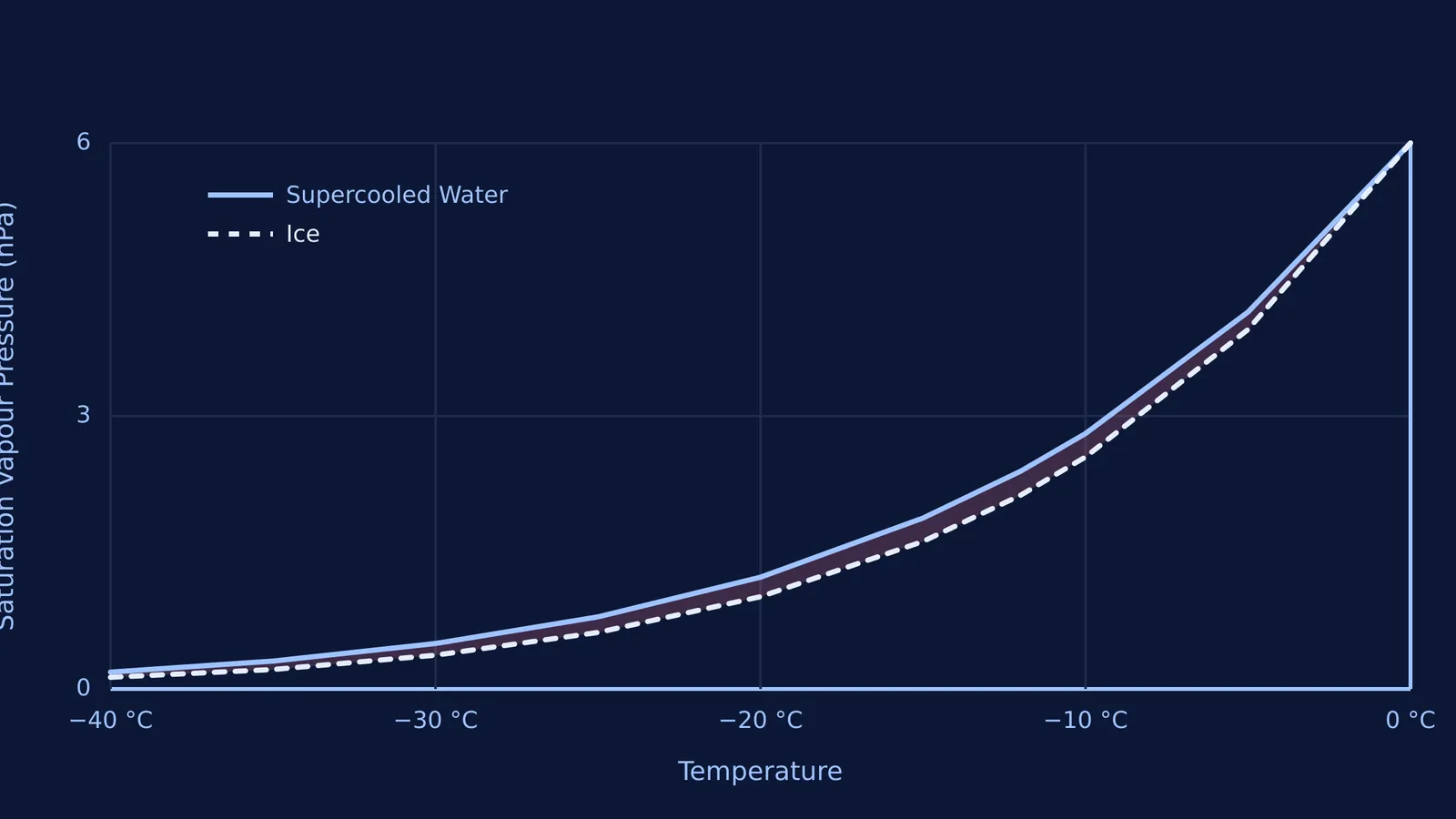
The secret lies in the thermodynamics of phase changes and vapour pressure. At subfreezing temperatures, the saturation vapour pressure over ice is strictly lower than the saturation vapour pressure over liquid water.
Because water molecules are locked tightly into the rigid crystalline lattice of ice, they possess less kinetic energy and are less likely to escape than the molecules moving loosely in a liquid droplet. Consequently, a specific volume of cold air might be entirely unsaturated for the water droplet (causing the droplet to evaporate to reach equilibrium) but supersaturated for the ice crystal (causing excess vapour to deposit directly onto the ice).
This vapour pressure gradient means the ice crystal acts like a thermodynamic sponge, constantly scavenging water vapour. As the droplet evaporates to replace the lost vapour in the air, the ice crystal just keeps absorbing it, creating optimal conditions for rapid ice growth.
If you find it hard to picture how physical properties and invisible gradients change simultaneously, the Fermi Simulation Lab has interactive simulations for the ideas that are easier to see than to read.
How does this drive rain formation?
As the ice crystal continuously robs the supercooled droplets of their mass, it grows rapidly from a microscopic speck into a large, heavy snowflake. Eventually, it becomes too heavy for the cloud's upward air currents to support, and gravity pulls it down.
If the air below the cloud is also freezing, the flake falls all the way to the ground as snow. But in most cases, particularly in warmer months, the snowflake passes through a layer of warm air near the Earth's surface. As it drops through this warmer layer, it melts into a raindrop before it hits the ground. This ice crystal rain formation process accounts for nearly all the rain produced in mid-latitude and high-latitude regions around the world.
When studying thermodynamics or meteorology for competitive exams, interpreting phase changes and gas laws can get tricky. If you find yourself stuck on a problem involving vapour pressure, Fermi's AI tutor can work out what you already know, build a plan for the session, and teach through it.
A framework for analysing phase change problems
When tackling physics or chemistry questions on vapour pressure or phase changes, you can use this simple, systematic framework:
Identify the states present: Does the problem mention a mixed phase (like ice and supercooled water existing together)?
Determine the vapour pressures: Look up or calculate the saturation vapour pressure for each state at the given temperature. The state with the lower saturation pressure (usually the solid) will act as a sink for vapour.
Trace the mass transfer: The substance with the higher vapour pressure will evaporate, while the substance with the lower vapour pressure will grow through deposition.
Relate to energy and work: Consider the thermal changes and work done during volume expansions. For example, if you are looking at the expansion of gases alongside phase changes, remember the rules for the free expansion of an ideal gas.
Chart it graphically: Sketch a PT (pressure-temperature) curve to visualise where the equilibrium lines lie, or practice converting PV, PT and VT graphs to ensure you understand the thermodynamic boundaries.
By mastering the thermodynamics behind how a simple ice crystal can drain a water droplet, you are not just learning about the weather—you are observing the precise, invisible laws of physics that govern our world.


