On this page
How do you find the distance to a star you cannot reach? One way is to work out how bright it really is, compare that with how bright it looks, and let the difference tell you how far away it is. In 1957 the Indian astronomer Vainu Bappu and his colleague O. C. Wilson found a way to read a cool star's true brightness from the width of a single line in its spectrum. This post explains that effect, works through a distance calculation, covers the observatory Bappu built, and ends with lessons for students.
Who was Vainu Bappu?
The Indian Institute of Astrophysics (IIA) marks his birthday, 10 August, as its Founder's Day, and its 2026 celebration opened his birth centenary year, ahead of what would have been his hundredth birthday in 2027. The institute's history page, which reproduces a history of the observatory that Bappu wrote in the early 1970s, gives his dates as 1927 to 1982.
Early in his career he shared in the discovery of a comet. The JPL Small-Body Database entry for C/1949 N1 lists it as comet Bappu–Bok–Newkirk.
What is the Wilson–Bappu effect?
In 1957 O. C. Wilson and M. K. Vainu Bappu published H and K emission in late-type stars: dependence of line width on luminosity and related topics in the Astrophysical Journal. Late-type stars are the cooler classes, roughly G, K and M in Annie Jump Cannon's scheme; our profile of Annie Jump Cannon and the OBAFGKM classes explains the letters.
Many such stars show a narrow bright emission feature in the middle of the dark K line of ionised calcium. Wilson and Bappu found that the width of this emission is closely linked to the star's absolute visual magnitude, its true brightness. As a 2003 recalibration by Pace, Pasquini and Ortolani puts it, they showed "a remarkable correlation" between the two. That paper, using 119 nearby stars with distances from the Hipparcos satellite, gives the relation as MV = 33.2 − 18.0 log W0, with W0 in km/s, and a scatter of about 0.6 magnitudes.
Worked example: how far away is the star?
Suppose a cool giant star has a measured emission width W0 = 50 km/s and an apparent visual magnitude m = 7.62.
Absolute magnitude. log 50 = 1.699. MV = 33.2 − 18.0 × 1.699 = 33.2 − 30.58 = 2.62.
Distance modulus. m − MV = 7.62 − 2.62 = 5.00.
Distance. Use d = 10^((m − MV + 5)/5) parsecs. d = 10^(10/5) = 10² = 100 parsecs.
How sure are we? The calibration scatter is about 0.6 magnitudes. A change of 0.6 in MV changes d by a factor of 10^(0.6/5) = 10^0.12 = 1.32. So the star is somewhere between about 76 and 132 parsecs away.
Step 4 matters as much as step 3. A number without its uncertainty is only half an answer.
Common mistakes. Using natural log instead of log base 10. Getting the sign wrong: a larger emission width means a brighter star, so a smaller (more negative) MV. And mixing parsecs with light-years (1 parsec is about 3.26 light-years). Distance moduli of this kind come up in astronomy olympiad papers; see our guide to the National Standard Examination in Astronomy.
What did he build?
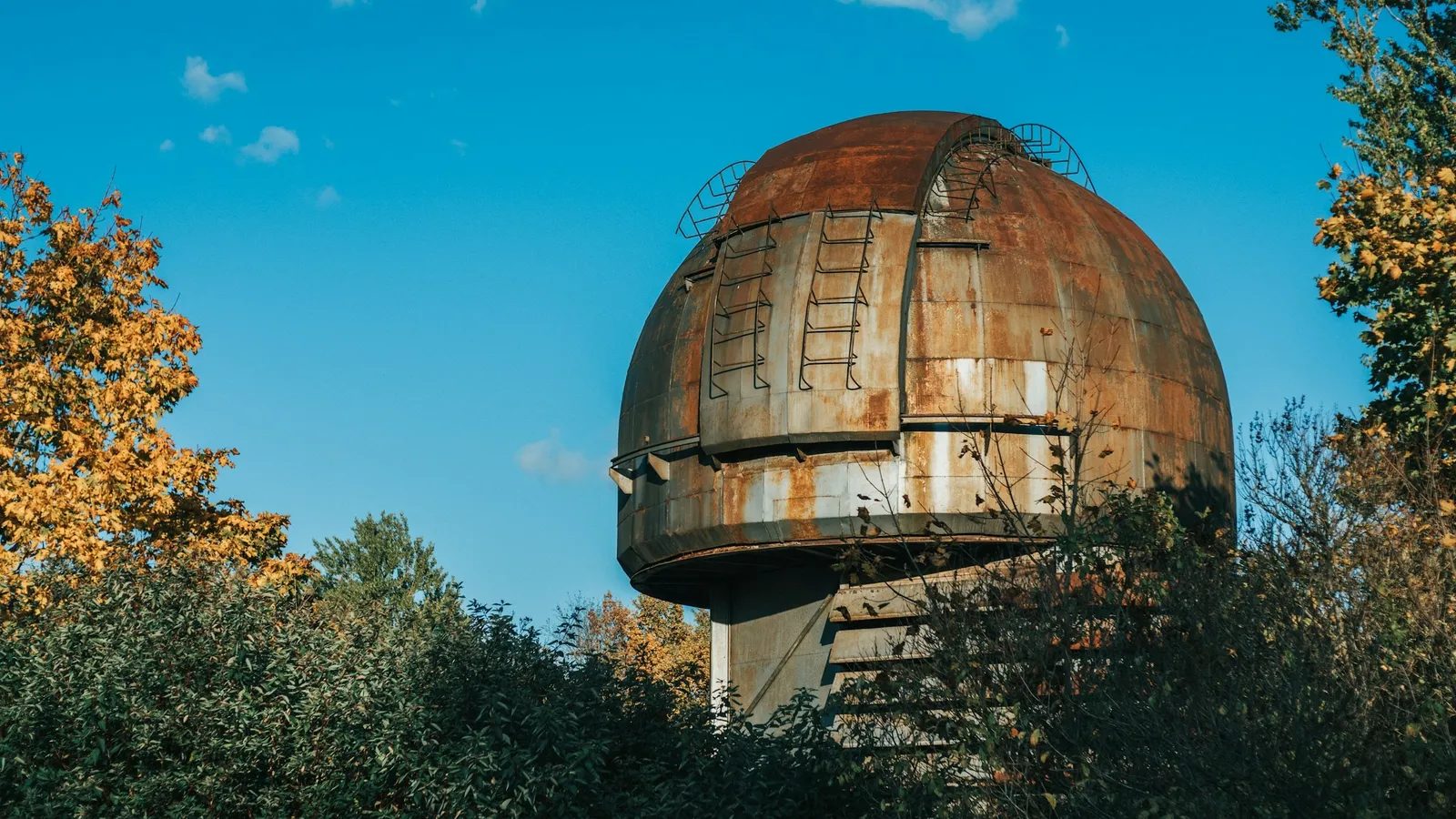
The IIA Founder's Day page records that in 1971 the Government of India made the Kodaikanal Observatory an autonomous research institute, creating the Indian Institute of Astrophysics. Bappu, then director of the observatory, was the moving force behind it, and he set out to establish a modern optical observatory for night-time astronomy in peninsular India. That became the Vainu Bappu Observatory at Kavalur in the Javadi Hills of Tamil Nadu, established in the 1960s. Its largest instrument is the 2.34 m Vainu Bappu Telescope, which the IIA overview calls the foremost of its telescopes there.
The IIA page also notes that he inspired a whole generation of optical astronomers in India and that training young astronomers remains central to the institute.
What can a student take from how he worked?
Look for a simple handle on a hard problem. Distance to a star is hard; the width of one line is easy to measure. Finding the right measurable quantity is a skill you can practise in every numerical.
Always state the uncertainty. The Wilson–Bappu relation is useful because its scatter is known.
Test before you build. Bappu's history of the observatory notes that the site of its main night-time telescope was chosen after fifteen months of tests of "seeing", the steadiness of the air. Good data starts with good conditions, in a telescope or a lab practical.
Build for the next generation. He left behind an institute and an observatory, not just papers.
If logarithms and magnitudes still feel slippery, the Fermi Problem Library has a step-by-step solver that explains the reasoning rather than printing an answer.
Your next step: redo the worked example with W0 = 30 km/s and the same apparent magnitude, and see whether the star comes out nearer or farther.