

On this page
Standard chemotherapy circulates throughout the body, attacking rapidly dividing cells indiscriminately and damaging healthy tissue. In our review of cancer biology for NEET, targeted tumour destruction remains a vital goal in medical oncology.
Professor Tebello Nyokong, a South African chemist at Rhodes University, has spent decades pioneering an alternative: photodynamic therapy (PDT). Born in Lesotho in 1951, Nyokong spent her childhood alternating days between school and herding sheep barefoot in the mountains. Despite being discouraged from science, she earned chemistry degrees in Lesotho and Canada before establishing the Institute for Nanotechnology Innovation at Rhodes University. In Nature Materials, Nyokong detailed the challenges of building research infrastructure across Africa. Her scientific achievements have earned wide international acclaim, including the 2005 Order of Mapungubwe (Bronze) from South Africa and election as a Fellow of the Royal Society in 2023. Her breakthrough lies in designing synthetic dyes that remain harmless in the dark but turn lethal when struck by red laser light.
How does photodynamic cancer therapy work?
Photodynamic therapy combines three non-toxic components: a light-sensitive dye (photosensitizer), dissolved tissue oxygen, and light of a specific wavelength. The photosensitizer has no inherent toxicity until targeted light strikes it.
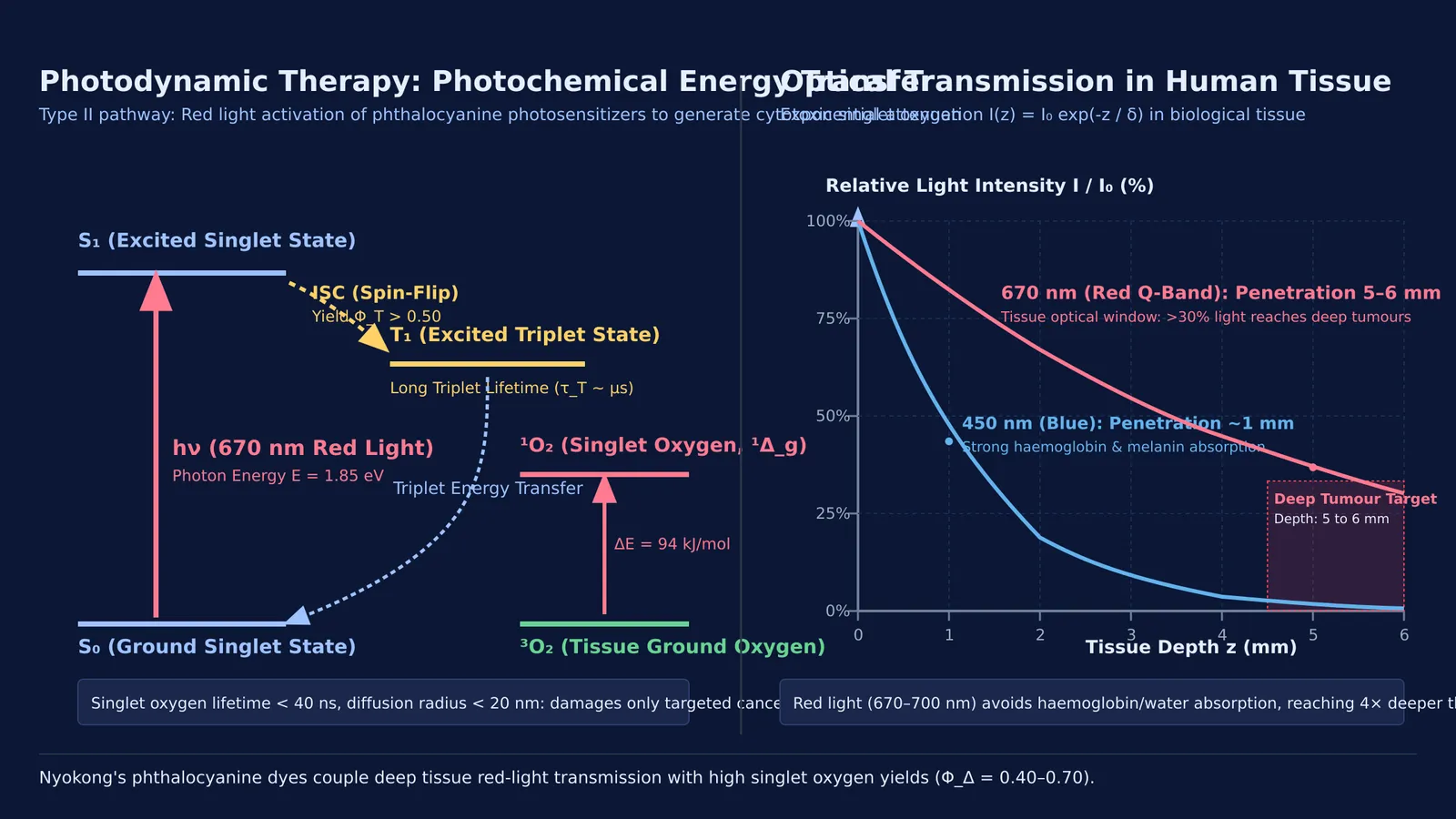
As detailed in Nyokong’s review in Pure and Applied Chemistry, the process follows a Type II photochemical pathway:
Photon absorption: Ground singlet dye molecules (S₀) absorb red photons, exciting an electron to the first singlet state (S₁).
Intersystem crossing: Instead of fluorescing immediately, the molecule undergoes a quantum spin-flip into a long-lived triplet state (T₁).
Triplet energy transfer: The excited triplet dye collides with ground-state triplet oxygen (³O₂), promoting it into cytotoxic singlet oxygen (¹O₂, ¹Δ_g).
Singlet oxygen rapidly oxidizes cell membranes, inducing apoptosis. Because its biological lifetime is under 40 nanoseconds and its diffusion radius is under 20 nanometres, damage is confined strictly to illuminated tissue, sparing healthy neighbouring organs.
Why are phthalocyanine dyes suited for photodynamic therapy?
As documented in Nyokong's analysis in Coordination Chemistry Reviews, first-generation photodynamic drugs absorbed light near 630 nanometres, where endogenous chromophores like melanin and haemoglobin absorb strongly, restricting tissue penetration to only 1 to 2 millimetres. These early porphyrin compounds also cleared slowly from the skin, leaving patients hypersensitive to sunlight for weeks.
Nyokong overcame this barrier with phthalocyanines—deep blue synthetic macrocycles widely used as pigments, a chemistry explored in India by K. Venkataraman and synthetic dyes. Phthalocyanines contain a planar 18 π-electron aromatic core with four isoindole units linked by nitrogen atoms. This conjugated system creates an intense absorption band, called the Q-band, between 670 and 700 nanometres.
Red light in this 650–850 nanometre optical window passes through tissue with minimal absorption by water or haemoglobin, enabling beams from helium-neon or diode lasers to reach tumours 5 to 6 millimetres deep. By coordinating diamagnetic metal ions like zinc(II) or aluminium(III) in the central cavity, Nyokong achieved singlet oxygen quantum yields (Φ_Δ) between 0.40 and 0.70. Unlike paramagnetic iron or copper, which quench triplet states, zinc and aluminium facilitate spin-orbit coupling without accelerating non-radiative decay.
Visualising how electron spin flips during intersystem crossing can be challenging on a flat textbook page. The Fermi Simulation Lab offers interactive simulations that make energy levels and photon absorption easier to see than read.
How does nanotechnology solve dye solubility and targeting?
The primary chemical obstacle with phthalocyanines is hydrophobic aggregation. Planar aromatic discs stack face-to-face in aqueous fluids through π-π interactions. This aggregation quenches the excited state, dissipating absorbed photons as heat rather than generating singlet oxygen.
Nyokong overcame aggregation through chemical functionalisation and nanotechnology:
Electrostatic repulsion: Introducing charged sulfonate (–SO₃⁻) or carboxylate (–COO⁻) groups forces molecules apart in saline solutions.
Nanoparticle conjugates: Linking phthalocyanines to gold nanoparticles or quantum dots prevents stacking. In The Journal of Physical Chemistry B, Nyokong showed that CdTe quantum dots transfer excitation energy to sulfonated aluminium phthalocyanines via Förster resonance energy transfer (FRET), raising singlet oxygen generation.
Targeted cytotoxicity: In Spectrochimica Acta Part A, her group conjugated zinc phthalocyanines to carbon nanotubes to kill MCF-7 human breast cancer cells under red light.
Nanoparticles also exploit leaky tumour capillaries, accumulating inside tumours while clearing rapidly from healthy skin.
What criteria define an ideal photodynamic dye?
As outlined in Nyokong’s benchmarks in Pure and Applied Chemistry, evaluating a photosensitizer for clinical photodynamic therapy relies on four quantitative criteria:
Red-to-near-infrared absorption: High molar absorption (ε > 10⁵ M⁻¹ cm⁻¹) within the tissue optical window (650–850 nm) for deep light penetration.
High triplet quantum yield: Efficient intersystem crossing (Φ_T > 0.50) with a microsecond-scale triplet lifetime (τ_T) to allow collisions with dissolved oxygen.
High singlet oxygen efficiency: A singlet oxygen quantum yield (Φ_Δ > 0.40) and high photostability against self-bleaching during illumination.
Aqueous monomeric stability: Polar side chains or nanoparticle carriers that prevent co-facial stacking and preserve photochemical activity in physiological fluid.
When balancing photochemical rate equations or calculating photon energy from wavelength, working through structured practice prevents formula confusion. The Fermi Problem Library provides a step-by-step solver that explains the reasoning behind physical chemistry calculations.


