

On this page
In 1551, more than a century before the European Industrial Revolution, Ottoman polymath Taqi al-Din Muhammad ibn Ma'ruf completed an engineering treatise in Cairo titled *Al-Turuq al-saniyya fi al-alat al-ruhaniyya* (*The Sublime Methods of Spiritual Machines*). The manuscript recorded something unprecedented in mechanical literature: an apparatus that converted the thermal expansion of boiling water into continuous rotary motion to perform physical work.
The machine was an impulse steam turbine designed to turn a roasting spit over a hearth. In his 1976 critical edition of the text, historian Ahmad Y. al-Hassan translated the Arabic manuscript, and science historian Donald R. Hill (1978) confirmed its historical significance in *Isis*. Taqi al-Din’s roasting jack proved that steam was not merely an explosive hazard or an entertaining toy. Directed through a constricted nozzle, high-velocity vapor could act as a prime mover to drive continuous mechanical work.
How did Taqi al-Din build a steam turbine in 1551?
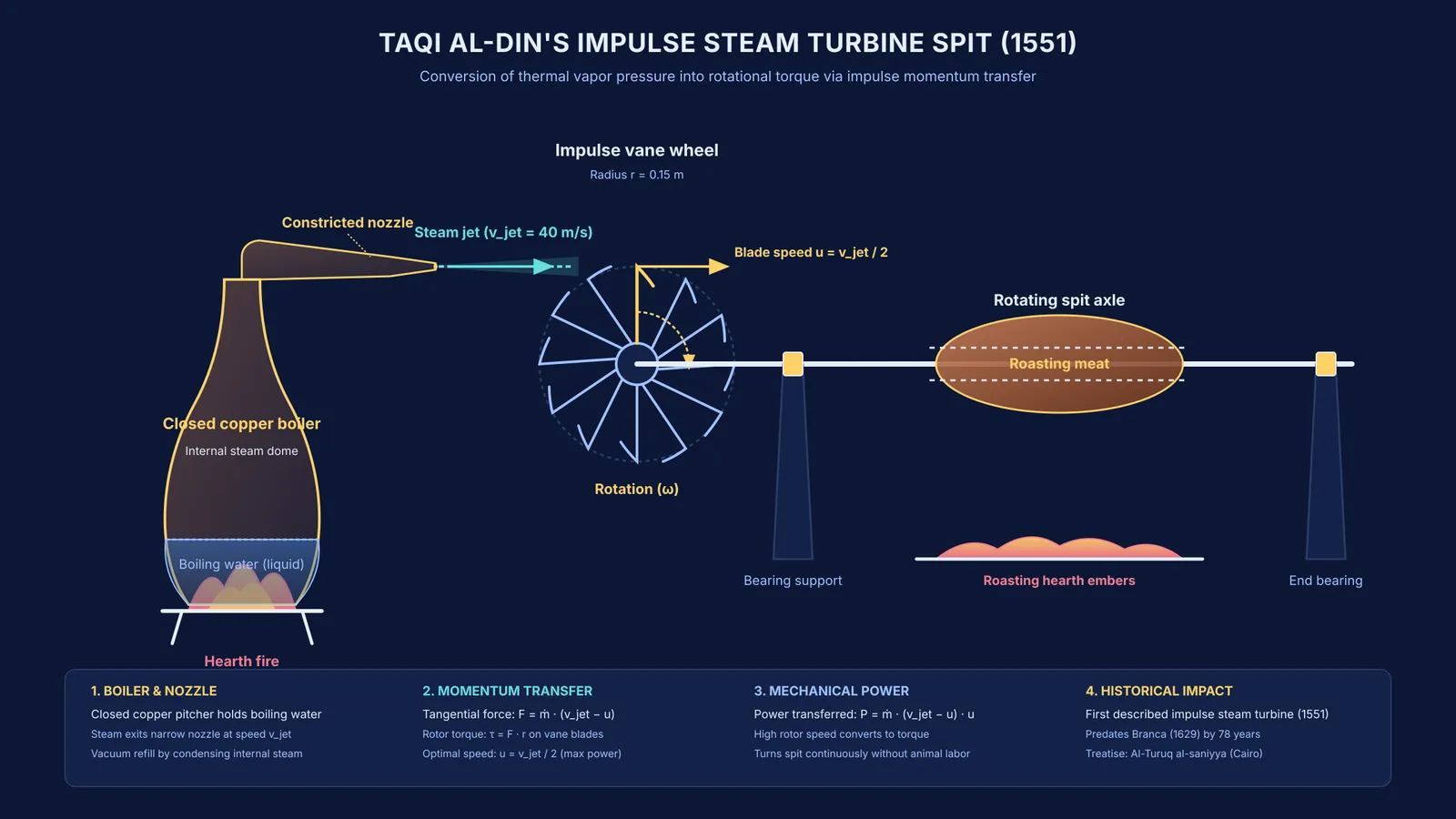
Taqi al-Din described his device in Part Six of the treatise as a spit that rotates by itself without animal power. According to Ahmad Y. al-Hassan's translation, the system combined four core components:
A closed copper boiler shaped like a pitcher, filled with water and placed over a fire.
A tapered nozzle fitted to the neck, constricting the escaping steam into a high-speed jet.
A vane wheel mounted in front of the nozzle, whose blades caught the steam.
An axle shaft connecting the wheel to the spit holding the meat, supported on bearings.
As the fire boiled the water, steam pressure mounted within the sealed pitcher. The escaping vapor accelerated through the nozzle, striking the vanes and turning the spit continuously. Taqi al-Din also outlined a practical refill trick: when the boiler ran dry, dipping the hot nozzle into cold water caused internal steam to condense, creating a partial vacuum that drew fresh water back into the vessel.
Why is an impulse turbine different from Hero's engine?
Ancient mechanics had toyed with steam, but never in this form. In the first century AD, Hero of Alexandria described the *aeolipile*, a spherical vessel with opposing curved nozzles. Escaping steam spun the sphere by reaction force, like a rotary lawn sprinkler. The *aeolipile* was an open-system demonstration that spun freely with negligible torque, incapable of driving heavy machinery.
Taqi al-Din designed an impulse turbine. Instead of rotating the boiler, he kept the boiler stationary, accelerated steam through a nozzle, and transferred the fluid's kinetic momentum to the vanes of an external rotor. As noted in Ahmad Y. al-Hassan's historical survey, his design preceded Giovanni Branca’s 1629 Italian impulse wheel by 78 years and John Wilkins’s 1648 English steam spit by 97 years. His work built on the mechanical traditions of Al-Jazari and the book of ingenious mechanical devices, anticipated Denis Papin and the pressure cooker of the 1600s, and echoed the water-driven escapements of Su Song and the water-driven astronomical clock tower.
How much mechanical power could the steam jet deliver?
To examine how Taqi al-Din's spit operates, consider the classical impulse turbine physics of momentum transfer. Historian Ahmad Y. al-Hassan classified the 1551 mechanism as an impulse turbine because steam momentum, rather than reaction recoil, drives the vanes.
Suppose the boiler produces a steam jet with mass flow rate m = 0.005 kg/s at exit velocity v_jet = 40 m/s striking flat rotor vanes at radius r = 0.15 m. If the blade moves at tangential speed u = ωr, the relative speed of the steam striking the blade is (v_jet − u). Deflecting through 90° along the vane face imparts tangential force F = m(v_jet − u) and torque τ = F × r.
The mechanical power transferred to the rotor is P = F × u = m(v_jet − u)u. Differentiating with respect to u shows that power peaks when dP/du = m(v_jet − 2u) = 0, or u = v_jet / 2: exactly half the jet velocity.
At optimal speed u = 20 m/s:
Tangential force: F = 0.005 × (40 − 20) = 0.10 N
Rotor power: P = 0.10 N × 20 m/s = 2.0 W
Rotor angular speed: ω = 20 / 0.15 ≈ 133 rad/s (approx 1270 rpm)
A roasting spit turning heavy meat needs roughly 6 rpm (0.63 rad/s). In his manuscript, Taqi al-Din mounted the vane wheel directly on the spit axle, which at slow turning speeds yields around 0.03 N·m of torque for light skewers. For heavier roasting joints, sixteenth-century jacks typically required reduction gearing: a 200:1 gear ratio converts 2.0 W into a torque of τ = 2.0 / 0.63 ≈ 3.2 N·m, easily rotating a 5 kg joint of meat.
What was the legacy of Ottoman steam engineering?
Taqi al-Din went on to serve as Chief Astronomer to Sultan Murad III, founding the Istanbul Observatory in 1577. Yet his steam turbine remained an elite kitchen novelty rather than an industrial prime mover. As historians of technology, including Donald R. Hill (1978), have highlighted in assessments of early Arabic mechanics, sixteenth-century metallurgy could not safely contain high pressures, and an open single-stage jet dissipated nearly all of its thermal energy into surrounding air. In addition, existing animal and water power reliably met local milling and irrigation demands without the fuel costs of boiling water.
Connecting the physics of fluid momentum, nozzle acceleration, and rotational torque requires seeing how core principles fit together. The Fermi Concept Library covers every concept in physics, chemistry, biology, mathematics and computing, each with its own lesson and its place in the map. For students practicing rotational mechanics and impulse problems, the Fermi Problem Library has worked problems with a step-by-step solver that explains the reasoning rather than printing an answer. When visualizing relative velocities and turbine vanes proves challenging, the Fermi Simulation Lab provides interactive simulations for the ideas that are easier to see than to read.


