

On this page
Picture a clock in which a peahen slowly turns, a glass roundel changes colour and two peacocks whistle every half hour, all driven by water. That is one of the machines al-Jazari designed and wrote up in detail. He did not just build devices; he explained and drew them so others could follow. This post covers his book, the physics inside it and what you can learn from his method.
Who was al-Jazari?
The Metropolitan Museum of Art holds several illustrated pages from a 1315 copy of his book. Its catalogue entry for the Water Clock of the Peacocks folio names him as Badi al-Zaman ibn al-Razzaz al-Jazari, gives his dates as 1136-1206 in northern Mesopotamia, and says he served at the Artuqid court in Diyar Bakr.
According to the Met, the book began with a conversation. The Artuqid prince Nasr al-Din Mahmud, who ruled from 1201 to 1222, saw a device al-Jazari had made, complimented him, and asked him to compose "a book which assembles what you have created separately, and brings together a selection of individual items and pictures." Sources differ on exactly when he finished it. The Met's catalogue entry places its completion between 1198 and 1200, while it is also often dated to 1206, as in the title of a chapter on it by Gunalan Nadarajan in MediaArtHistories (MIT Press).
What is in the Book of the Knowledge of Ingenious Mechanical Devices?
The Met describes the treatise as organised in six sections, with explanations and illustrations of fifty types of devices:
clocks showing the passage of the "constant and solar hours"
vessels and figures used at drinking parties
pitchers and basins for bloodletting and ritual washing
fountains that change shape, and machines for a "perpetual flute"
machines for raising water
"different, dissimilar things"
An English translation, published by Springer as The Book of Knowledge of Ingenious Mechanical Devices, keeps this structure; its chapters open with the castle water-clock, the water-clock of the drummers, the water-clock of the boat and the elephant water-clock.
How did the water clock of the peacocks work?
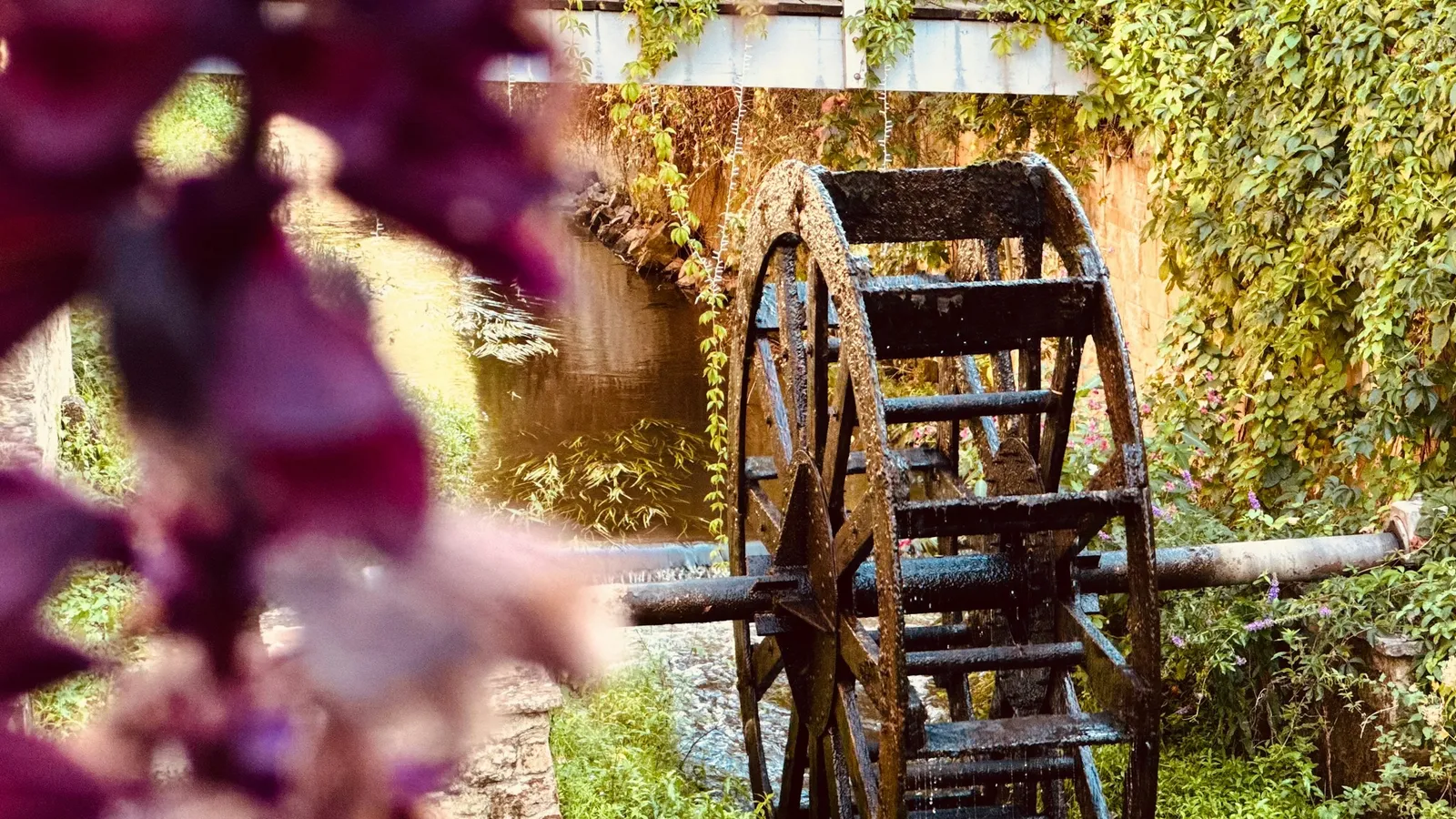
The Met's description of the folio is a small lesson in mechanism. Water fills the scoops of a wheel, and the wheel turns. Its axle carries a second wheel that meshes with a toothed wheel connected to the ball on which a peacock stands, so the peacock rotates. Rods moved by the waterwheel turn the pair of peacocks. A small air vessel pushes air through a pipe into a ball hidden in the roof, where it whistles.
At daybreak the peahen faces right; over half an hour she turns fully to the left, half of a roundel turns red and the peacocks whistle. Then she turns back, and so on until half an hour after sunset. The Met's page on the elephant clock folio shows another of his water clocks, with a driver holding a pickaxe and a mallet.
Why does a water clock need a steady flow?
This part is standard physics rather than a description of any one of his machines, but it shows the problem every water-clock maker faced. Water leaving a hole at depth h below the surface comes out at speed v = square root of (2gh), Torricelli's law, which the NCERT Class 11 chapter on fluids derives in its section on speed of efflux.
Worked example. Take g = 9.8 m/s^2.
With h = 0.80 m: v = square root of (2 x 9.8 x 0.80) = square root of 15.68 = 3.96 m/s.
With h = 0.20 m: v = square root of 3.92 = 1.98 m/s.
With h = 0.05 m: v = square root of 0.98 = 0.99 m/s.
Each time the depth drops to a quarter, the outflow speed, and so the flow rate through the same hole, halves. A clock that simply let a tank drain would run fast at the start and slow at the end. That is why designers of water clocks worked to keep the water level, and so the flow, constant.
What about the gears?
When two toothed wheels mesh, the teeth passing the contact point per second are the same on both. So (teeth on wheel 1) x (turns per minute of wheel 1) = (teeth on wheel 2) x (turns per minute of wheel 2).
Sample numbers. A 12-tooth wheel driven by a waterwheel at 6 turns per minute meshes with a 72-tooth wheel. The big wheel turns at 6 x 12 / 72 = 1 turn per minute. Add another 12-to-72 pair and the final wheel turns once every 6 minutes. Gearing down like this is how a fast-turning wheel can drive a slow display.
Common mistakes in efflux and gear problems
Using the height of the tank instead of the depth of the hole below the surface. In v = square root of (2gh), h is measured from the free surface down to the hole.
Assuming constant flow from a draining tank. The speed falls as the level falls, so the time to empty is not volume divided by the initial flow rate.
Inverting the gear ratio. The wheel with more teeth turns more slowly.
Our post on Torricelli's law, efflux speed and range has more practice. If a mechanism is hard to picture from a still drawing, the Fermi Simulation Lab has interactive simulations for ideas easier to see than read.
What can a student take from how al-Jazari worked?
Write it up so someone else can build it. His book exists because a patron asked him to gather separate inventions into one explained, illustrated collection.
Break a machine into stages. Each of his clocks is a chain: water source, wheel, gears and rods, display. Problems in mechanics get easier when you name each stage.
Practice routine: draw one machine around you (a ceiling fan, a bicycle) as a chain of stages, then write one equation for each stage, such as a gear ratio or an energy balance.
Next step: calculate the efflux speed at depths of 45 cm and 11.25 cm, and check that it halves when the depth drops to a quarter.


