

On this page
For more than a century after Charles Darwin, the standard view of evolution was a slow, steady march. Scientists assumed that species gradually transformed into new ones over millions of years. When the fossil record showed sudden changes instead of smooth transitions, researchers often blamed the "imperfection" of the geological record.
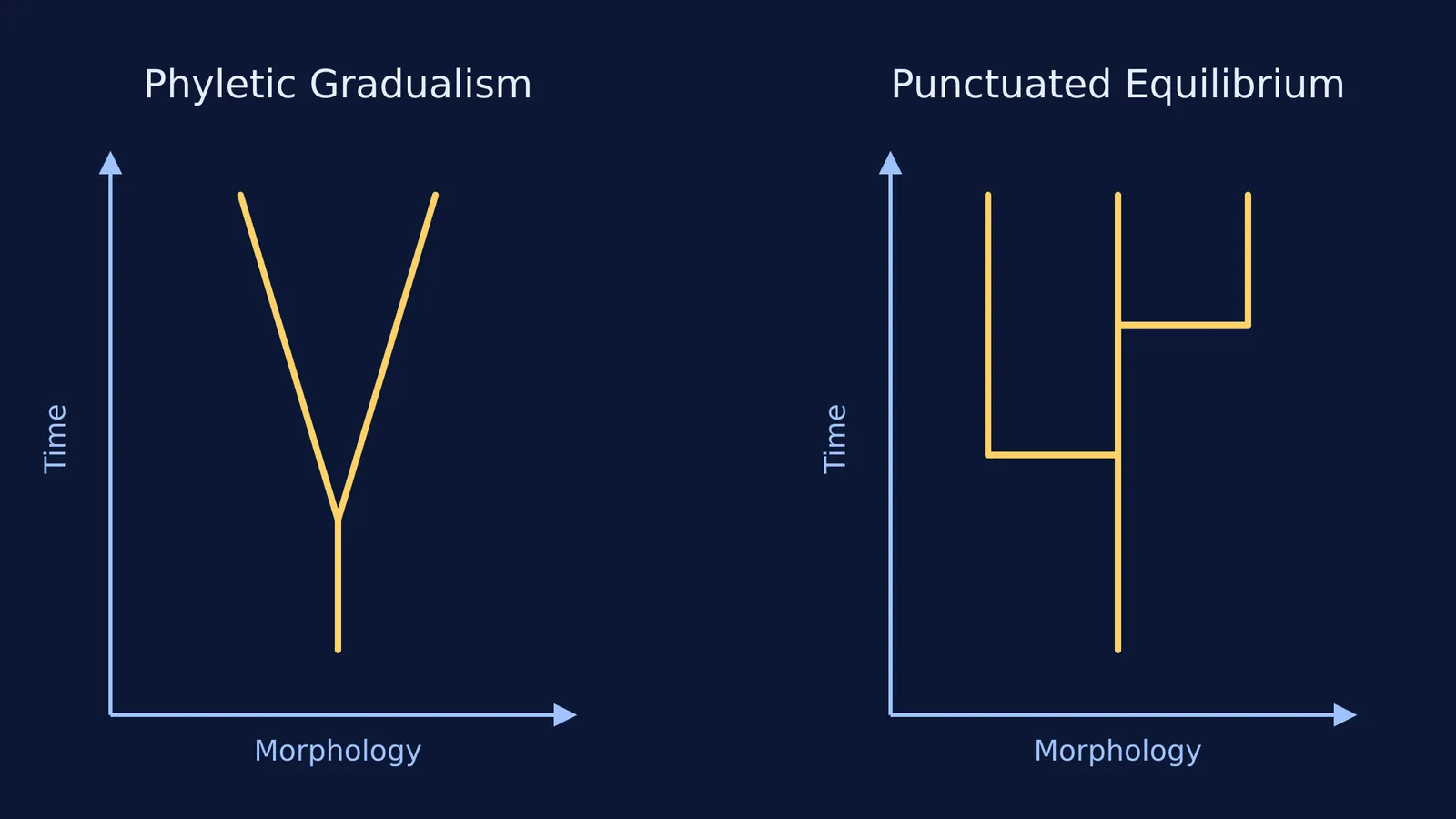
In 1972, paleontologists Stephen Jay Gould and Niles Eldredge challenged this narrative with their landmark paper, *Punctuated equilibria: an alternative to phyletic gradualism*. They argued that the fossil record was not missing pages; it was showing exactly how evolution happens.
What is punctuated equilibrium?
Eldredge and Gould proposed that a species spends the vast majority of its existence in "stasis" — a period of stability lasting millions of years where it barely changes its physical form.
When significant evolutionary change does occur, it happens in a geological blink of an eye. This "punctuation" is a rapid burst of speciation (a process called cladogenesis) that takes place over 50,000 to 100,000 years. Because this burst is so quick compared to the millions of years of stasis, the transitional forms are rarely caught in the fossil layers.
If you are mapping out these evolutionary models for your exams, the Fermi Concept Library contains every concept in biology, each with its own lesson and its place in the map, helping you track how speciation and stasis fit together.
What are some real examples of stasis?
To support their theory, researchers point to living fossils and long-standing lineages that have barely changed. For instance, the royal fern *Osmunda claytoniana* has remained unchanged, even at the cellular level, for at least 180 million years.
Similarly, researchers have documented fossil evidence of certain Olive Shells (*Amalda sp.*) that confirm strict morphological stasis lasting over three million years. These periods of no change are so common that a meta-analysis of 58 published studies on speciation patterns revealed that 71% of species exhibited stasis.
Before punctuated equilibrium, evolutionary biologists considered stasis to be rare or unimportant. The recognition of these long periods of stability forced the scientific community to reconsider how genetic and physical traits persist over vast timescales.
How does rapid speciation happen?
Gould and Eldredge built their theory on Ernst Mayr's model of allopatric speciation. This occurs when a small group of a species becomes geographically separated from the main population, often at the edge of their territory.
Because this isolated population is small and faces new environmental pressures, it adapts quickly. The parent species continues unchanged in its original habitat, while the isolated offshoot rapidly becomes a new species to survive in the new conditions. Once the new species is established and grows in number, it eventually enters its own long period of stasis.
This principle of natural selection acting on isolated populations is a key part of studying Evolution for NEET: natural selection, Hardy-Weinberg and evidence.
Why was the 1972 paper a breakthrough?
Before 1972, "phyletic gradualism" was the dominant theory, assuming that an entire species slowly and uniformly transformed into another. Gould and Eldredge proved that "stasis is data" — the long stable periods in the fossil record were actual evidence of how species behave, rather than a lack of transitional evidence.
As Gould later wrote, "stasis may emerge as the theory's most important contribution to evolutionary science."
The paper shifted the focus of evolutionary biology from anagenesis (the smooth transformation of one lineage) to cladogenesis (the branching of lineages). It showed that species could be treated as distinct entities that branch and persist. This influenced how researchers like Theodosius Dobzhansky and others viewed the evolutionary synthesis. Even Ernst Mayr complimented their work, noting that such evolutionary stasis had been completely unexpected by most biologists.
When tackling theories that changed scientific consensus, Fermi's AI tutor can work out what you already know and build a plan for the session, writing on a board to contrast gradualism with punctuated change.
How does punctuated equilibrium apply to learning?
The pattern of punctuated equilibrium is also a remarkably accurate model for how humans learn complex academic subjects.
The stasis plateau: You might spend weeks studying a difficult topic and feel like you are making no visible progress. This long plateau is your brain consolidating information and building a foundation.
The sudden punctuation: Keep pushing through the plateau. True understanding often arrives in a sudden burst or an "aha" moment, rapidly elevating your skill level to a completely new baseline.
If you are struggling to picture these abstract jumps in logic while you study, the Fermi Simulation Lab provides interactive simulations for the ideas that are easier to see than to read.


