

On this page
In 1977, two research groups working separately found that a gene does not have to be one unbroken stretch of DNA. Richard Roberts at Cold Spring Harbor Laboratory and Phillip Sharp at the Massachusetts Institute of Technology both showed that a single messenger RNA could come from several well-separated pieces of DNA, according to the Nobel Assembly's 1993 press release. If you are in Class 12, this is the experiment behind the textbook statement that eukaryotic genes are split.
What did scientists think a gene looked like before 1977?
Most early molecular biology was done on bacteria and the viruses that infect them. In the mid-1970s, the accepted picture was simple: a gene is one continuous segment of DNA, it is copied into messenger RNA, and that RNA is translated into protein, as the Nobel press release describes.
Both labs chose adenovirus, a common-cold virus that infects the cells of higher organisms and has genes much like theirs, but whose genome is a single DNA molecule simple enough to map. Their goal was ordinary: find where each gene sits on that DNA.
How were introns discovered by Sharp and Roberts?
Biochemical tests showed that one end of an adenovirus mRNA did not behave as expected, so the teams used electron microscopy to see where it matched the DNA, per the Nobel press release.
Sharp's group, with Susan Berget and Claire Moore, described the details in a paper in PNAS in August 1977. Here is what they did, step by step:
They purified the mRNA for hexon, the main protein of the virus coat.
They mixed it with single-stranded viral DNA so that matching sequences paired up into RNA-DNA hybrids.
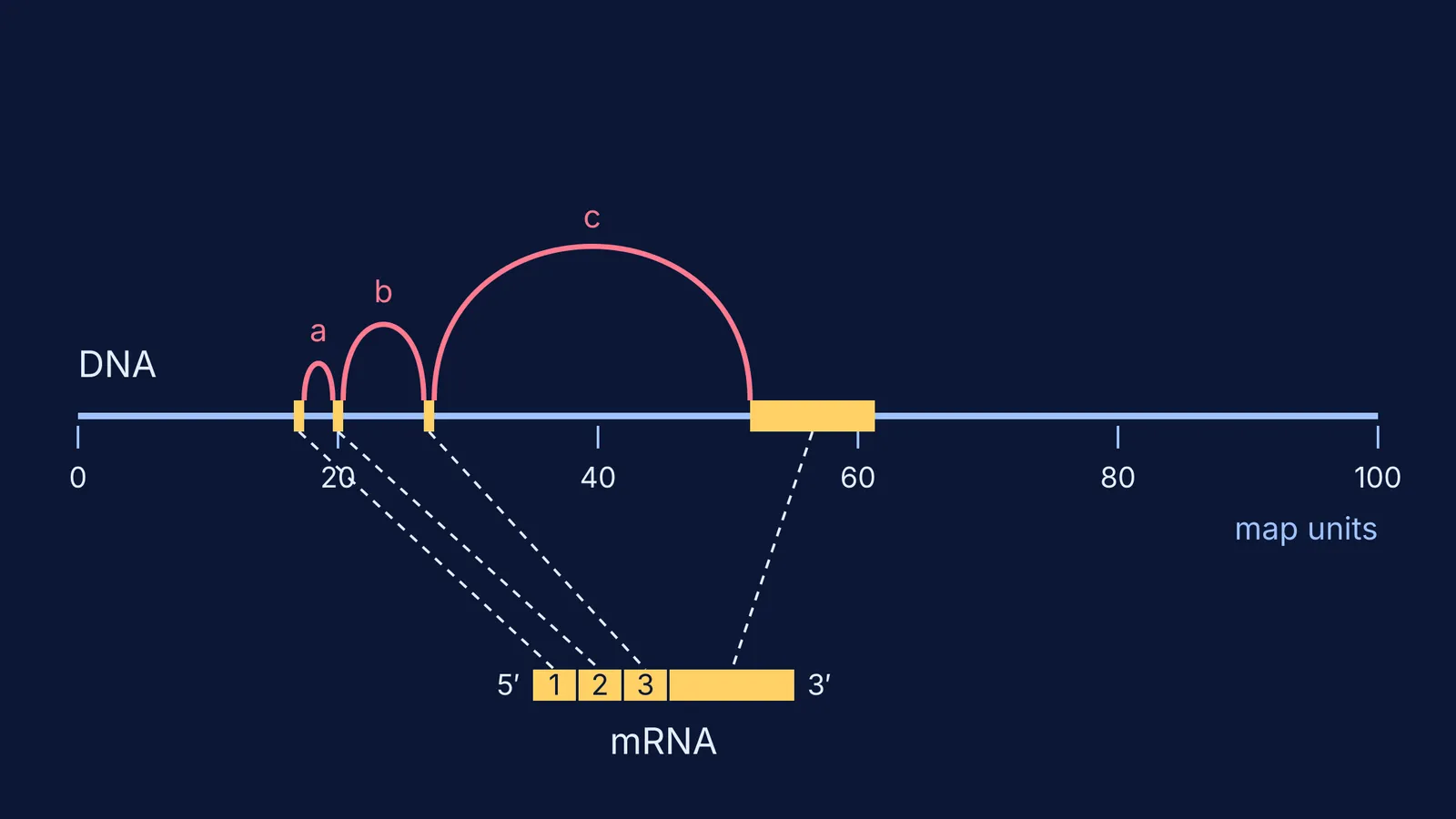
Under the electron microscope, the body of the hexon mRNA lined up between 51.7 and 61.3 units on the genome map.
But about 160 nucleotides at the 5' end did not pair with the DNA there at all.
The DNA matching that loose tail turned up far away, at 17, 20 and 27 units on the same strand.
The paper concluded that four segments of viral RNA may be joined together during the synthesis of mature hexon mRNA, and proposed that a larger nuclear precursor RNA is spliced several times. Roberts's group, with Louise Chow, Richard Gelinas and Thomas Broker, published their own independent account in Cell in September 1977, in a paper titled "An amazing sequence arrangement at the 5' ends of adenovirus 2 messenger RNA".
The press release's diagram shows why: the three stretches of DNA between the four matching segments have no partner in the RNA, so they loop out.
What are exons, introns and splicing?
Exons are the segments of a gene that end up in the finished RNA, and introns are the intervening DNA between them, as defined in the Nobel press release. Splicing is the step in which introns are cut out of the first RNA copy and the exons are joined into a shorter mature RNA.
The same source gives two reasons this matters:
Alternative splicing: different tissues can keep different combinations of exons, so one stretch of DNA can code for several proteins.
Disease: splicing errors cause some inherited disorders, the best studied being beta-thalassaemia, where faulty splicing of beta-globin RNA leads to anaemia.
Roberts and Sharp shared the 1993 Nobel Prize in Physiology or Medicine "for their discovery of 'split genes'", announced on 11 October 1993.
For every step that turns the first RNA copy into mRNA, see our guide to capping, tailing and splicing in eukaryotes.
How do you explain split genes in a Class 12 answer?
A strong long answer follows the experiment, not just the definitions:
Old view: a gene was thought to be one continuous DNA segment.
System: adenovirus, chosen because its genes resemble those of higher organisms.
Method: mRNA was paired with single-stranded DNA and the hybrids viewed by electron microscopy.
Result: one mRNA matched four separate DNA segments, and the unmatched DNA formed loops.
Meaning: genes are split into exons and introns, and splicing removes introns from the primary transcript.
Here is a worked check you can do with the numbers from the 1977 PNAS paper. The hexon mRNA body spans 61.3 minus 51.7, which is 9.6 map units. The nearest leader piece sits at about 27 units, so the last intron is roughly 51.7 minus 27, or about 24.7 units long. That cut-out stretch of DNA is more than twice as long as the mRNA body beside it.
Watch for two common slips:
Calling introns "junk". Say "intervening sequences that are removed".
Saying split genes were found in bacteria. They were found in a virus that infects the cells of higher organisms.
If exons, introns and the primary transcript still blur together, the Fermi Concept Library gives every biology concept its own lesson and shows where it sits in the map of related ideas. For the wider chapter, our summary of the molecular basis of inheritance, from DNA to the lac operon puts split genes next to replication, transcription and the genetic code.


