

On this page
The antimatter twin
In 1933, Paul Dirac accepted his Nobel Prize and predicted that the proton has a negative counterpart. His mathematical equations had already revealed the positron, an antimatter twin of the electron with a positive charge. Physicists naturally wondered if charge symmetry applied to the heavier particles in the atomic nucleus as well.
But finding the antiproton was a much harder engineering problem. The proton has a mass of about 938 MeV/c². Because mass and energy are equivalent, creating an antiproton out of pure energy requires an immense collision, far beyond what any cyclotron in the 1930s or 1940s could produce. The field had to wait for accelerator technology to catch up with theoretical physics (George Johnstone Stoney, who named the electron).
Why 6.2 GeV?
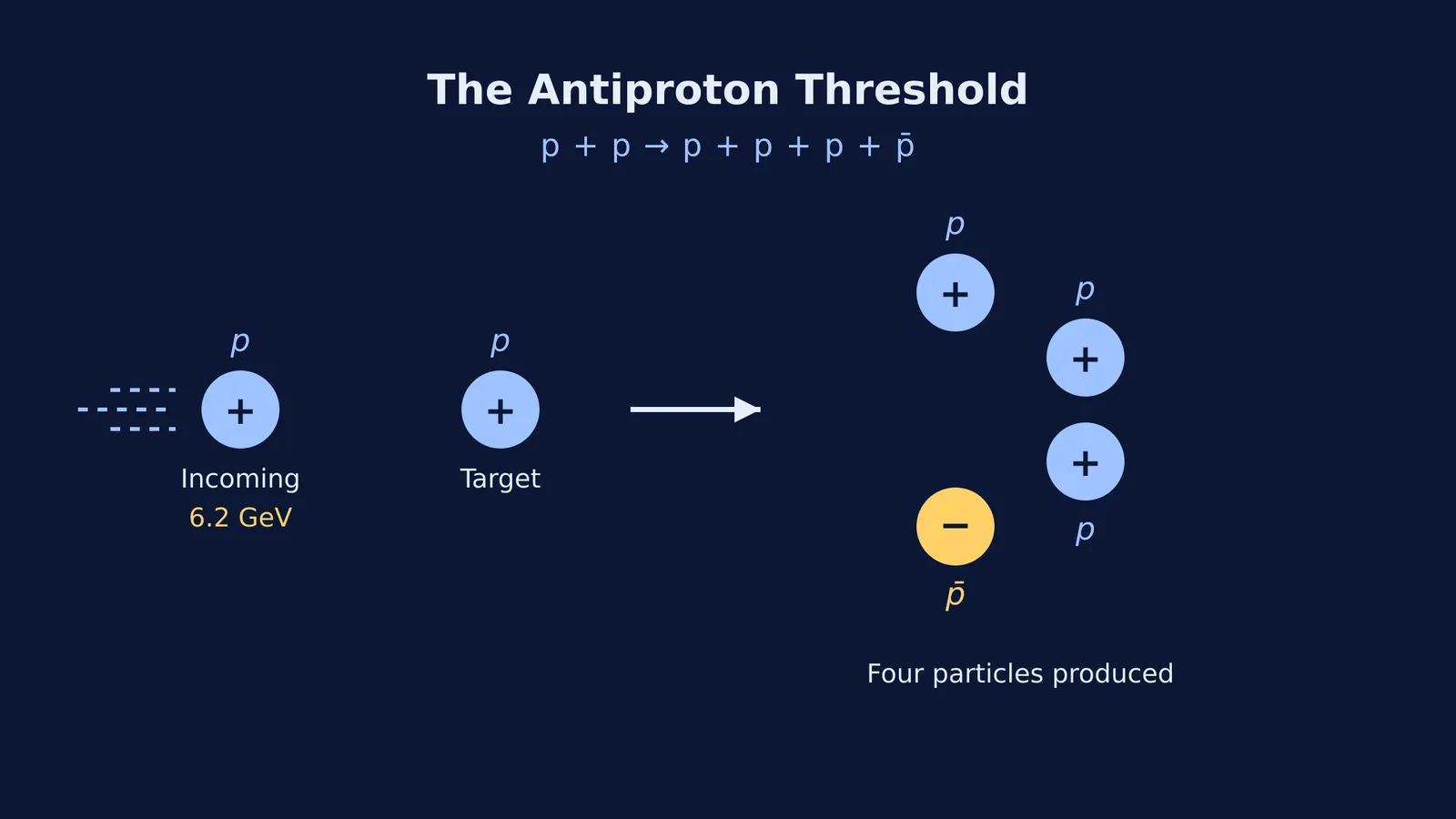
To create an antiproton, physicists had to smash a high-energy proton into a stationary target proton. Because baryon number (the total number of protons and neutrons) is strictly conserved in particle physics, you cannot create a single antiproton out of a collision. The reaction must produce an additional proton-antiproton pair alongside the original two protons:
p + p → p + p + p + p̄
This means the collision must supply the rest-mass energy for two entirely new heavy particles. However, the calculation is not as simple as adding up the masses. Because the incoming proton carries tremendous forward momentum, the newly created particles cannot be at rest after the collision. They must also move forward, absorbing much of the initial beam energy as their own kinetic energy.
To conserve both energy and momentum, the incoming proton must have a minimum kinetic energy of 6mₚc², which is about 5.6 GeV. To practice these calculations, the Fermi Problem Library has worked problems with a step-by-step solver that explains the relativistic momentum reasoning.
How did they guide the beam?
To reach this exact threshold, the Lawrence Berkeley National Laboratory designed a weak-focusing proton synchrotron called the Bevatron. The Bevatron achieved a beam energy of 6.2 GeV. This energy level was deliberately chosen to give physicists a comfortable margin over the 5.6 GeV requirement needed to hunt for the antiproton.
Accelerating protons to relativistic speeds required bending their path into a circle so they could be pushed by electric fields many times. Its beam was guided by a 10,000-ton iron magnet. The circulating proton beam travelled through a vacuum aperture of four square feet. For each five-second acceleration cycle, a massive motor-generator system ramped up the magnetic field, filling the complex with a characteristic wailing sound as the energy was returned to the generator afterwards.
How did they separate the signal from the noise?
In 1955, Emilio Segrè and Owen Chamberlain ran the experiment that proved the antiproton was real. They fired the 6.2 GeV beam into a copper target. Out of many collisions, the Bevatron created a spray of subatomic debris. The challenge was proving they were seeing antiprotons, not just lighter negative particles like pions (Cesar Lattes, borax plates and the discovery of the pi meson).
They built a magnetic spectrometer to filter the debris. The magnetic field bent the paths of the negatively charged particles down a specific channel. Because a pion is much lighter than an antiproton, a pion with the same momentum travels much faster. Segrè and Chamberlain used a sophisticated time-of-flight system, timing how long the particles took to travel 40 feet between two scintillation counters. They proved they had found a particle with a negative charge and the exact mass of a proton.
The legacy of the antiproton
Today, we understand the proton as a cluster of two up quarks and one down quark. The antiproton consists of two up antiquarks and one down antiquark. Its electric charge and magnetic moment are the exact opposites of the proton, confirming that matter and antimatter obey strict symmetries. The antineutron was discovered at the Bevatron just one year later.
If you are struggling to map out particle properties, conservation laws or the mathematics of momentum, Fermi's AI tutor can work out what you already know and build a plan for the session, teaching you the core concepts step by step.


