

On this page
Dr. Segenet Kelemu, an Ethiopian molecular plant pathologist, spent her career investigating how plants survive in harsh environments. While smallholder farmers in Africa face drought, poor soils, and pests that destroy their maize crops, she looked closely at the invisible ecosystems inside the plants for solutions. Growing up in the rural Ethiopian town of Finote Selam, Kelemu witnessed the back-breaking labour of agriculture firsthand. Like many other children in her village, she was expected to help out with farming chores, which placed people in her community in a constant struggle to meet minimum household food needs. She became the first woman from her region to attend Addis Ababa University in 1974, later earning a PhD from Kansas State University and researching pathogenesis at Cornell University.
What did Segenet Kelemu discover in Brachiaria grass?
Between 1992 and 2007, Dr. Kelemu worked at the International Center for Tropical Agriculture (CIAT) in Colombia, first as a Senior Scientist, and later as Leader of Crop and Agroecosystem Health Management. Her breakthrough research focused on *Brachiaria*, a tough tropical forage grass. While working as a molecular plant pathologist, she discovered that the secret to the grass's resilience was not just its genetics, but the microbes living inside it.
She identified endophytic fungi and bacteria that live inside the plant tissues without causing disease. These endophytes help the grass maintain its biomass even during severe water stress. The microbes act as a natural defence system, producing bioactive compounds that protect the grass from pathogenic fungi and insect pests such as spider mites and spittlebugs. Just as we see in the work of other pioneers—such as how Johanna Döbereiner Saved Brazil Billions with Bacteria—Kelemu showed that microscopic partners are an essential part of a plant's survival strategy.
How does the push-pull farming system work?
Dr. Kelemu served as the Director General of the International Centre of Insect Physiology and Ecology (ICIPE) from November 2013 to December 2023. In this role, she championed the "Climate-Smart Push-Pull" technology, a system that uses plant chemistry to protect cereal crops without chemical pesticides, sharing a similar goal with Baculovirus and the Science of Narrow-Spectrum Pest Control.
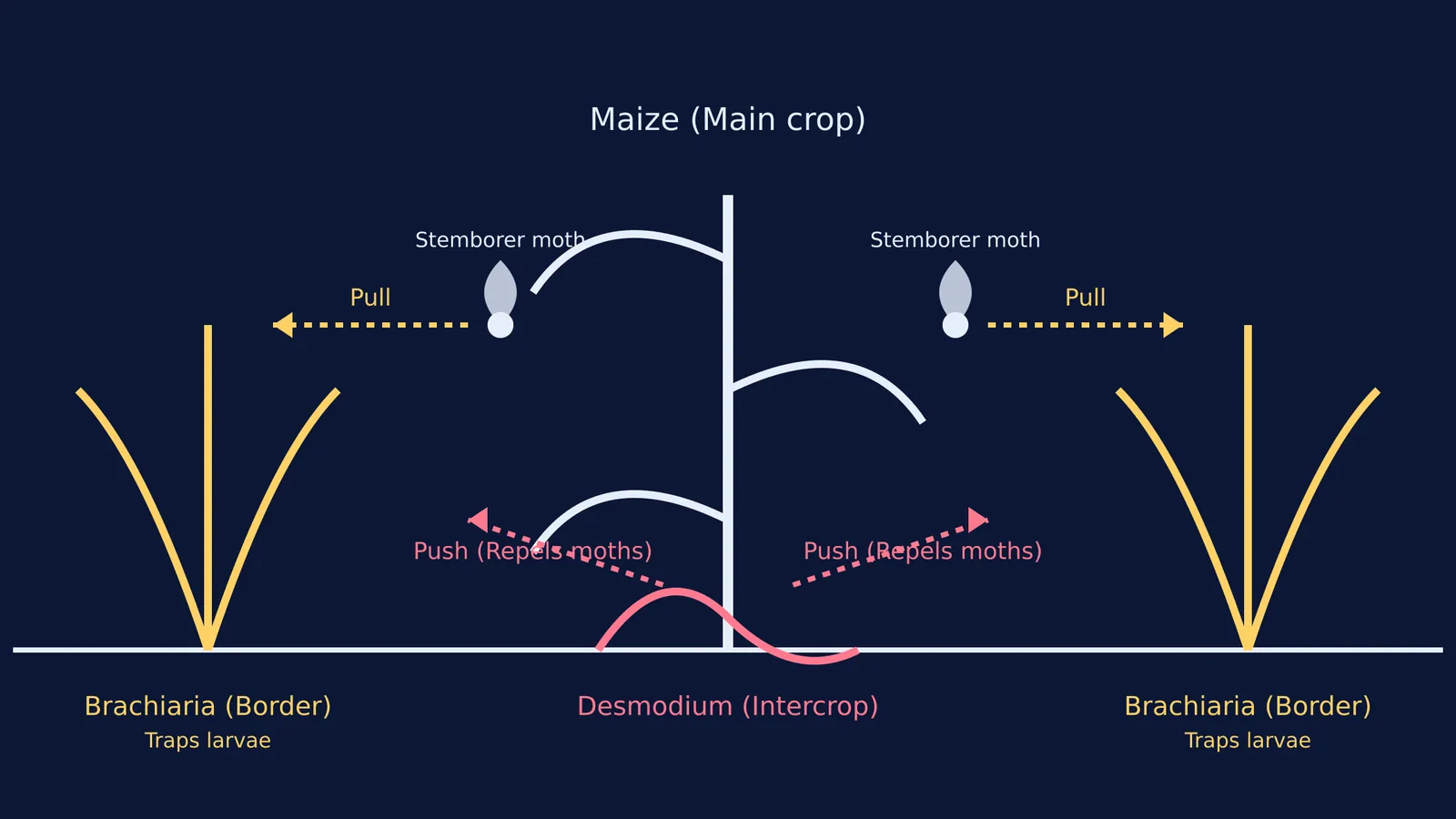
Farmers plant a legume called *Desmodium* between the rows of maize. *Desmodium* emits volatile chemicals that repel stemborer moths, effectively "pushing" them away from the crop. At the same time, its roots exude chemicals that cause "suicidal germination" of the parasitic *Striga* weed, clearing it from the soil.
Farmers also plant *Brachiaria* or Napier grass around the border of the field. This grass emits chemicals that are highly attractive to the moths, "pulling" them in to lay their eggs. When the larvae hatch on the trap plants, they produce a sticky gum that traps and kills the insects.
According to the Push-Pull Network, over 33,600 smallholder farmers in sub-Saharan Africa have adopted this technology. They report a 7% average yield improvement in cereal crops. The border grasses also provide excellent fodder for livestock, leading to better milk production, while the *Desmodium* improves soil fertility by fixing nitrogen and acting as a natural mulch.
How can we study biological systems like push-pull?
When preparing for exams like NEET-UG, students often try to memorise isolated facts, such as the name of a pest or a single plant trait. Kelemu's work shows that ecology is about relationships. Here is a three-step checklist to understand any biological system:
Identify the actors: List the crops, pests, weeds, and microscopic partners (like the endophytes in *Brachiaria*).
Trace the signals: Ask what connects them. In the push-pull system, volatile chemicals act as the messengers that repel (push) or attract (pull) insects.
Follow the nutrients: Notice how resources move. *Desmodium* fixes nitrogen from the air into the soil, feeding the entire system.
If you struggle to picture how these complex relationships fit together, Fermi's AI tutor can build a plan for the session, helping you map out food webs, symbiosis, and nutrient cycles step by step.
Instead of reading passively, test your understanding. You can use the Fermi Concept Library to explore topics like nitrogen fixation and symbiosis from first principles, ensuring you see the whole picture before exam day.


