

On this page
We rely on broad-spectrum chemical pesticides to protect crops, but these chemicals often kill the beneficial predators and pollinators that farms need. Worse, synthetic chemicals concentrate in the food chain, a danger explained in our guide to biological magnification: how pesticides build up, Class 10. In biological pest control, scientists instead look for natural enemies that target only the pest, leaving the rest of the ecosystem intact.
The baculoviruses, specifically the genus *Nucleopolyhedrovirus* (NPV), are a group of viruses that infect and kill insects, primarily the caterpillars of moths and butterflies. They are a textbook example of how understanding viruses, viroids and lichens: the misfits of five-kingdom biology can solve real-world agricultural problems.
How does a nucleopolyhedrovirus kill an insect?
The virus particles of an NPV are encased in a protective protein crystal called an occlusion body. When a farmer sprays a field with the virus, these crystals coat the leaves, waiting for a host.
When a caterpillar eats the leaf, the crystals enter its midgut. A caterpillar's gut is highly alkaline, and this specific environment dissolves the protective protein to release the virus particles. The virus invades the gut cells and begins to replicate, eventually spreading to almost every tissue in the insect's body.
As the virus multiplies, it actively changes the insect's behaviour. The caterpillar stops eating and climbs to the top of the plant, a symptom known as "tree top disease" or *Wipfelkrankheit*. Once it reaches the top, the caterpillar dies, and its body liquefies. This melts the insect over the leaves below, releasing vast numbers of new occlusion bodies to infect other caterpillars feeding lower down.
If you struggle to picture how a virus enters a cell and hijacks its machinery, the Fermi Concept Library has interactive lessons on viral replication and host interactions.
Why are narrow-spectrum viruses better than chemicals?
The greatest strength of an NPV is its extremely narrow host range. Chemical pesticides kill indiscriminately, but a nucleopolyhedrovirus often targets only a single species or a closely related group of species.
A 2020 field study investigated a specific nucleopolyhedrovirus strain acting against the jute hairy caterpillar (*Spilosoma obliqua*). The researchers found that the virus reduced the caterpillar population by 93.16% in just seven days. Crucially, they tested the virus against eleven other species of caterpillars, including the silkworm, and it failed to infect any of them (DOI: 10.1186/s41938-020-00282-5).
This high specificity means NPVs are completely safe for humans, birds, fish, and beneficial insects like bees and ladybirds. You can spray a field and know that only the pest will suffer.
How do farmers protect the virus from sunlight and heat?
While NPVs are incredibly effective, they are living biological agents that face environmental limits. Their biggest vulnerabilities in the field are ultraviolet (UV) light from the sun and high temperatures, both of which can degrade the viral DNA and render it harmless.
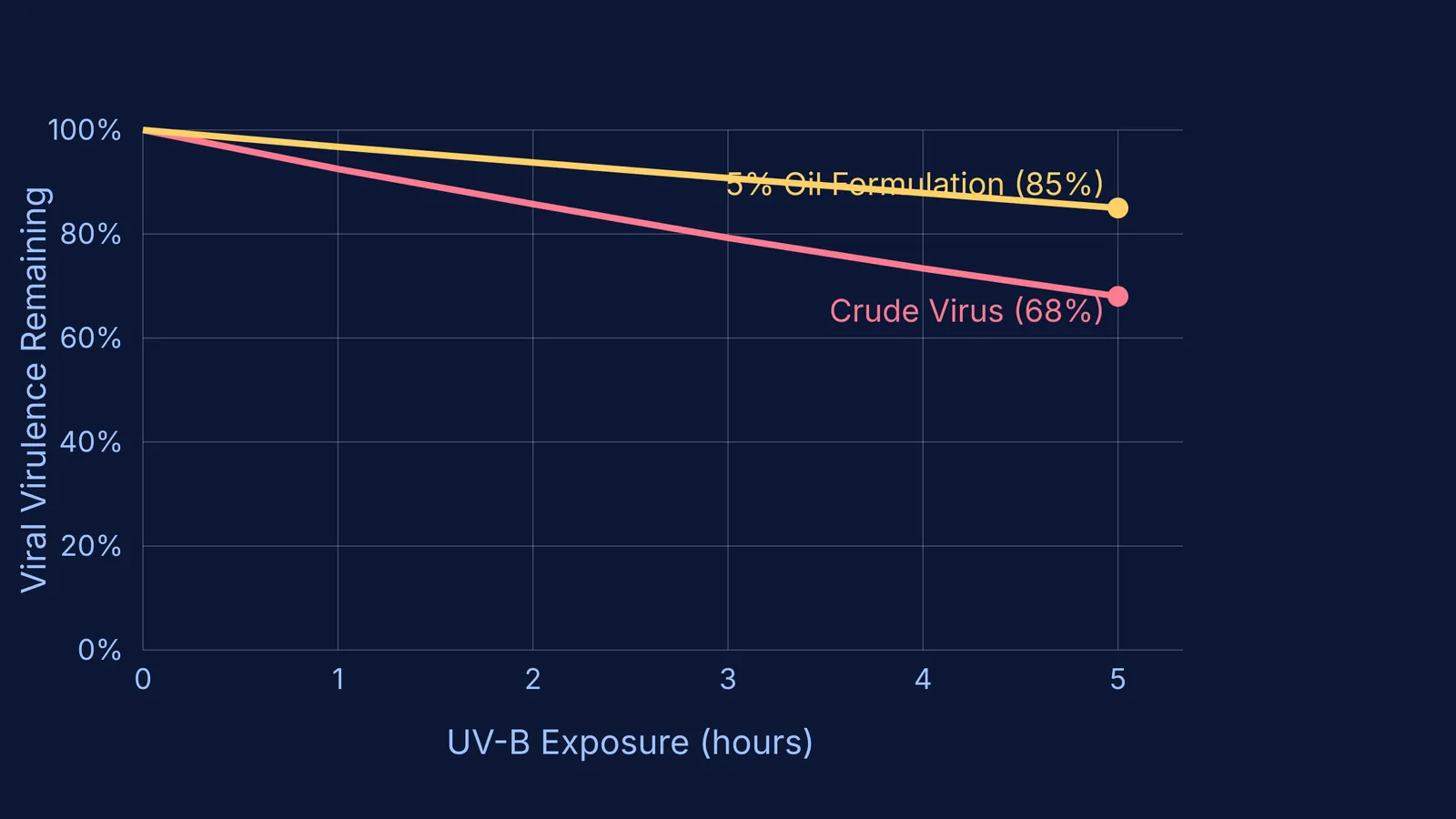
To fix this, researchers engineer protective formulations, such as mixing the virus with specific oils, to shield it on the leaf.
When exposed to five hours of UV-B light, an unprotected nucleopolyhedrovirus lost 32% of its virulence. However, applying a 5% oil-based formulation reduced this loss to just 15%. The same study tested heat tolerance: at 42 °C, the crude virus lost 70% of its virulence, while the oil formulation lost only 10% (DOI: 10.1186/s41938-022-00552-4).
By studying the exact conditions that viruses need to survive—a topic you will encounter when reviewing biological classification for NEET: the five kingdoms compared—scientists can engineer better ways to deliver them, turning a fragile virus into a reliable agricultural tool.
How do you apply biological control agents?
Because NPVs are living organisms rather than simple chemicals, they require careful and specific handling to work effectively. If you are studying agricultural science or simply managing a large garden, you must keep these rules in mind:
Apply at dusk: Because UV light degrades the virus, spraying in the late afternoon gives the virus the entire night to be ingested by feeding caterpillars before the sun rises.
Target early instars: Young caterpillars are much more susceptible to the virus than older, larger ones. The dosage required to kill a fully grown caterpillar can be exponentially higher.
Check the pH: The water used in the spray tank should be neutral or slightly acidic. Highly alkaline water can dissolve the protective occlusion bodies prematurely, killing the virus in the tank before it ever reaches the insect.
Store in the dark: Always keep the formulation refrigerated and away from direct light to maintain its shelf life over the growing season.


