

On this page
Every time a doctor wraps a cuff around your upper arm and pumps it up, they are using an idea published in Turin in 1896. Scipione Riva-Rocci did not invent the idea of blood pressure, but he made measuring it simple, painless and repeatable. This post covers who he was, how his cuff works, the physics behind "millimetres of mercury", and a worked example that converts a reading into pascals.
Who was Scipione Riva-Rocci?
The Dizionario Biografico degli Italiani entry by Valentina Cani) records that he was born on 7 August 1863 in Almese, near Turin, the son of the village doctor. He graduated in medicine and surgery from the University of Turin in 1888 and became a student and then assistant in the clinic of Carlo Forlanini, where he studied breathing and Forlanini's new treatment for tuberculosis.
In 1896 he published "Un nuovo sfigmomanometro" (A new sphygmomanometer) in the Gazzetta medica di Torino. In 1898 he followed Forlanini to Pavia, where he later taught paediatrics, and from 1900 to 1928 he also worked at the hospital in Varese. He died in Rapallo on 15 March 1937.
What problem did his cuff solve?
People had been measuring blood pressure for more than a century, but not easily. A history by Ariel Roguin in the International Journal of Clinical Practice traces the steps: Stephen Hales made the first invasive measurements in horses in the mid-1700s; Poiseuille introduced the mercury instrument and mm Hg units in the early 1800s; Karl von Vierordt showed in 1855 that enough outside pressure could stop the arterial pulse; and von Basch built a sphygmomanometer in 1881. Riva-Rocci's 1896 mercury sphygmomanometer was, in Roguin's words, "almost as we know it today".
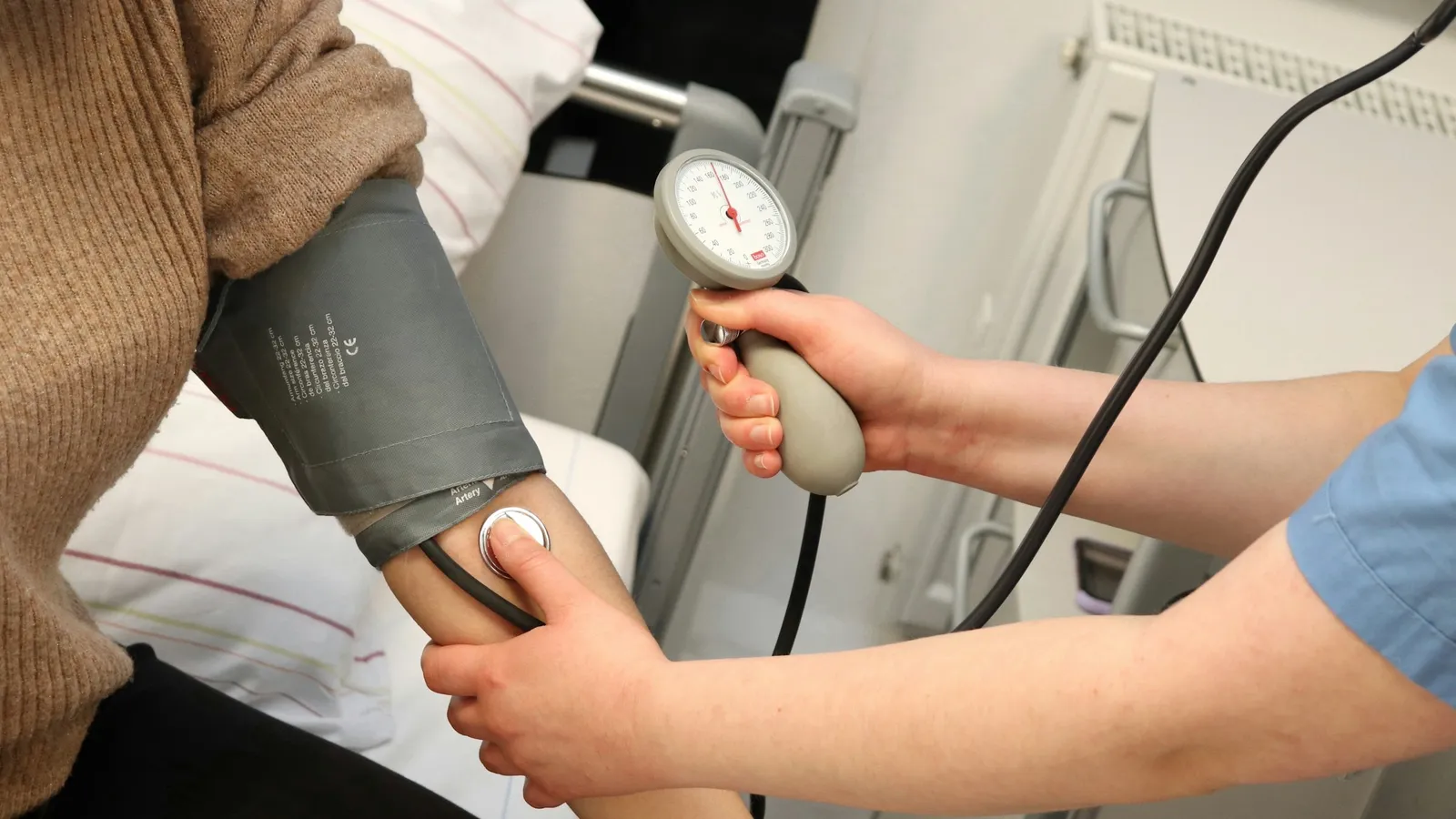
A 2024 review in Cureus describes his design. The cuff was made from a bicycle inner tube about 4 to 5 cm wide, wrapped in strong fabric on the outside so it could only expand inward. It went around the upper arm rather than the wrist. Rubber bulbs pumped air into it until the pulse at the wrist could no longer be felt, and a mercury column showed the pressure at that moment.
The Treccani entry adds that the method was painless for the patient. In 1901 the American surgeon Harvey Cushing saw the instrument in Pavia, recognised its potential to reduce deaths linked to anaesthesia, especially in brain surgery, and helped spread it across the Atlantic.
How does a cuff measure pressure in an artery?
The cuff squeezes the main artery of the upper arm. While the cuff pressure is higher than the highest pressure the heart produces in that artery, blood cannot get through and the pulse below disappears. As the cuff is let down, blood starts to spurt through at the moment cuff pressure drops just below that peak. That peak is the systolic pressure.
Roguin notes that feeling for the pulse only gave the systolic value reliably. In 1905 the surgeon Nikolai Korotkoff, speaking to military doctors in St Petersburg, described listening to the artery under the cuff with a stethoscope and reported that sounds appear at the systolic pressure and fade at the diastolic pressure. Cuff plus stethoscope is the method many clinics still use.
Your NCERT Class 11 biology chapter, Body Fluids and Circulation, gives 120/80 mm Hg as normal, with 120 the systolic and 80 the diastolic pressure, and says that repeated readings of 140/90 or higher indicate hypertension. Our guide to body fluids and circulation covers the rest of that chapter.
Worked example: what does 120 mm Hg mean in pascals?
The NCERT Class 11 physics chapter Mechanical Properties of Fluids gives the gauge pressure as P − Pa = ρgh and says that a pressure of 1 mm of mercury (1 torr) is 133 Pa.
Method 1, using the conversion factor. 120 × 133 Pa = 15,960 Pa, or about 16.0 kPa.
Method 2, using ρgh. Take the density of mercury as 13.6 × 10³ kg/m³ (specific gravity 13.6), g = 9.8 m/s² and h = 120 mm = 0.120 m.
ρg = 13,600 × 9.8 = 133,280
ρgh = 133,280 × 0.120 = 15,993.6 Pa, again about 16.0 kPa.
The two answers differ by about 34 Pa only because 133 is a rounded figure.
For the diastolic value: 80 × 133 Pa = 10,640 Pa, about 10.6 kPa.
Why mercury and not water? The same pressure needs a column 13.6 times taller in water: 120 mm × 13.6 = 1,632 mm, about 1.63 m. A mercury column fits on a desk. A water column would be taller than many students.
What mistakes do students make in these problems?
Forgetting it is gauge pressure. The absolute pressure in the artery is atmospheric pressure (about 1.01 × 10⁵ Pa) plus about 16 kPa, roughly 117 kPa.
Leaving h in millimetres. In ρgh, h must be in metres: 120 mm is 0.120 m.
Using 13.6 as the density. 13.6 is the specific gravity. The density is 13.6 × 10³ kg/m³.
If a pressure problem goes wrong and you cannot see where, the Fermi Problem Library has a step-by-step solver that explains the reasoning, so you can find the exact step where the units slipped. For more practice, try our set of hydrostatic pressure problems.
This post is about history and physics. A blood pressure reading on its own says little, and any question about your health belongs with a doctor.
What can a student take from how Riva-Rocci worked?
Build on what exists. His cuff combined earlier ideas, from Vierordt's pulse-stopping pressure to the mercury column, into one simple instrument.
Make it easy to repeat. A method that is painless and quick gets used, and a method that gets used produces data.
Leave room for the next person. Korotkoff's sounds completed what Riva-Rocci's touch could not.
Next step: solve one ρgh problem tonight with h given in millimetres, and convert the answer to kPa both ways shown above.


