

On this page
In 1943, Nobel Prize-winning physicist Erwin Schrödinger delivered a series of lectures in Dublin. He asked a question that was then a profound mystery: how can the events in space and time within a living organism be explained by physics and chemistry? At the time, the chemical nature of the gene was entirely unknown.
When published as the book *What is Life? The Physical Aspect of the Living Cell* in 1944, his work became a historic bridge between disciplines source. It drew a generation of physicists into genetics and laid the conceptual groundwork for molecular biology.
What is an aperiodic crystal?
Schrödinger argued that the hereditary material had to satisfy two contradictory rules. First, it had to be stable enough to survive the constant thermal chaos of the microscopic world. Second, it had to store a vast amount of information.
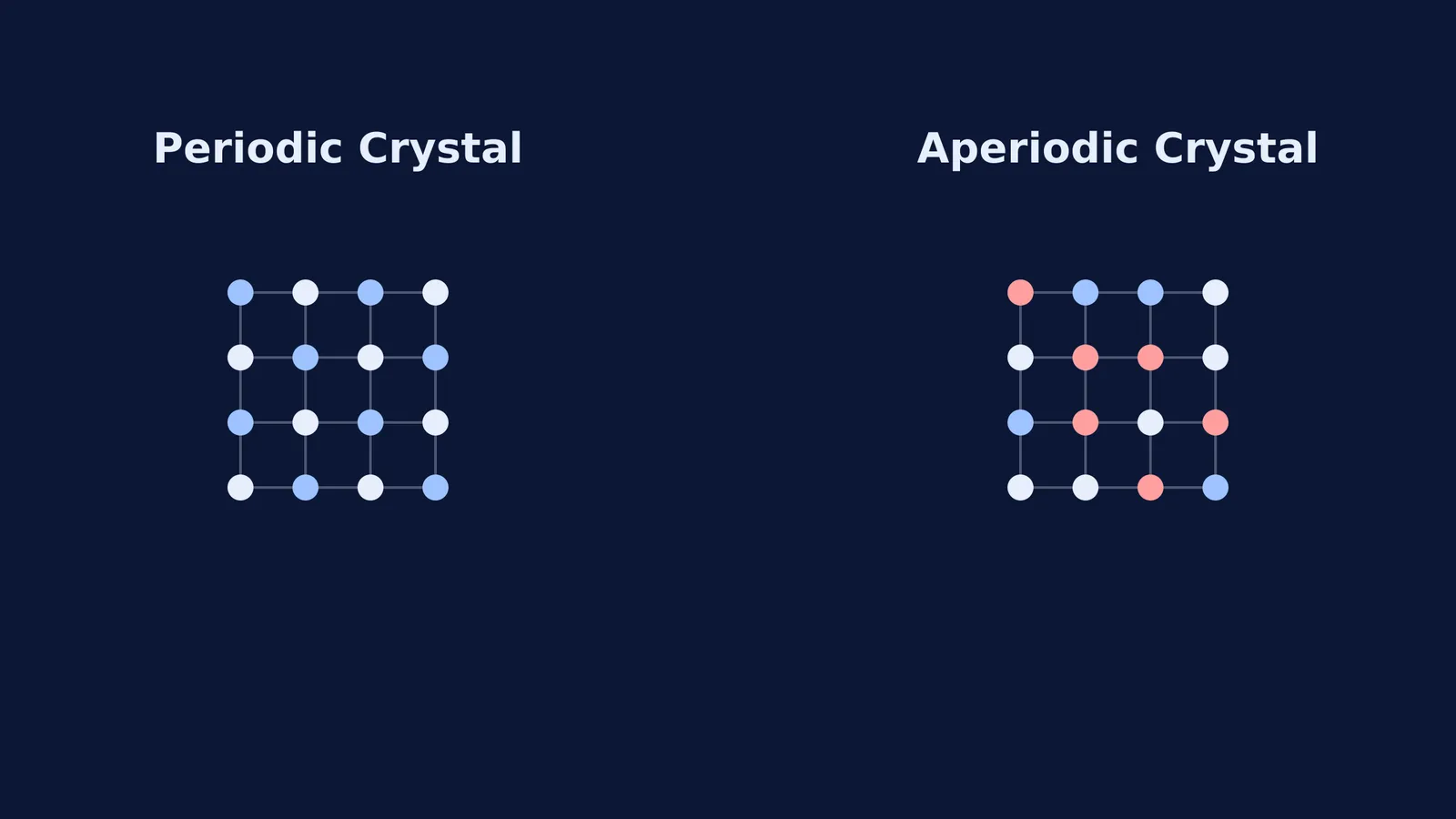
He proposed that the gene was a large molecule with a regular but non-repeating structure, which he called an "aperiodic crystal". He compared a normal, periodic crystal (like salt or diamond) to wallpaper, where the same pattern repeats endlessly and carries very little information. An aperiodic crystal, however, is like a masterpiece of embroidery. Its lack of repetition allows it to function as a "code-script", holding the exact instructions for an organism's development in its specific sequence of atoms.
How did Schrödinger influence Watson and Crick?
*What is Life?* acted as an intellectual catalyst. There is no doubt that James Watson and Francis Crick, who co-discovered the structure of DNA in 1953, were inspired to turn to biology by the general thrust of Schrödinger's work source.
Crick, originally a physicist, was inspired to apply the rigorous principles of physics to biology. The Dublin Institute for Advanced Studies even holds a 1953 letter from Crick to Schrödinger acknowledging the influence of his book and the aptness of his term "aperiodic crystal" source.
The DNA double helix perfectly fulfilled Schrödinger’s theory. Its sugar-phosphate backbone gave it the physical stability of a crystal, and the non-repeating sequence of its four bases provided the information-carrying code-script. You can see how these rules appear in modern exam questions by reviewing Assertion-reason traps on replication, genetic code and operons.
What did he mean by negative entropy?
Schrödinger also explored how living things maintain their highly ordered states without violating the Second Law of Thermodynamics, which dictates that closed systems naturally tend toward disorder, or entropy.
He argued that life operates on a principle of "order from order". To avoid decaying into thermodynamic equilibrium (which is death), a living organism feeds on "negative entropy" from its environment through metabolism source. It extracts highly ordered nutrients, uses their energy, and releases degraded, high-entropy waste (like heat). While modern biologists use terms like free energy, his fundamental insight that life is a continuous physical struggle to preserve order remains a core principle of biochemistry. This perspective shifted how scientists viewed digestion and respiration—not just as fueling the body, but as an ongoing battle against physical decay.
How can you use physical models in biology?
Schrödinger's breakthrough came from applying the mental models of one discipline (quantum mechanics) to another (heredity). Other scientists achieved similar leaps, such as How Alan Turing's maths explained animal coat patterns. You can apply this cross-disciplinary, active-learning habit to your own studies:
Look for the physical limit: Ask why a biological process has an upper bound. For example, why do single cells divide rather than growing infinitely large? The answer lies in the physical constraints of surface-area-to-volume ratios and diffusion rates.
Track the energy: In biochemistry, follow where the energy comes from and where it goes. Every active transport mechanism or enzyme reaction obeys strict thermodynamic rules. This is similar to How to learn physics from first principles, not formulas.
Focus on the information: Modern biology is a science of information transfer. When studying genetics, trace exactly how the sequence code moves from DNA to RNA to protein, and ask how mutations physically alter that code.
If you struggle to picture how these abstract physical rules govern tiny biological structures, the Fermi Concept Library has every concept in physics, chemistry, biology, mathematics and computing, each with its own lesson and its place in the map. Seeing how these disciplines connect is the fastest way to turn rote memorisation into genuine understanding, just as Schrödinger did when he looked at a biological cell and saw a physical code.


