

On this page
In the early 1950s, most geneticists took it for granted that genes lived on chromosomes inside the nucleus. Ruth Sager, working with a single-celled green alga in New York, found a trait that would not follow that rule. It passed to offspring from one parent only, and that odd pattern became one of the strongest early cases for a second genetic system inside the cell.
Who was Ruth Sager?
Sager was born in Chicago on 7 February 1918 and earned her PhD in maize genetics at Columbia University in 1948 under Marcus Rhoades, according to the National Academy of Sciences biographical memoir by Arthur B. Pardee. From 1949 she worked at the Rockefeller Institute, first with Sam Granick on the chloroplast, and there she chose the alga Chlamydomonas reinhardi as her model organism.
The memoir explains the choice: the alga has a chloroplast and a sexual life cycle, grows quickly, and its growth and mating are easy to control in the lab.
What did Ruth Sager discover in Chlamydomonas?
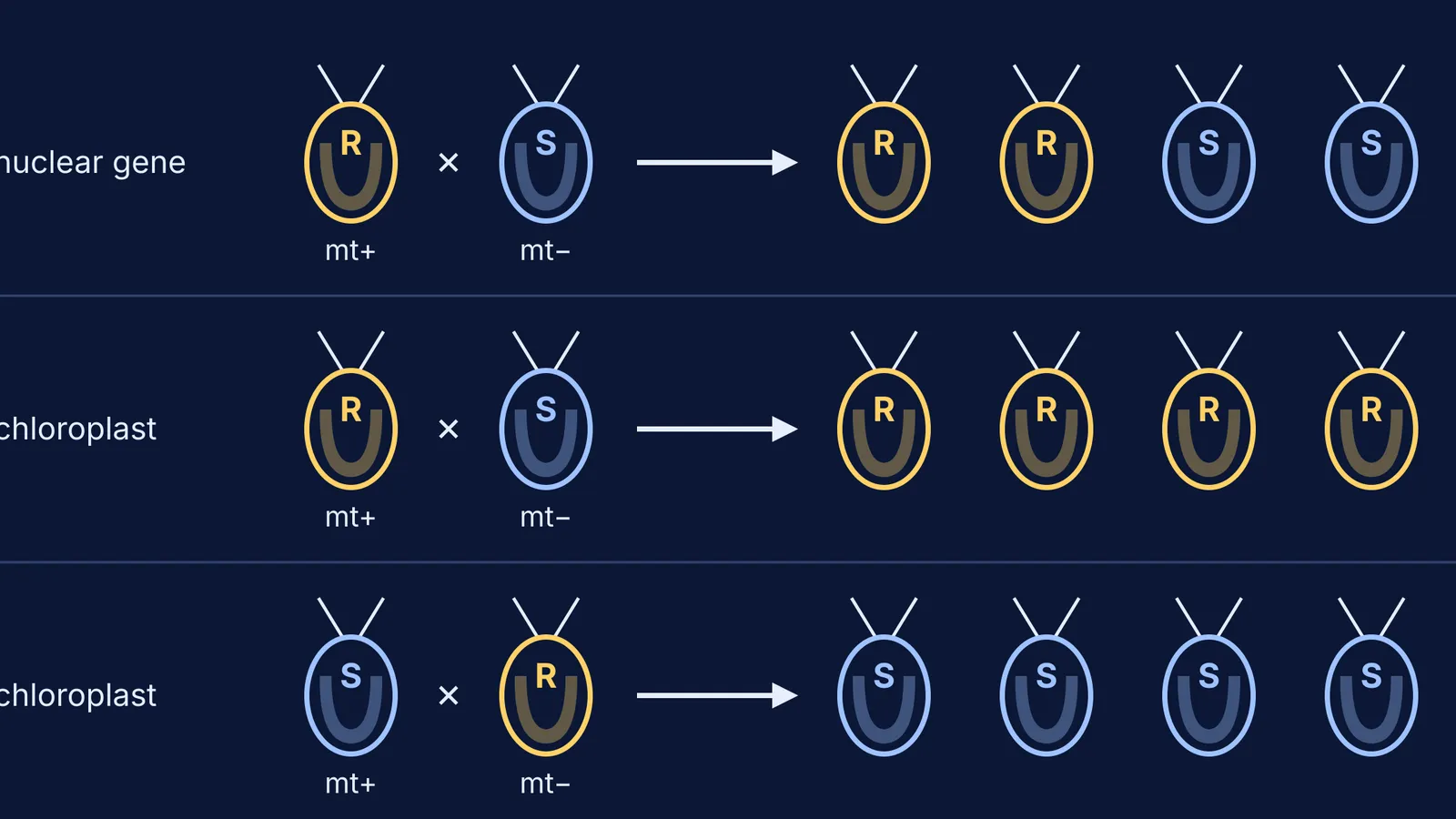
She grew the alga on streptomycin, an antibiotic, and picked out resistant mutants. Her 1954 paper, Mendelian and non-Mendelian inheritance of streptomycin resistance in Chlamydomonas reinhardi, described two kinds of hereditary factor. One was inherited the ordinary Mendelian way. The other, as the Encyclopedia.com profile of Sager puts it, "always came from only one of the parents."
That should not happen to a nuclear gene. Ordinary Chlamydomonas cells are haploid, so in a cross each parent brings one copy of every chromosome, and meiosis sorts them so that half the products get each parent's version. A trait that appears in every offspring when one parent carries it, and in none when only the other parent does, is not riding on a chromosome.
The Pardee memoir credits Sager and her long-time collaborator Zenta Ramanis with a "clear demonstration of the maternal inheritance pattern" of these non-Mendelian traits. With Y. Tsubo, she also found that streptomycin itself creates mutations in these "cytoplasmic" genes.
Why did one-parent inheritance point to genes outside the nucleus?
If the nucleus behaves fairly and the trait still does not, something else in the cell must carry it. The memoir notes that non-nuclear genes had been "proposed in 1908 from observations on higher plants," yet a large part of the scientific community doubted they existed. Sager, it says, "gathered data and argued in support of a second genetic system in the face of great skepticism." For background, read how Sutton and Boveri tied Mendel's laws to chromosomes.
The obvious suspect in a green alga was its chloroplast. Others had shown that isolated chloroplasts can release oxygen on their own; Sager asked whether they carry their own genes too.
How was chloroplast DNA finally shown?
In 1963 Sager and M. R. Ishida published Chloroplast DNA in Chlamydomonas in PNAS. According to the Pardee memoir, they found a distinct DNA in isolated chloroplasts, and "this was the evidence that convinced most scientists that there is indeed a separate non-nuclear organelle genetic system." Her group went on to map chloroplast genes and showed that chloroplast DNA is circular.
Modern work explains the one-parent pattern she saw. A 2022 Nature Communications study by Joo and colleagues notes that, in crosses of haploid plus and minus gametes, the chloroplast DNA of the plus parent is passed to the offspring, and that earlier experiments showed chloroplast DNA in the minus parent's chloroplast is selectively degraded within 1 to 2 hours after the two cells fuse.
The work cost her. The memoir records that for 20 years, until the age of 48, she could not get a faculty position. "I guess I knew I was right, and I wasn't terribly upset," she said. She was elected to the National Academy of Sciences in 1977, later moved into cancer genetics and the study of tumour suppressor genes, and died on 29 March 1997.
How can you tell if a trait is nuclear or extranuclear?
Use the reciprocal cross, the move shown in the diagram above:
Cross a resistant plus strain with a sensitive minus strain. Count the resistant and sensitive offspring.
Now reverse it: a sensitive plus strain with a resistant minus strain. Count again.
If both crosses give a mix, half and half from each meiosis, the gene is nuclear and Mendelian.
If every offspring matches the plus parent in both crosses, whatever trait it carries, the gene travels with an organelle.
Check yourself: a trait appears in all offspring of cross 1 and none of cross 2. Could it be a dominant nuclear allele? No. That would show up in half the offspring of both crosses, so dominance cannot explain an all-or-nothing switch.
For the basics, revisit Mendel's experiments in Class 10 heredity. The Fermi Concept Library gives every biology concept its own lesson and its place in the map, so you can see where cytoplasmic inheritance sits beside Mendel's laws. If you are not sure where your gap is, Fermi's AI tutor works out what you already know and builds a plan for the session.
Next time a cross gives a result that ignores dominance, ask Sager's question: which parent did it come from?


