On this page
Ruđer Bošković (often written Roger Joseph Boscovich) was born in Dubrovnik on 18 May 1711 and studied at the Collegium Romanum in Rome, according to his MacTutor History of Mathematics biography. In 1758 he published Theoria philosophiae naturalis, a book that tried to explain every natural phenomenon with one law of force acting between atoms. Its single wavy curve will look familiar from chemical bonding.
What did Ruđer Bošković's atomic theory say?
First, atoms have no size. A 1981 study by K. Umenaga, quoted in the MacTutor biography, says Bošković "assumed point-atoms in opposition to hard, extended atoms". The Linda Hall Library's profile of Boscovich says he proposed that an atom is a dimensionless point, surrounded by forces that alternately attract and repel other atoms. It notes the book appeared in Vienna in 1758 and again in Venice in 1763.
Second, one force law connects every pair of points. In Article 10 of the book, in J. M. Child's 1922 English translation of the 1763 edition (reproduced by ChemTeam), Bošković writes that "the forces are repulsive at very small distances, & become indefinitely greater & greater, as the distances are diminished indefinitely". As the distance grows, the force falls to zero, turns attractive, then repulsive again, "& so on, in turn, for a very great number of distances, which are all still very minute". At larger distances the force becomes "continually attractive & approximately inversely proportional to the squares of the distances", which is Newton's gravity.
In the same article he says this repulsion can destroy any velocity with which one point approaches another before the distance vanishes. So points never touch, and hardness comes from force, not from solid little balls.
How do you read the Bošković force curve?
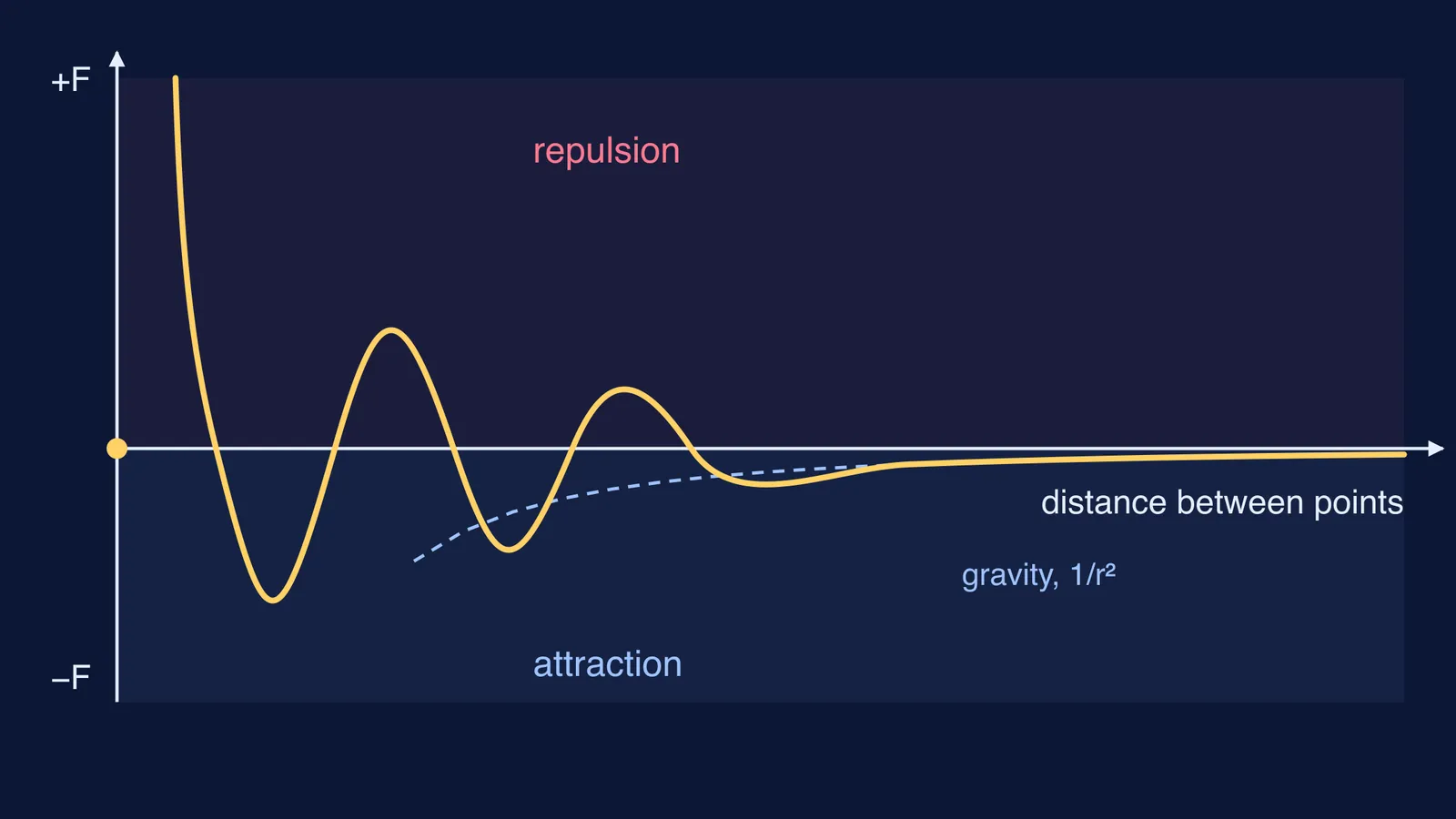
The diagram above sketches the shape he described. Distance runs along the horizontal axis; above it the force is repulsive, below it attractive. Read it left to right:
Near zero distance the curve shoots upward, so points cannot meet.
It falls through the axis. Bošković calls such a crossing a "limit-point for attractions and repulsions" (Article 78).
It swings below and above the axis again and again. He allowed a very great number; the diagram shows five. In Article 79 he links these zones to cohesion, elasticity and vapour.
Far out, it follows the dashed 1/r² gravity curve, weakening but never reaching zero.
How do you find the stable balance points?
At every limit-point the force is zero, so two points could rest there. Test each crossing:
Push the points slightly closer. If the force there is repulsive, they are pushed back out.
Pull them slightly apart. If the force there is attractive, they are pulled back in.
Both yes means stable. A crossing the other way, from attraction to repulsion, is unstable: any nudge grows.
On the diagram, the first, third and fifth crossings are stable; the second and fourth are unstable. Bošković argued along these lines about wax in Article 79: pull the front of a soft solid and the part behind follows; push it and the part behind recedes. That, he said, cannot happen unless there are limit-points at all those distances.
Potential energy curves in your textbooks use the same logic. Force is the negative slope of potential energy (F = −dU/dr), so a stable zero of force sits at the bottom of a valley in U. Our explainer on reading potential energy curves for force and equilibrium works through that version, and the potential energy curve of H2 shows the one valley that sets bond length and bond energy.
Was Bošković right about atoms?
Partly. Atoms are not points, and the forces between them are electrical, not one law shared with gravity. But steep short-range repulsion, a zone of attraction and a stable spacing where force is zero is still how interactions between atoms are sketched.
The Umenaga passage quoted by MacTutor says the theory's influence "was wide in the eighteenth and nineteenth centuries especially in Britain". Michael Faraday's 1844 paper A speculation touching electric conduction and the nature of matter, in the Philosophical Magazine, said that "the atoms of Boscovich appear to me to have a great advantage over the more usual notion" (quoted in this account of the paper). The Linda Hall profile adds a caution: more recent scholarship has downplayed how much Faraday owed to Bošković.
The curve is still being studied. A 2026 paper in Physchem by Vincenzo Villani (doi:10.3390/physchem6030053) reinterprets the Boscovich curve as a mean-field potential for particles in condensed matter, and validates the method on liquid argon and face-centred cubic lattices.
If going from force to energy still feels slippery, the Fermi Simulation Lab has interactive simulations for ideas that are easier to see than to read.
To compare Bošković's force-filled points with the indivisible atoms that came later, read our piece on John Dalton's atomic theory.