

On this page
When two isolated hydrogen atoms drift towards each other, their potential energy changes. Initially, they are too far apart to interact, and the system's energy is defined as zero. As they move closer, a tug-of-war begins between attractive and repulsive forces, ultimately settling into a highly stable state—a covalent bond.
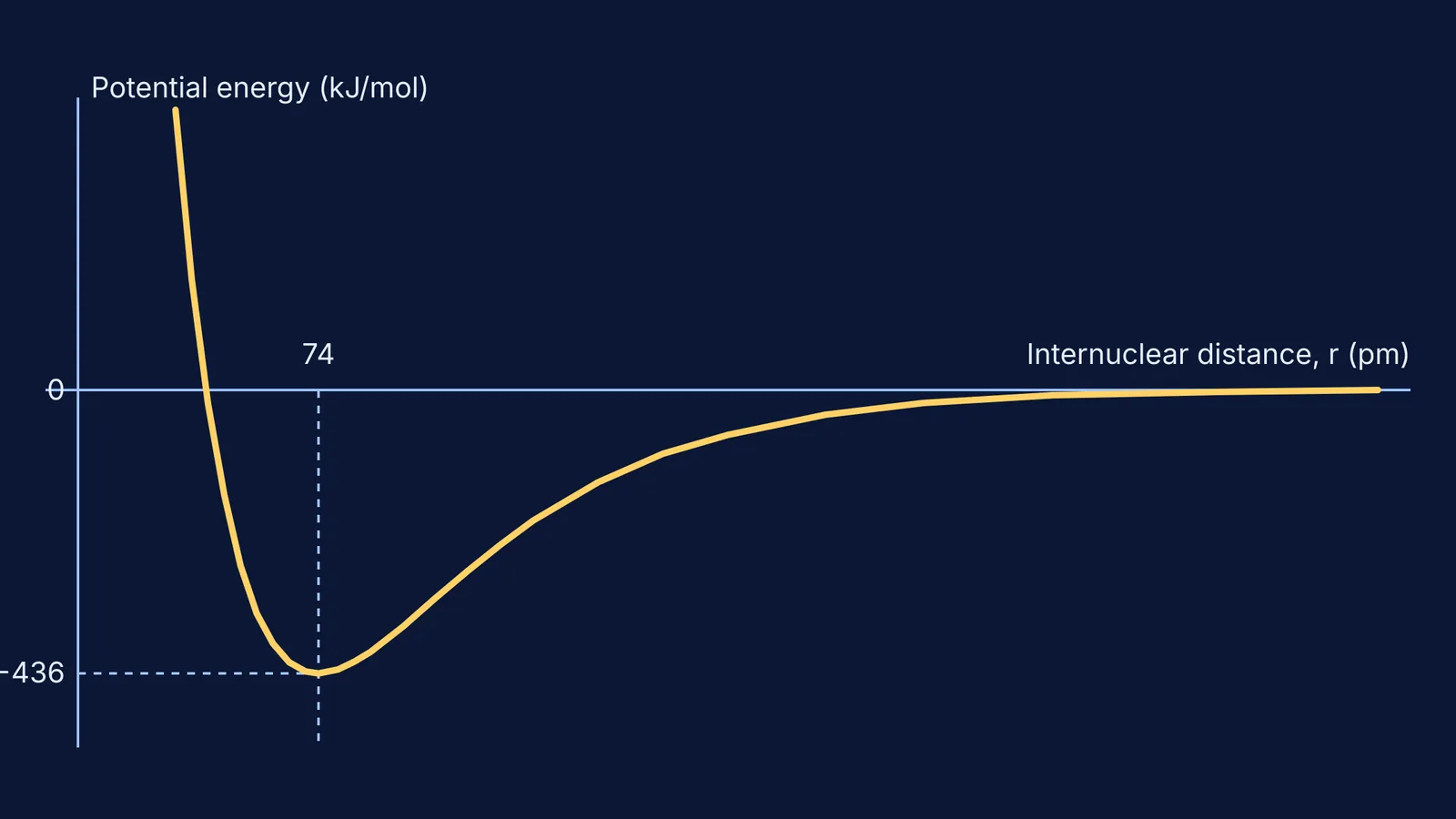
Plotting this energy against the distance between the nuclei gives the potential energy curve. For the hydrogen molecule (H₂), this curve dips to a deep minimum before rising sharply. Valence Bond Theory (VBT) uses this curve to explain exactly how and why covalent bonds form. You can explore its place in the map in the Fermi Concept Library.
Why does the potential energy of H2 change?
As two hydrogen atoms approach, their electron clouds begin to interact, and two competing sets of electrostatic forces come into play:
Attractive forces: The positively charged nucleus of each atom begins to pull on the negatively charged electron of the other atom. Because the atoms are getting closer, the electron density between the two nuclei increases. This attraction brings the atoms together and lowers the potential energy of the system, making it more stable.
Repulsive forces: At the same time, the two positive nuclei repel each other, and the two negative electrons repel each other.
At large distances, the attractive forces dominate, pulling the atoms inwards. But as the atoms get very close, the electrostatic repulsion between the two nuclei shoots up. Furthermore, the Pauli exclusion principle dictates that electron clouds cannot overlap heavily unless the electrons have opposite spins. This causes the repulsive forces to skyrocket at short distances. The steep rise in potential energy acts as an impenetrable wall, pushing the atoms apart.
How does the potential energy curve explain the formation of the H2 molecule?
The delicate balance between attraction and repulsion creates a distinct "well" in the potential energy graph. We can trace the formation of the H₂ molecule through four distinct regions on the curve:
At infinite distance: The atoms are entirely separate and do not interact. The potential energy is zero.
The descent: As the atoms approach, the attractive forces take over. The 1s orbitals of the two hydrogen atoms begin to overlap, provided their electrons have opposite spins. The potential energy becomes negative, and the curve drops into a well. (For more on how electron clouds merge, see Sigma and pi bonds: orbital overlap and why pi bonds are weaker).
The minimum: The attractive and repulsive forces exactly cancel each other out at the bottom of the well. This is the most stable state of the system, and it marks the formation of the H₂ molecule. The atoms are locked in a stable tug-of-war.
The steep wall: If the atoms are pushed closer than this minimum point, nuclear and electronic repulsion dominate. The energy rises rapidly towards positive values, destabilising the system.
If you find it difficult to picture how forces shift as atoms move, the Fermi Simulation Lab has interactive simulations for the ideas that are easier to see than to read.
What are bond length and bond energy on the potential energy curve?
The coordinates of the lowest point on the curve give us two fundamental properties of the H₂ molecule.
The horizontal position (internuclear distance) at the minimum is the bond length. For hydrogen, this equilibrium bond length is exactly 74.14 pm. At this distance, the atoms vibrate back and forth in the bottom of the potential well, holding the molecule together. It is the perfect distance where orbital overlap is maximised without triggering massive repulsion.
The vertical depth of the well represents the bond dissociation energy. For the H₂ molecule, the potential energy at the minimum is −435.7 kJ/mol. This means you must supply 435.7 kJ of energy to one mole of H₂ to climb out of the well and separate the bonded atoms entirely back into isolated hydrogen atoms.
This energy minimum is why chemical reactions happen: physical systems always tend towards lower, more stable energy states. When you are using these thermodynamic values to calculate the heat of a larger chemical reaction, the Fermi Problem Library has worked problems with a step-by-step solver that explains the reasoning rather than printing an answer. Or, you can read more about how to use these numbers in practice in Bond enthalpies: estimating reaction enthalpy and knowing its limits.


