

On this page
Have you ever looked at a tiled floor and noticed how the pattern repeats? Whether it is a grid of squares on a chessboard or the hexagonal wax cells of a honeycomb, standard tilings are periodic. If you take a copy of the pattern and shift it in a straight line, it will eventually overlap perfectly with the original.
For centuries, mathematicians and crystallographers believed that all highly ordered structures had to repeat in this way. That changed when Roger Penrose began playing with shapes in the 1970s, proving that order does not always mean repetition.
What makes a Penrose tiling a non-repeating pattern?
A Penrose tiling is a way of covering an infinite flat plane with shapes such that the pattern is aperiodic, meaning it never repeats by translation source. You can search the entire infinite plane, and you will never find the exact same arrangement of tiles repeating in a periodic grid.
The tiling also displays a "forbidden" five-fold rotational symmetry. If you rotate a large patch of a Penrose tiling by 72 degrees (one-fifth of a full circle), the overall pattern looks statistically identical, even though no two regions are exactly the same.
John Conway and the Game of Life on a grid is another example of simple mathematical rules generating endless complexity, but Penrose tilings achieve their complexity purely through geometry.
How do the kite and dart tiles work?
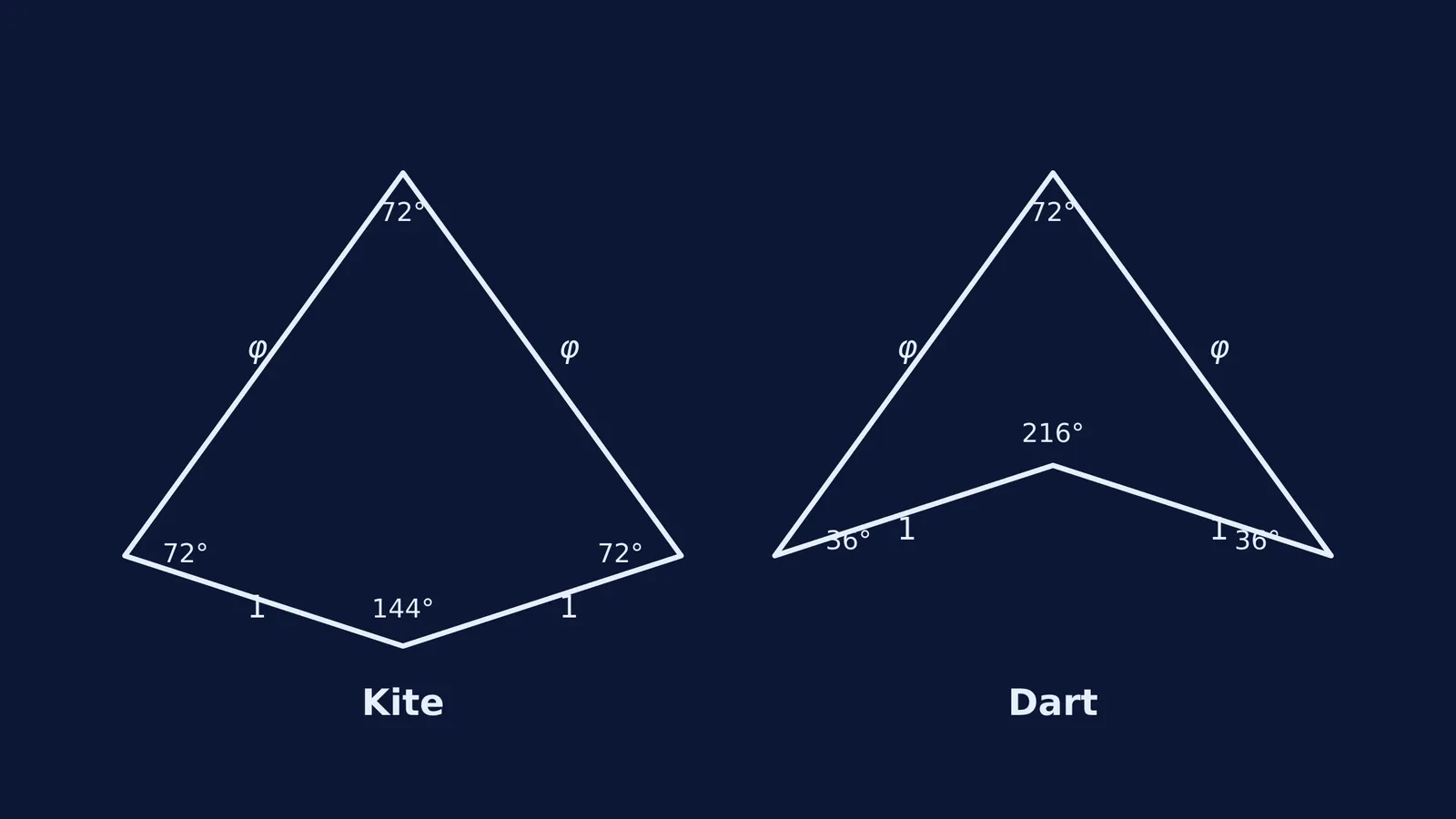
While Penrose's original 1974 discovery used six different shapes, he soon simplified it to just two prototiles: the kite and the dart source.
Both shapes are quadrilaterals built around the golden ratio (φ ≈ 1.618). The kite has interior angles of 72°, 72°, 72° and 144°. The dart has interior angles of 36°, 72°, 36° and a reflex angle of 216°.
To ensure the pattern never falls into a repeating loop, the tiles must be joined according to strict matching rules. You cannot simply join a kite and a dart to form a simple rhombus, because that would allow a periodic tiling. Instead, vertices are often marked with colours or curves that must match across edges, forcing the pattern to grow aperiodically.
How do you draw your own Penrose tiles?
You can construct your own kite and dart tiles using a compass and straightedge by following these geometric steps source.
Start with an isosceles triangle where the side lengths are in the ratio φ : φ : 1. This is called an acute Robinson triangle.
Join two of these triangles along their longest side (φ) to create a kite. The kite will have two short sides of length 1 and two long sides of length φ.
Now, draw an obtuse Robinson triangle with side lengths in the ratio 1 : 1 : φ.
Join two of these obtuse triangles along their shortest side (1) to create a dart. The dart will look like an arrowhead, with two long sides of length φ and two short sides of length 1.
To enforce the matching rules, draw a red arc near the sharp tip of both shapes, and a green arc near the wider corners. When placing tiles, you are only allowed to join edges if the coloured arcs meet to form a continuous line.
Do quasicrystals exist in nature?
For years, the Penrose tiling was seen as a beautiful piece of recreational mathematics. In chemistry, the definition of a crystal required a repeating, periodic lattice. The idea of Max von Laue and X-rays diffracted by crystals relied entirely on this periodic repetition to produce clear diffraction patterns.
Then, on 8 April 1982, materials scientist Dan Shechtman looked at an aluminium-manganese alloy through an electron microscope source. He saw a diffraction pattern with ten-fold rotational symmetry. According to the laws of crystallography at the time, this was completely impossible.
The atoms in his alloy were packed in a regular but non-repeating pattern, exactly like a three-dimensional version of a Penrose tiling. The discovery was met with fierce initial resistance, with some leading scientists declaring the structure impossible. But Shechtman's data was undeniable, and his work fundamentally changed how scientists define solid matter. Shechtman was awarded the 2011 Nobel Prize in Chemistry for his discovery. You can read more about his fight for acceptance in Dan Shechtman and quasicrystals: the symmetry that was banned.
How can you explore crystal structures?
Understanding the difference between periodic lattices and quasicrystals requires strong spatial reasoning. Visualising how atoms pack together, where the voids are, and how symmetries restrict movement is one of the hardest parts of studying solid state physics.
If you struggle to picture 3D crystal structures, the Fermi Simulation Lab offers interactive simulations for the ideas that are easier to see than to read. When you move past reading about structures and start manipulating them, the rules of symmetry become much easier to understand. If you get stuck on a homework problem about lattice planes, the Fermi Problem Library has worked problems with a step-by-step solver that explains the reasoning rather than printing an answer.


