On this page
In class 12 biology, transcription usually arrives as a flowchart: DNA, then RNA polymerase, then mRNA. Roger Kornberg spent years turning that flowchart into a real picture. In 2001 his Stanford group published X-ray structures of the enzyme that reads DNA in yeast cells, including one caught halfway through making RNA.
Who is Roger Kornberg and why did he win the Nobel Prize?
Roger D. Kornberg of Stanford University won the 2006 Nobel Prize in Chemistry "for his studies of the molecular basis of eukaryotic transcription", according to the Royal Swedish Academy of Sciences press release. The Academy says he was the first to create an actual picture of how transcription works at the molecular level in eukaryotes. Eukaryotes are organisms whose cells have a well-defined nucleus, and the group includes mammals and ordinary yeast.
The same press release notes that at the age of twelve, Roger travelled to Stockholm to watch his father, Arthur Kornberg, receive the 1959 Nobel Prize in Physiology or Medicine for work on how genetic information passes from one DNA molecule to another. You can read how the father found his copying enzyme in our post on Arthur Kornberg and DNA polymerase. The son went on to show how DNA is copied into messenger RNA.
What did Kornberg's RNA polymerase structure show?
The core of the work is in two Science papers published in 2001. In the first, Cramer, Bushnell and Kornberg solved the structure of a 10-subunit yeast RNA polymerase II at 2.8 ångström resolution. They found a movable clamp, open wide enough to let promoter DNA in. They also found two metal ions at the active site, the spot where RNA building blocks are joined.
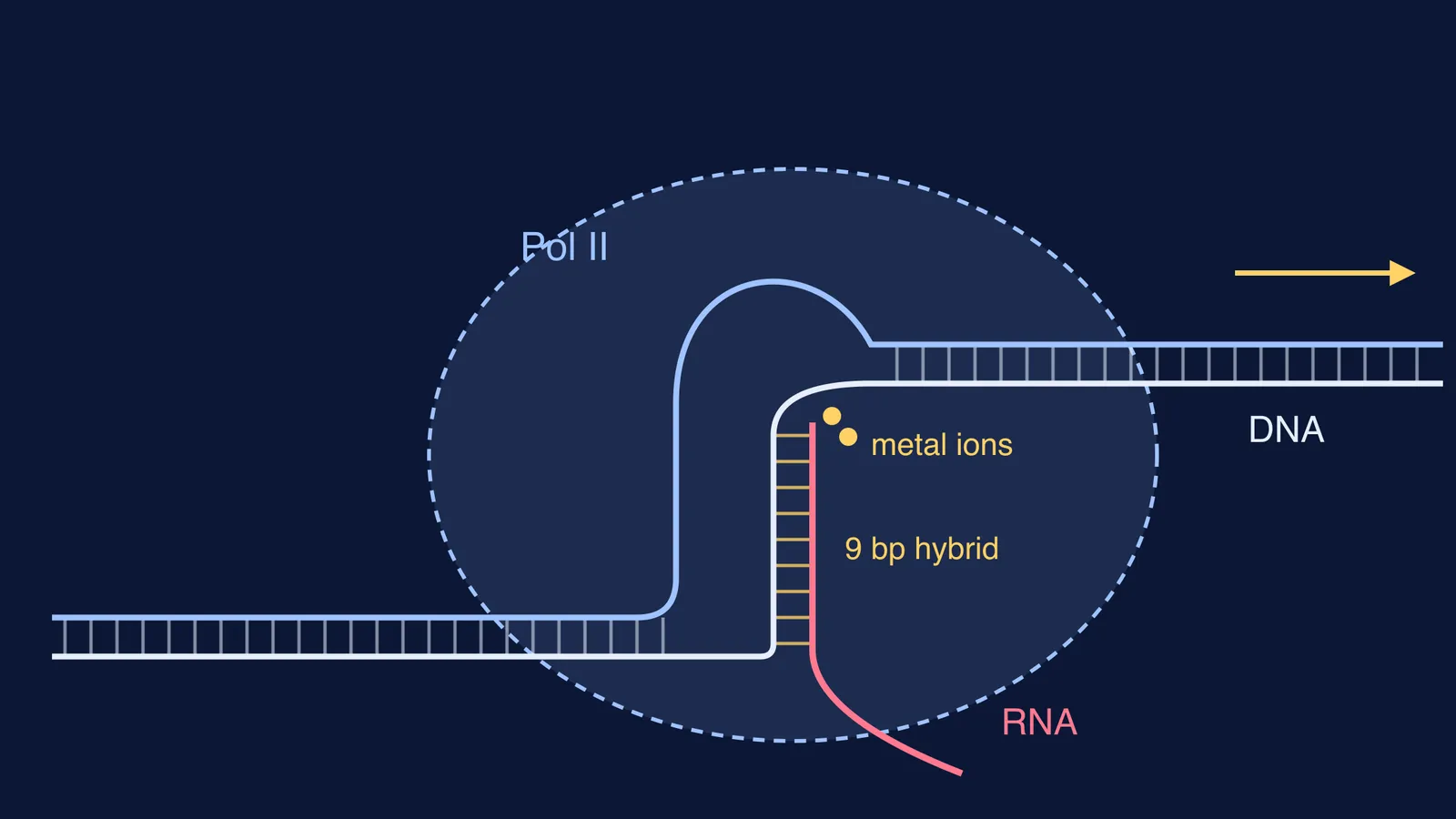
In the companion paper, Gnatt and colleagues caught RNA polymerase II "in the act of transcription" at 3.3 ångström resolution. Their abstract reports that double-stranded DNA enters the enzyme and unwinds before it reaches the active centre. It also reports that nine base pairs of DNA–RNA hybrid run from the active centre at nearly right angles to the entering DNA. Compared with the free enzyme, the clamp in the transcribing complex closes over the DNA and RNA.
How do you photograph a machine while it is working? The Nobel Prize popular explainer describes the trick. Kornberg left one RNA building block out of the solution, so the enzyme stalled at the point where that block was needed. The stalled complexes were crystallised and imaged with X-rays, and a computer then calculated where the atoms sit.
The same explainer says his group spent ten years fine-tuning a yeast system that could produce polymerase and transcription factors in the form and quantity needed to make crystals. Yeast was the right choice because it is a eukaryote like us, but much easier to manipulate in the lab.
Why does transcription matter outside the textbook?
The Nobel explainer says the toxin in the death cap mushroom blocks RNA polymerase, and that disturbances in transcription are linked to cancer, heart disease and inflammation. It also ties the control of transcription to the way stem cells become different kinds of cells. That is why the Academy stresses the medical importance of the work: it is hard to explain what goes wrong in a machine until you can see how it works.
How can you study transcription the way Kornberg did?
Kornberg's method gives students a useful habit: freeze the process at one instant and account for every part. The two 2001 abstracts, from Gnatt et al. and Cramer et al., give you enough for one freeze-frame. Try it on a blank page, then compare it with the diagram above.
Draw the DNA double helix entering the enzyme from one side.
Mark the point where the two strands separate, just before the active centre.
Follow the template strand as it turns through roughly a right angle, and pair nine RNA bases with it.
Put two dots at the active centre for the metal ions where each new building block is added.
Show the RNA peeling away from the template, and the two DNA strands closing up again behind the enzyme.
Then test yourself out loud:
Which DNA strand does the new RNA pair with, and what happens to the other strand?
Kornberg stalled the enzyme by leaving out one building block. Where on your drawing would it stop?
Why could yeast answer a question about human cells when bacteria could not?
To see which eukaryotic RNA polymerase makes which kind of RNA, read our explainer on eukaryotic RNA polymerases. To place transcription in the bigger flow from DNA to protein, read Francis Crick and the central dogma.
If a right-angle turn is hard to picture on paper, the Fermi Simulation Lab has interactive simulations for ideas that are easier to see than to read. The Fermi Concept Library gives each biology concept its own lesson and its place in the map, so you can check transcription against replication and translation.
Draw your freeze-frame once today, then again from memory in three days, and see what stuck.