

On this page
In the autumn of 1929, a young National Research Fellow at Princeton built a high-voltage machine out of a tin can, a silk ribbon and a small motor. Robert J. Van de Graaff's model reached 80,000 volts, according to a 1967 profile in Physics Today. Its idea, a moving belt carrying charge into a hollow metal sphere, still drives the dome machines in school labs, and it demonstrates a core electrostatics rule: extra charge on a conductor lives on its outer surface.
How does a Van de Graaff generator build huge voltage?
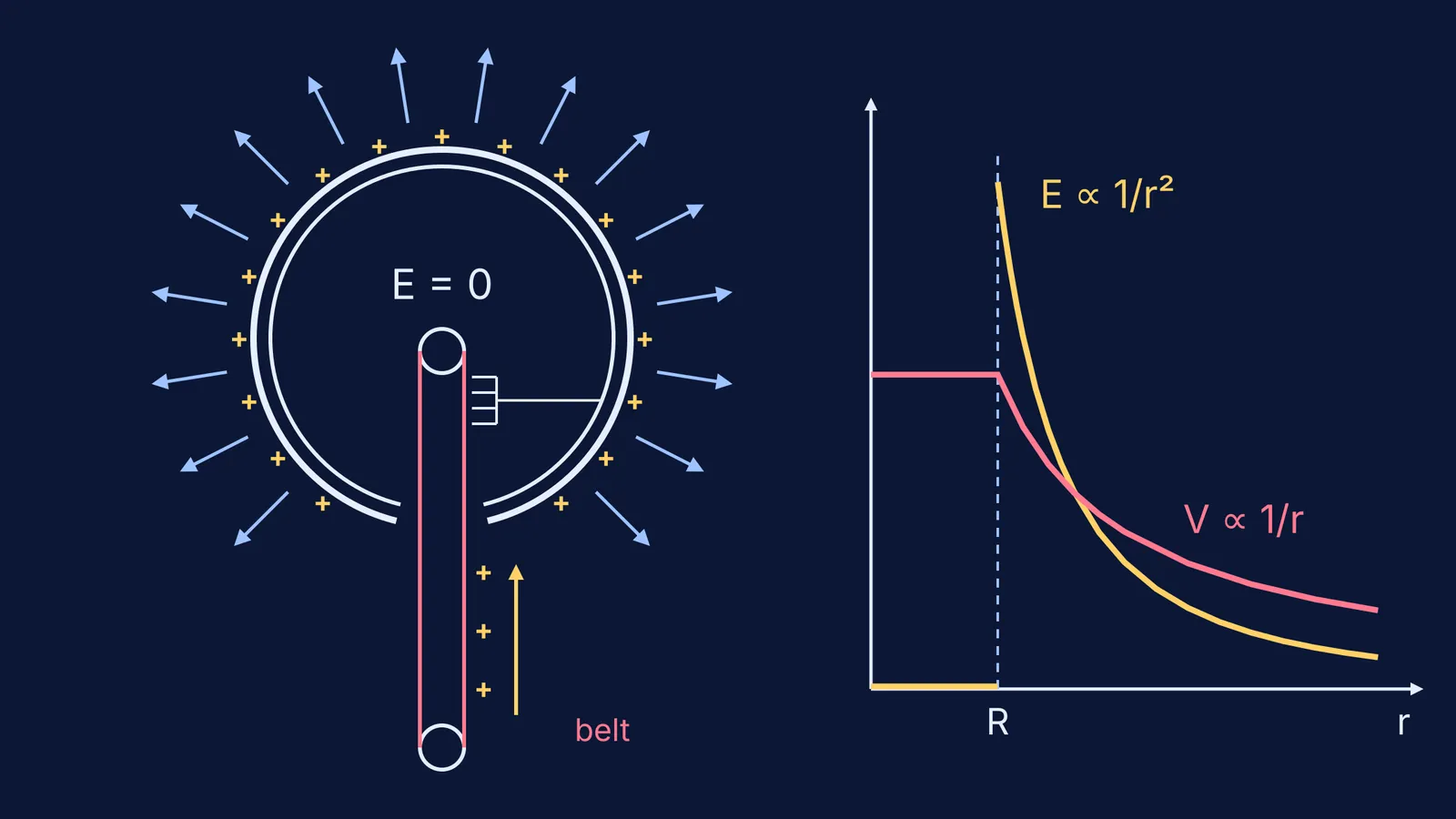
The machine has an insulating belt on two rollers, a sharp metal comb at each end, and a hollow metal dome. As HyperPhysics at Georgia State University describes it, a charged comb at the bottom removes electrons from the belt, leaving it positively charged, and a similar comb at the top lets that positive charge spread to the dome.
The trick is where the charge arrives: inside the sphere. In E. Alfred Burrill's words in Physics Today, "Using a moving belt to transfer charge continuously into the interior of an isolated conducting sphere, Van de Graaff overcame voltage limitations of existing electrostatic devices."
For a sphere of radius R carrying charge Q, V = kQ/R, so more charge means more voltage.
Why does charge sit on the outside of a conductor?
Charge on a conductor moves until the field inside the metal is zero. The OpenStax University Physics textbook puts it plainly: extra charges on a conductor in static equilibrium "end up on the outer surface of the conductor, regardless of where they originate."
For a hollow sphere, charge on the outer surface produces no field anywhere in the hollow. So the top comb, sitting inside, feels no push back from the charge already on the dome. Charge flows from the belt through the comb and out to the outer surface, however much the dome already holds.
What stops the voltage from going higher?
The air. The dielectric strength of dry air at one atmosphere is about 3.0 × 10⁶ V/m, according to OpenStax. Above that field, air ionises and charge leaks away as sparks or a faint corona glow.
Just outside a charged sphere, E = kQ/R² and V = kQ/R, so E = V/R. The dome tops out when E reaches the breakdown value.
Here is a worked example for a dome 30 cm across:
Radius R = 0.15 m. Breakdown field E = 3.0 × 10⁶ V/m.
Maximum potential: V = E × R = 3.0 × 10⁶ × 0.15 = 4.5 × 10⁵ V, or 450 kV.
Charge needed: Q = RV/k = (0.15 × 4.5 × 10⁵) / (9 × 10⁹) = 7.5 × 10⁻⁶ C, just 7.5 µC.
That is the ceiling for a perfectly smooth sphere; doubling R doubles it. Real demonstration models reach voltages in excess of 100,000 volts, according to HyperPhysics.
Sharp edges make things worse, because the field crowds where a surface curves tightly. Karl Compton, describing the 1929 model in 1933, wrote that it "developed 80 000 volts, being limited by the corona discharge from the edges of the can," as quoted in Physics Today. For how surface charge pushes outward on a conductor, see our post on electrostatic pressure on a charged conductor.
From a tin can to 5 million volts
Van de Graaff was born on 20 December 1901, according to the Linda Hall Library, and graduated as a mechanical engineer from the University of Alabama in 1922. The Physics Today profile records what followed:
In 1931 he demonstrated more than a million volts between the spheres of two belt-driven generators at the American Institute of Physics inaugural dinner. The machines cost less than $100.
His US patent, No. 1,991,236, was issued in 1935.
By 1967, well over 500 Van de Graaff machines were in use for research, medicine and industry in more than 30 countries.
The Linda Hall Library adds that in 1933 he built a 40-foot, two-sphere generator capable of 5 million volts at Round Hill, Massachusetts, later given to Boston's Museum of Science. He died on 16 January 1967, as a note in the Physics Today profile records.
How do you use this in an exam answer?
For any charged shell or dome question, check:
Is the point in the metal or the hollow? The shell's own charge gives E = 0 there, and V equals the surface value kQ/R.
Is the point outside? Treat the sphere as a point charge at its centre: E = kQ/r² and V = kQ/r.
Asked for a maximum voltage? Use V = E(breakdown) × R.
Two conductors joined by a wire? They end at equal potential, as in two charged spheres joined by a wire.
Field lines that start on the outer surface, with none inside, are easier to see than to read; the Fermi Simulation Lab has interactive simulations for ideas like this. If shell problems keep tripping you up, the Fermi Concept Library covers every concept in physics, each with its own lesson.


