

On this page
In 1965, psychologist Robert Rosenthal and school principal Lenore Jacobson ran one of the most quoted experiments in education. They told teachers that some children, actually picked at random, were about to bloom. The idea that a teacher's belief can raise a child's results became known as the Pygmalion effect. Here is what the study measured, and what later work says.
What did the Pygmalion in the classroom study find?
The children at a public elementary school, which the authors called Oak School, took an IQ test that teachers were told was the "Harvard Test of Inflected Acquisition", a test that could spot future "growth spurters" (Rosenthal and Jacobson, The Urban Review, 1968). No such test existed, and the named children were chosen at random. According to a later review, the bloomers were a randomly selected 20% of pupils, retested 8 months after teachers got their names (Raudenbush, 1984).
Over that school year, the 255 children in the control group gained 8.42 IQ points on average and the 65 named children gained 12.22 points, a difference of 3.8 points (Table 1 of the 1968 paper).
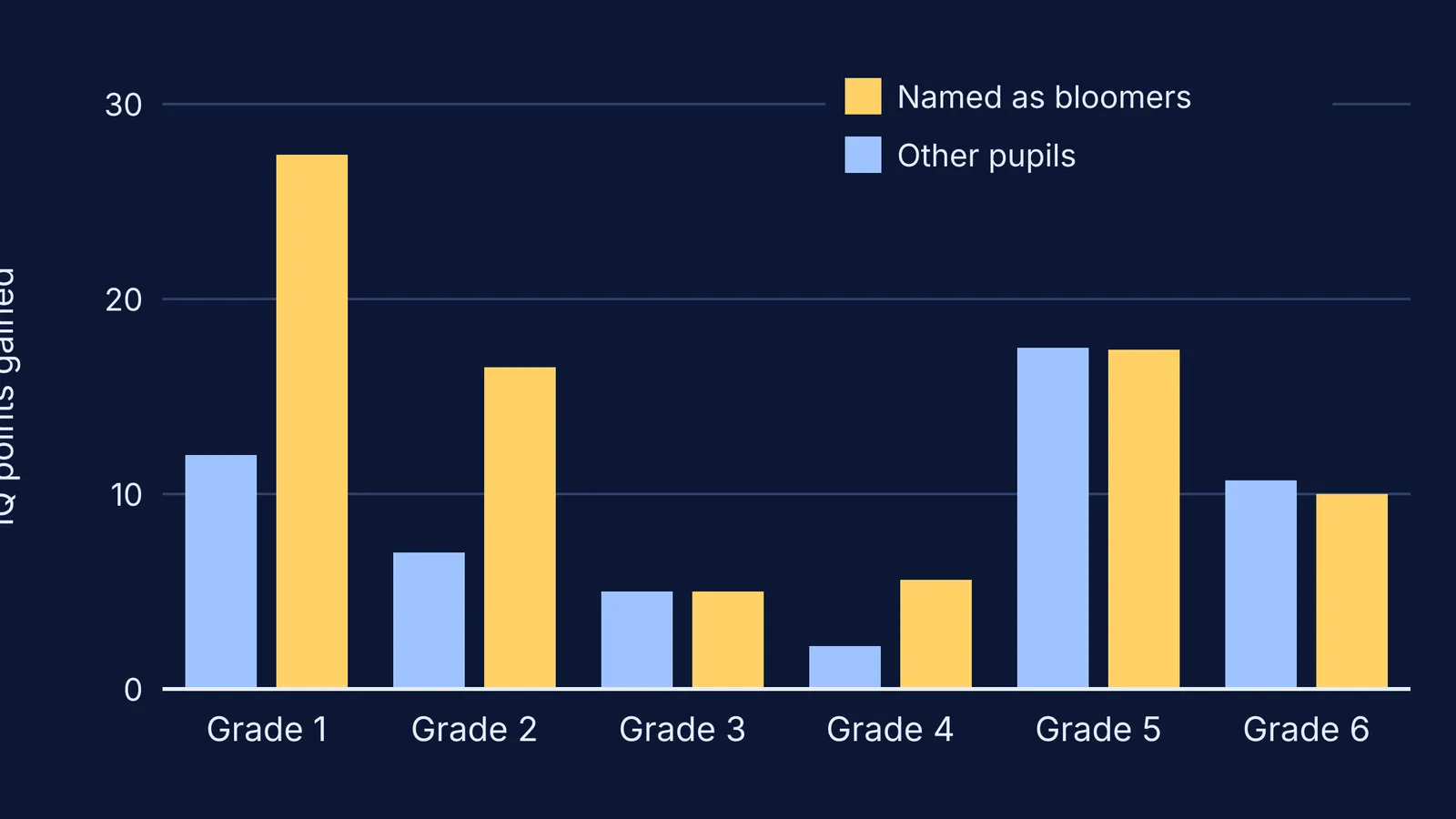
The overall number hides where the gain came from. In grade 1, named children gained 27.4 points against 12.0 for the rest; in grade 2, 16.5 against 7.0. In grade 3 both groups gained 5.0, in grade 4 named children gained 5.6 against 2.2, and in grades 5 and 6 the other pupils gained slightly more. In grades 1 and 2, 47% of named children gained at least 20 points, compared with 19% of the others.
Why did other researchers doubt it?
Robert L. Thorndike reviewed the book in the American Educational Research Journal in 1968, and according to Raudenbush's 1984 review, Thorndike, Jensen, and Elashoff and Snow argued that methodological flaws meant the study gave no basis for its widely publicised findings. The same review reports that when Baker and Crist looked at early replications in 1971, none of the nine studies using IQ as the outcome found an overall significant effect.
How big is the Pygmalion effect really?
Stephen Raudenbush pooled 18 experiments on teacher expectations and pupil IQ (Journal of Educational Psychology, 1984). The average effect was 0.11 standard deviations, about a tenth of the usual spread in scores between pupils. The effects ranged from 0.55 to minus 0.13.
The key finding was about timing. In the four experiments where teachers had no contact with pupils before getting the false information, the average effect was 0.32. In the three with one week of contact, it was 0.26. In the eight where teachers had known the class for more than two weeks, it was minus 0.04, which is effectively nothing (Raudenbush, 1984). Once teachers had seen children's real work, a stranger's label made little difference.
Lee Jussim and Kent Harber reviewed 35 years of research and concluded that self-fulfilling prophecies in the classroom do occur, but they are typically small and are more likely to fade than build up over time (Personality and Social Psychology Review, 2005). They also concluded that the effects may occur selectively among students from stigmatised groups, and that teacher expectations may predict results because they are accurate, rather than because they cause them.
What should you do if you feel labelled?
Raudenbush's timing result suggests that what a teacher has seen for themselves can outweigh what they are told. So the most useful answer to a label is new evidence.
Ask what the label rests on. "Weak in maths" usually means particular tests or homework. Find out which ones.
Name the exact gap. Go through those papers and sort each lost mark: concept not known, wrong method, or careless slip.
Fix one gap at a time and make the progress visible: a corrected notebook, a re-attempted test, a question asked in class.
Show the teacher the change after a few weeks, calmly and with the work in hand.
A parent might say: "Her last two physics tests were 11 out of 25 and 12 out of 25. We found most marks went on method in numericals, and she has been redoing those problems. Could you look at her next test and tell us if that step has improved?"
If the gap turns out to be method, the Fermi Problem Library has worked problems with a step-by-step solver that explains the reasoning rather than printing an answer, so you can see exactly which step breaks. If you do not know where to start, Fermi's AI tutor works out what you already know and builds a plan for the session.
Parents can read what to ask when a teacher calls your child a slow learner and what to do when your child says the teacher hates them; students, how to respond when a teacher scolds you for low marks.
A teacher's belief matters a little; the work you show them matters more.


