

On this page
For decades, ecologists looked at nature and saw an intuitive rule: complexity brings stability. Leading figures argued that diverse ecosystems, like rainforests with their tangled food webs, were more robust than simple ones. If one food source vanished, predators could easily switch to another.
In 1972, an Australian-born physicist turned ecologist named Robert May proved that intuition wrong. Using the mathematics of Random Matrix Theory, May demonstrated that a randomly assembled complex system is inherently unstable.
Does complexity equal stability?
May wanted to test the complexity-stability assumption rigorously. He built a mathematical model of an ecosystem, assigning interaction strengths between species entirely at random. He published his results in the 1972 *Nature* paper, Will a Large Complex System be Stable?.
He defined three variables to measure complexity:
S: The number of species in the ecosystem.
C: The connectance, or the fraction of all possible links between species that actually exist.
α: The average strength of the interaction between any two connected species.
What is the α√(SC) < 1 rule?
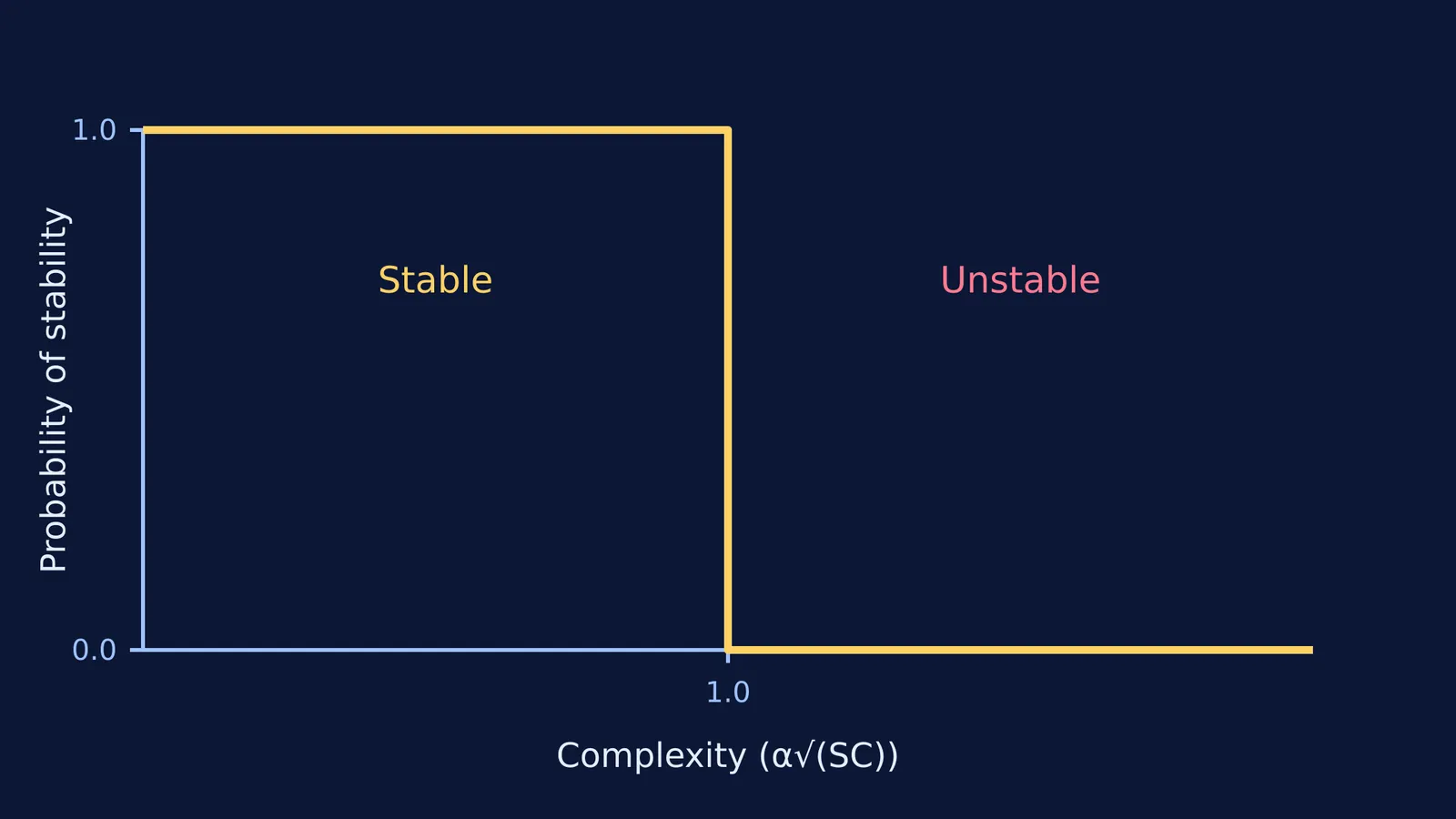
When May solved the equations for a large system, he found a sharp mathematical threshold. For the ecosystem to be stable—meaning it returns to equilibrium after a small disturbance—it must satisfy this condition:
α√(SC) < 1
If the product of these three numbers exceeds 1, the probability of the system remaining stable drops abruptly to zero. This proved that increasing the number of species (S) or the number of connections (C) actually pushes a randomly assembled ecosystem towards collapse.
How do complex ecosystems survive?
May's work did not mean that rainforests are doomed. Instead, it showed that stable natural ecosystems are not randomly assembled.
If you just throw species together at random, the math guarantees failure. Real ecosystems survive because they have specific, non-random architectures. They rely on "weak links" (where most interactions are not strong enough to cause a chain reaction of extinctions) and modularity, meaning the network is broken up into smaller, loosely connected compartments. It is the careful arrangement of the connections, not the sheer number of them, that gives an ecosystem its resilience.
If you are exploring how populations change over time and want to see how interactions shape the results, the Fermi Simulation Lab has interactive simulations for the ideas that are easier to see than to read.
Can simple equations create chaos?
May's talent for finding deep mathematical truths in ecology extended beyond food webs. In 1976, he published another landmark *Nature* paper, Simple mathematical models with very complicated dynamics.
Here, he examined the logistic map, a simple equation used to model population growth: x[n+1] = r × x[n] × (1 − x[n]). He showed that as the growth rate (r) increases, the population does not just settle at a higher number. Instead, it begins to oscillate between two values, then four, before suddenly breaking into complete, unpredictable chaos. This work helped launch the entire field of chaos theory, proving that deterministic rules can produce wildly unpredictable results.
For more on mathematical models of populations, see Population growth and cooling: exponential models via dy/dt = ky.
Robert May went on to become President of the Royal Society and Chief Scientific Adviser to the UK Government. His legacy is a profound reminder: whether in D'Arcy Thompson and the mathematics of growth and form or the structure of a food web, the deepest truths in biology often speak the language of maths.


