

On this page
Before 1962, the world's first lasers relied on gases or synthetic rubies. The very first laser, built by Theodore Maiman in 1960 using a synthetic ruby crystal, required an extremely bright flashlamp wrapped around it to pump the atoms into an excited state. Gas lasers, which followed soon after, used high-voltage electrical discharges inside large glass tubes. Both types were fragile, bulky, and inefficient because they required converting electricity into an intermediate form of energy to pump the laser medium.
Scientists theorised that it should be possible to bypass this middle step. If a laser could be built from a semiconductor—the same solid-state materials used in the recently invented transistor—it could be pumped directly by a simple electric current. This would make the device smaller, more durable, and vastly more efficient.
What is an injection laser?
An injection laser generates coherent light directly by passing an electric current through a semiconductor p-n junction. In the autumn of 1962, several research groups across the United States were racing to build one. A team at the General Electric Research Laboratory in Schenectady, New York, led by Robert N. Hall, won this scientific photo finish.
On 24 September 1962, Hall along with G. E. Fenner, J. D. Kingsley, T. J. Soltys, and R. O. Carlson submitted a paper titled "Coherent Light Emission From GaAs Junctions" (Physical Review Letters). It was published on 1 November 1962 in Volume 9, Issue 9 of the journal.
How did the first semiconductor laser work?
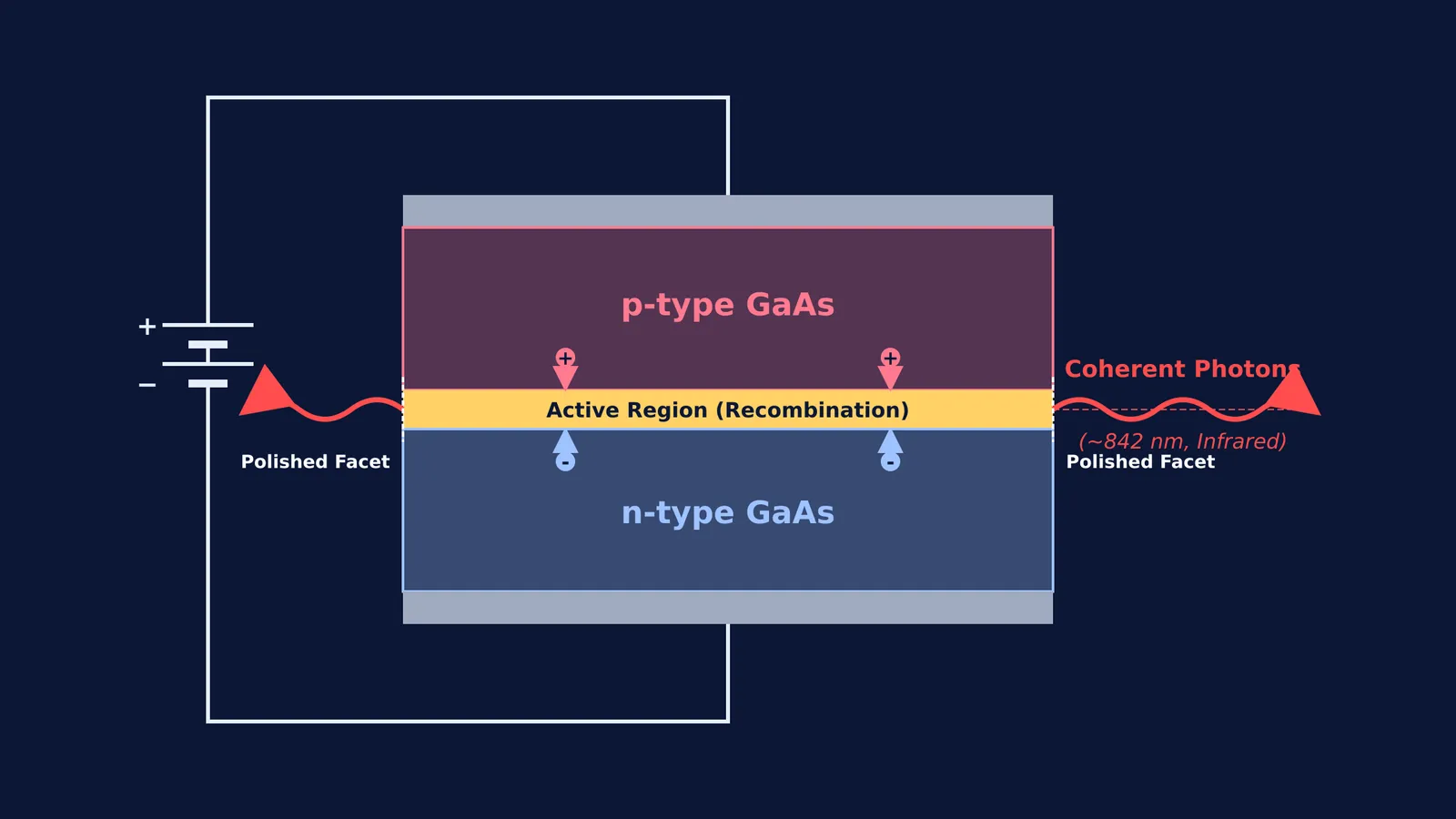
To build the laser, Hall's team used a p-n junction made of gallium arsenide (GaAs). When a forward voltage was applied, electrons and holes were injected into the active region from opposite sides of the junction. As they met and recombined, they shed their excess energy in the form of photons.
The device itself was incredibly tiny—a cube measuring about 1/3 of a millimetre on each side (Lemelson-MIT). The team polished two parallel faces of the crystal to act as mirrors. This created an optical cavity that bounced the photons back and forth, stimulating the emission of even more photons in phase with the original ones. The result was a beam of coherent infrared light at a wavelength of 842 nanometers (Physical Review Letters).
Why did the first laser diode need liquid nitrogen?
Because the semiconductor laser required high electrical current densities to achieve lasing, heat was a major obstacle. As the electrons and holes fell into the active region, not all of them recombined to emit light. Some of the energy turned into phonons—vibrations in the crystal lattice that manifested as intense heat. If operated continuously at room temperature, the high current would have quickly melted the tiny GaAs crystal.
To solve this, Hall's team cooled the device to 77 K using liquid nitrogen (Physical Review Letters). They also operated the laser in short electrical pulses rather than a continuous wave, allowing the crystal to cool between bursts of light.
Over the following decades, engineers developed heterojunctions—layering different materials like aluminium gallium arsenide—to confine the light and electrons more tightly. This solved the heating issue and allowed continuous operation at room temperature. Today, laser diodes are manufactured in massive numbers. They read data in CD and Blu-ray players, scan barcodes at the supermarket, and push light through the fibre-optic cables that form the backbone of the internet.
How can you master semiconductor physics for exams?
Semiconductor devices form a high-yield topic in board exams and entrance tests. To understand how devices like the laser diode work, rather than just memorising facts (a key step in learning physics from first principles), test yourself against these three steps:
Draw the energy bands: Sketch the valence and conduction bands before memorising device properties.
Trace the charge carriers: When a forward voltage is applied, trace how electrons from the n-type side and holes from the p-type side are pushed into the depletion region. (For a refresher, see how depletion layer width changes in forward and reverse bias).
Identify the energy output: In a standard diode, carrier recombination primarily releases heat. In a light-emitting diode (LED) or laser diode, the semiconductor material has a direct bandgap, so the energy is released directly as photons.
If you are unsure how these bands align, the Fermi Concept Library explains the physics of energy bands and p-n junctions from the ground up. And when you move on to numericals, the Fermi Problem Library has a step-by-step solver that explains the reasoning rather than just printing the final answer.


