On this page
René-Antoine Ferchault de Réaumur was born in La Rochelle, France, on 28 February 1683 and died on 18 October 1757, according to the Dictionary of Scientific Biography entry by J. B. Gough. Two pieces of his work still turn up in school science: a temperature scale that runs from 0 to 80, and a set of bird experiments that showed the stomach digests food chemically.
What is the Réaumur temperature scale?
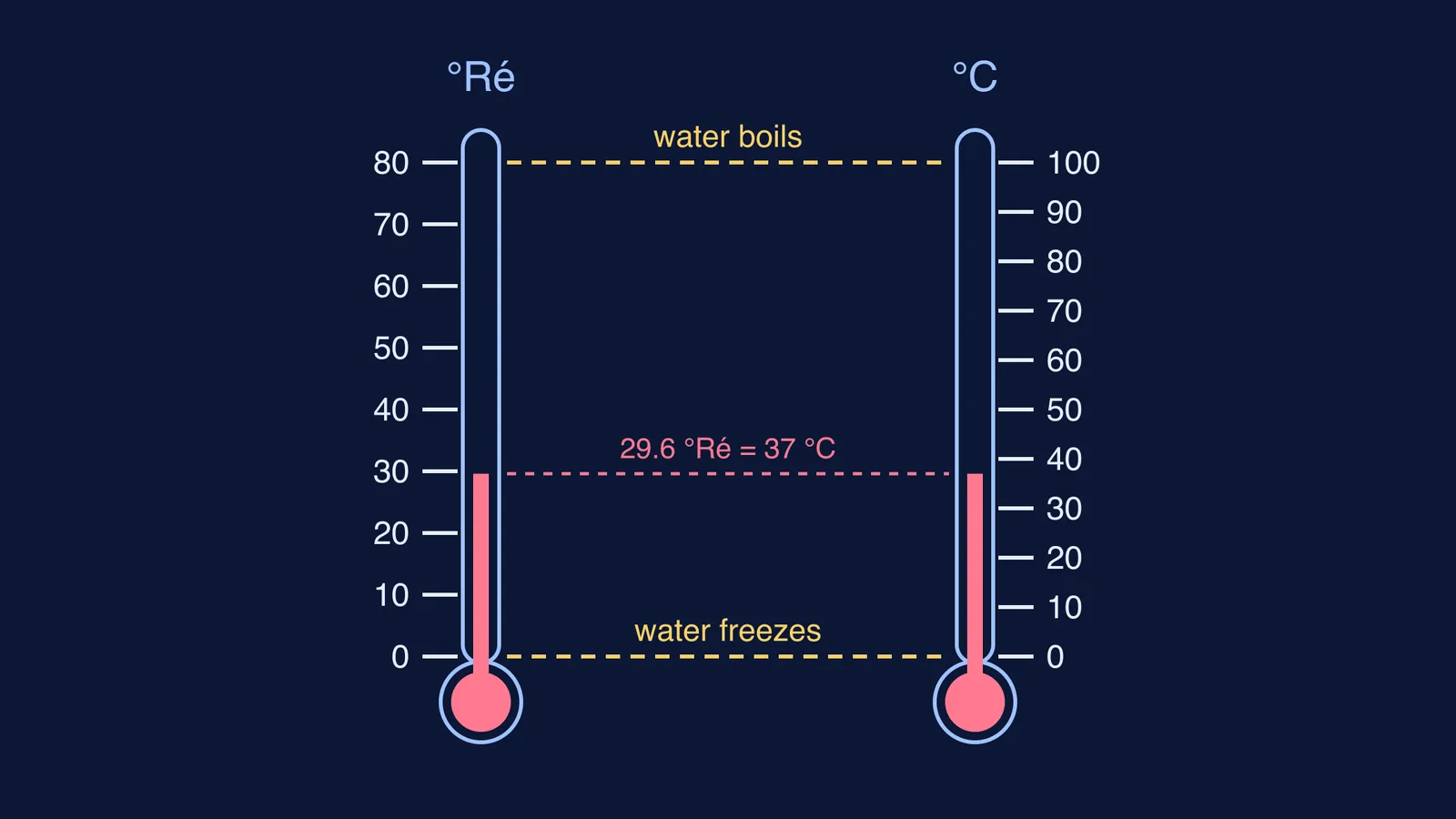
The Réaumur scale sets the freezing point of water at 0° and the boiling point of water at 80° (Réaumur scale, Wikipedia). Réaumur published an article on his alcohol thermometer in 1730, before Celsius introduced his scale (Hektoen International).
His idea was unusual. Instead of two fixed points, he used a single fixed point and defined each degree as 1/1,000 of the volume of the liquid at 0° (Gough). He suggested an alcohol mixture diluted so that it began boiling at 80 of these degrees, when it had expanded in volume by 8% (Wikipedia).
That design had a weak spot: different strengths of alcohol expand by different amounts, so two thermometers could disagree (Gough). Instrument makers generally chose other liquids and simply marked 80° at the boiling point of water, which caused much confusion, and from the late 18th century mercury was used almost without exception (Wikipedia).
The scale was used widely in Europe, particularly in France, Germany and Russia. By the 1790s France had chosen the centigrade scale as part of the metric system, though parts of Russia kept Réaumur into the early 20th century. Today some Italian and Swiss factories still use it for milk temperature in cheese making, and in the Netherlands it is used when cooking sugar syrup (Wikipedia). For the 100-degree scale, read how Anders Celsius set up his 100-degree scale, and for the instrument-making side, how Daniel Fahrenheit made thermometers that agreed.
How do you convert Réaumur to Celsius and Fahrenheit?
Because 80 Réaumur degrees cover the same gap as 100 Celsius degrees, 1 °Ré equals 1.25 °C or 2.25 °F (Wikipedia). Réaumur and Celsius both put freezing water at 0, so there is no offset between them.
°C = °Ré × 5/4
°Ré = °C × 4/5
°F = °Ré × 9/4 + 32
Three worked examples:
Normal body temperature, 37 °C: 37 × 4/5 = 29.6 °Ré.
"20 degrees of frost" on the Réaumur scale is −20 °Ré: −20 × 5/4 = −25 °C, and −20 × 9/4 + 32 = −13 °F.
Self-check: 80 °Ré × 5/4 = 100 °C, and 80 × 9/4 + 32 = 212 °F. Both are boiling water, as they should be.
If unit conversions keep tripping you up, the Fermi Problem Library has worked problems with a step-by-step solver that explains the reasoning rather than printing an answer.
How did Réaumur study digestion in birds?
In the 18th century one theory held that digestion was purely mechanical: food was simply ground up in the gut (Académie de Nantes teaching sheet). Réaumur did not believe it, and he tested it on two kinds of bird.
First, grain-eaters. He made several grain-eating birds swallow tubes of glass and tin; when the birds were opened after two days, the glass was shattered and polished smooth and the tin tubes were crushed and flattened (Gough).
Then, birds of prey, which cough up what they cannot digest. Réaumur put meat inside a tube closed with fine gratings and made a kite swallow it; when the tube came back up, the meat was partly digested with no sign of putrefaction (Gough). Other accounts call the bird a buzzard (HistoryofMedicine.com). In his own description, the perforated iron tube was returned the next day with its shape unchanged and no rubbing marks, while the meat had been reduced to a quarter of its original volume (Académie de Nantes). The tube had blocked any grinding, so whatever dissolved the meat had to be a fluid.
In his second memoir on digestion, in 1752, he concluded that digestion is carried out by the action of a dissolving agent (Encyclopaedia Universalis). That year he also began digestion experiments outside the body (Schoolmouv). The story continued into the next century with William Beaumont watching digestion inside a living stomach.
What can you learn from the tube experiment?
Reuse his design whenever two causes compete:
Name the rival explanations: grinding or chemical action.
Block one of them: a rigid, perforated tube stops grinding but lets juices in.
Predict both outcomes: grinding alone means unchanged meat; chemistry means shrunken meat.
Check your control: an undamaged tube shows it was not crushed.
Compare cases: the gizzard birds crushed tin, so different animals lean on different methods.
If thermal expansion or digestive enzymes feel shaky, the Fermi Concept Library covers every concept in physics, chemistry and biology, each with its own lesson.
Try it now: convert today's temperature in your city to Réaumur, then run the fixed-point test on your answer.