

On this page
Early radio could only send dots and dashes. As the Canadian Encyclopedia puts it, early radio transmitters could only send information by telegraphy, using short and long pulses for Morse code. Reginald Fessenden, a Canadian electrical engineer, wanted radio to carry a human voice. The idea he used, amplitude modulation, is the AM still marked on radio dials.
Who was Reginald Fessenden?
Reginald Fessenden was born on 6 October 1866 in East Bolton, Canada East, and died on 22 July 1932 in Bermuda, according to the Canadian Encyclopedia. He was hired by Edison Machine Works as an assistant tester and went on to collect more than 500 patents in his lifetime, the same source says.
On 23 December 1900, at Cobb Island, Maryland, Fessenden transmitted his voice over about 1.6 km using amplitude modulation, the Canadian Encyclopedia records.
How did Fessenden make the first voice radio broadcast?
He needed two things: a steady wave, and a way for sound to shape it. James O'Neal's account in Radio World describes the transmitter.
A continuous carrier. Instead of sparks, Fessenden used a high-frequency alternator built by General Electric, a rotating machine that makes a smooth radio-frequency current.
A microphone in the antenna. He put a carbon microphone in series with the antenna lead. Speech changed the microphone's resistance, so the antenna current, and the strength of the wave, rose and fell with the sound.
At the far end, a receiver turns the changing strength of the wave back into sound.
On 21 December 1906, Fessenden demonstrated speech and music from Brant Rock, Massachusetts, to a receiving site in Plymouth, in front of telephone-company officials and engineers. O'Neal's follow-up in Radio World reports that the alternator ran at 50,000 cycles per second and that its measured output was only 36 watts. The Canadian Encyclopedia gives the distance between Brant Rock and Plymouth as 18 km.
Did the Christmas Eve 1906 broadcast really happen?
In a letter to Westinghouse's Sam Kintner dated 29 January 1932, Fessenden described a Christmas Eve programme: a short speech, a phonograph record of Handel's "Largo", himself playing "O Holy Night" on the violin and singing a verse, and a Bible text. He said it was heard on US Navy and United Fruit ships (Radio World, 2006).
O'Neal found that this letter is essentially the only evidence. His 2008 follow-up reports that a 1956 investigation found no mention of the broadcasts in newspapers, magazines or scientific papers, and that a wireless operator well placed to hear them logged nothing unusual. The fair summary: the 21 December demonstration had witnesses; the Christmas Eve concert may have happened, but it rests on Fessenden's own account, written 25 years later.
For the Morse-code side of the same era, read about Guglielmo Marconi and the first radio signals across the Atlantic and John Ambrose Fleming and the diode valve that rectified radio.
How does amplitude modulation work?
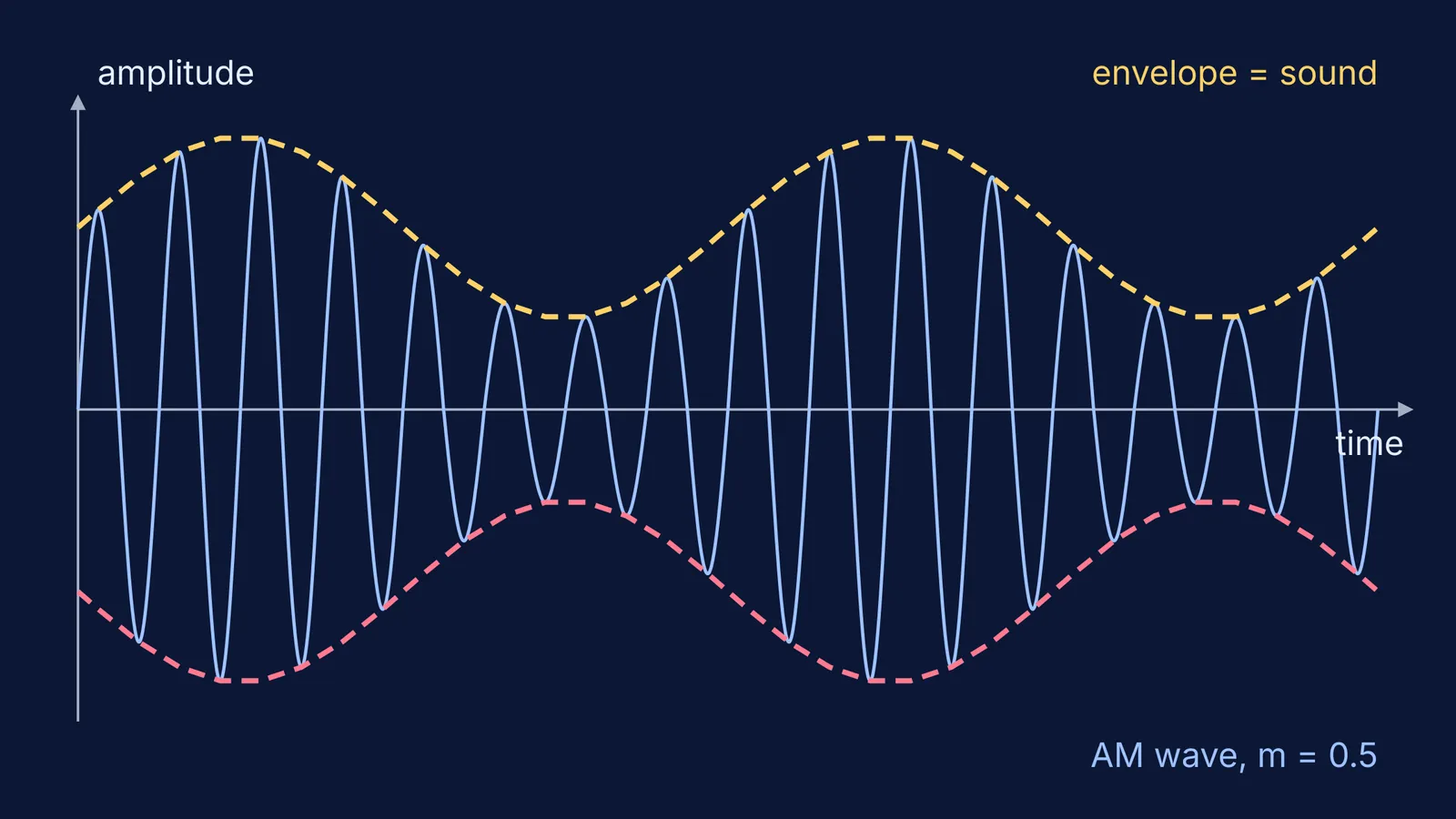
In amplitude modulation, the instantaneous amplitude of the carrier wave is varied in proportion to the message signal, such as audio (Wikipedia: Amplitude modulation). In the diagram at the top, the dashed envelope has the shape of the sound.
An AM signal contains the carrier plus two sidebands, at fc + fm and fc − fm, so it takes up a bandwidth twice the highest audio frequency, the same Wikipedia article explains. The modulation index is m = M/A, the message's peak divided by the carrier's amplitude; at m = 1 the wave dips all the way to zero.
Worked example with Fessenden's own carrier. Take the 50 kHz carrier from the December 1906 demonstration (Radio World) and a 1 kHz tone.
Sidebands: 50 + 1 = 51 kHz and 50 − 1 = 49 kHz.
Bandwidth: 51 − 49 = 2 kHz, twice the tone frequency.
Modulation index from a trace: suppose the envelope swings between Amax = 12 V and Amin = 4 V. The carrier amplitude is A = (12 + 4)/2 = 8 V and the message peak is M = (12 − 4)/2 = 4 V, so m = 4/8 = 0.5. That is the wave in the diagram.
Check: m is below 1, so the envelope never touches zero.
Modern stations sit much higher: HyperPhysics lists AM carrier frequencies of 540 to 1600 kHz, assigned at 10 kHz intervals. Run step 2 in reverse and a 10 kHz slot leaves room for audio up to about 5 kHz.
If the envelope still feels abstract, the Fermi Simulation Lab has interactive simulations for ideas that are easier to see than to read.
Is amplitude modulation in the Class 12 syllabus?
The CBSE Class XII physics curriculum for 2025-26 lists 14 chapters ending with semiconductor electronics, and communication systems is not one of them. Always check the current official syllabus.
AM still draws on chapters you do study: alternating current and electromagnetic waves. If those sums trip you up, the Fermi Problem Library has worked problems with a step-by-step solver that explains the reasoning rather than printing an answer.
For the next chapter of the radio story, read how Edwin Armstrong built FM radio to beat static.


