On this page
Most students meet x² + y² = z² as Pythagoras' theorem. Raman Parimala has spent her career on the bigger family that equation belongs to. Here is what she proved, why it matters, and an exercise you can try.
What is a quadratic form?
A quadratic form is a polynomial in which every term has degree exactly two, such as x² + y² − z² or 3x² + xy + 5y². The central question is: does the form equal zero for values that are not all zero? If it does, the form is called isotropic. If its only zero is the trivial one, it is anisotropic.
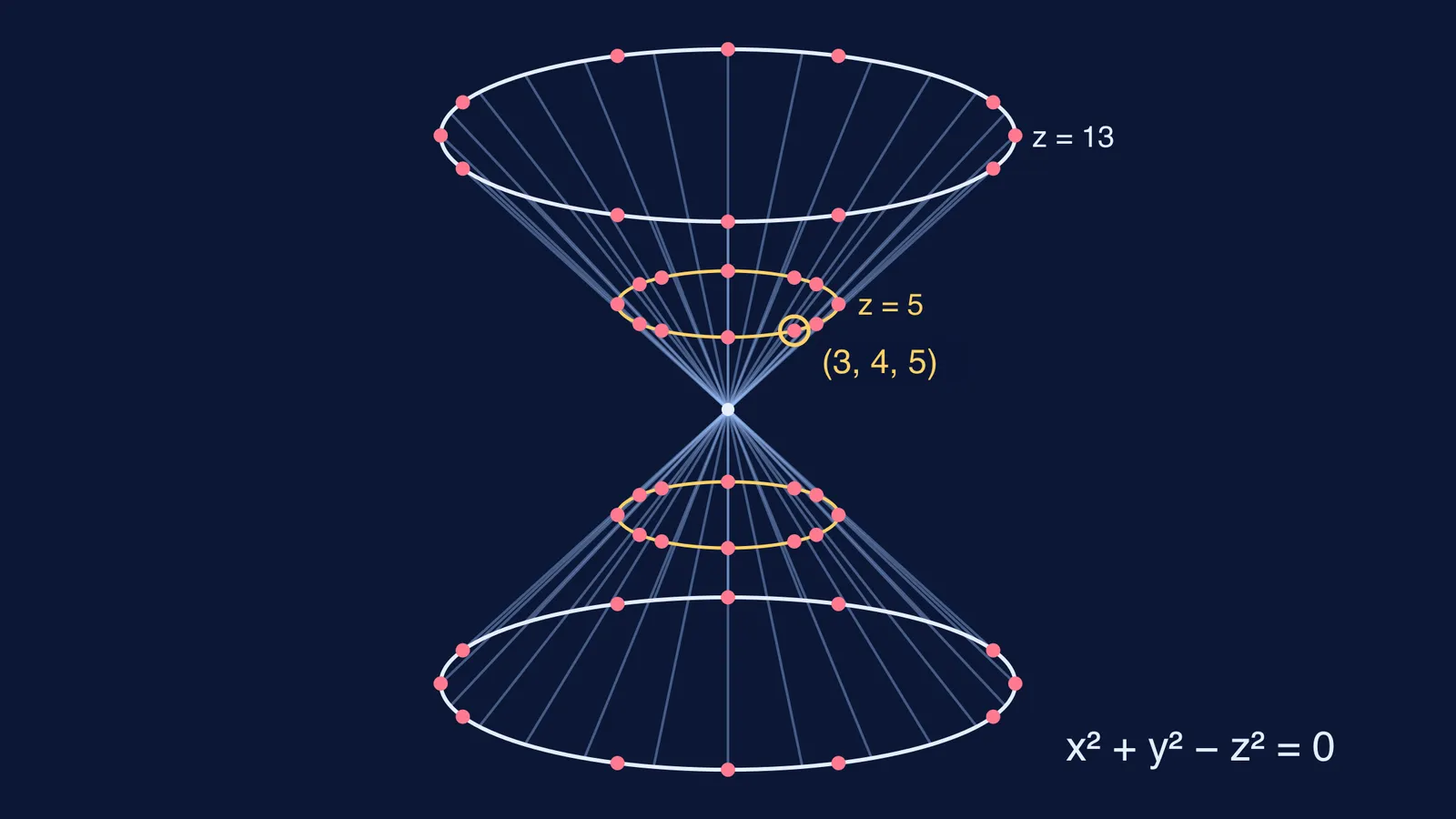
The answer depends on which numbers you allow. With whole numbers, x² + y² − z² has the zero (3, 4, 5), because 9 + 16 − 25 = 0. Every Pythagorean triple is a zero of this form, and they all lie on the cone in the diagram above. To generate more, our post on how to generate Pythagorean triplets with Plato's formula walks through one method.
Who is Raman Parimala?
Parimala grew up in Tamil Nadu and studied at Stella Maris College in Chennai before doing her doctorate at the Tata Institute of Fundamental Research (TIFR) in Mumbai, according to a 2009 Emory Report profile. She later taught at TIFR and joined Emory University in the United States in 2005. She once considered studying Sanskrit poetry instead, and told the profile: "Math has the beauty of poetry."
The International Mathematical Union's profile of Parimala lists the Bhatnagar Award (1987), an honorary doctorate from the University of Lausanne (1999) and the Srinivasa Ramanujan Birth Centenary Award (2003). The Emory profile notes she was selected as a plenary speaker at the 2010 International Congress of Mathematicians in Hyderabad.
What did Parimala prove about quadratic forms?
Among her early papers is Quadratic spaces over polynomial extensions of regular rings of dimension 2 (Mathematische Annalen, 1982), on quadratic forms whose coefficients are polynomials.
One of her best-known results is about a number called the u-invariant. The paper by Parimala and V. Suresh defines it: the u-invariant of a field is the maximum dimension of anisotropic quadratic forms over that field, that is, the most variables a form can have with no non-trivial zero.
The pair worked with function fields of p-adic curves, for example fractions of polynomials in t whose coefficients are p-adic numbers (a number system built around divisibility by a prime p). The paper calls it an open question "whether every quadratic form in at least nine variables over the function fields of p-adic curves has a non-trivial zero", noting that their earlier work had settled eleven variables when p is not 2. The 2010 paper, published in Annals of Mathematics, answers the question with a yes for the non-dyadic case. There, the u-invariant is exactly 8.
Why do quadratic forms matter in algebra and number theory?
Quadratic forms appear whenever you ask which numbers are sums of squares, measure lengths and angles, or look for whole-number solutions of equations. The Brahmagupta-Fibonacci identity, which says a product of two sums of two squares is again a sum of two squares, is a fact about the form x² + y². Parimala's question goes further: how many variables can a form have and still avoid zero?
Can you test a quadratic form for zeros yourself?
Yes, with remainders, the same tool you use in Class 10. Take x² + y² − 3z² and show its only whole-number zero is (0, 0, 0).
Squares leave remainder 0 or 1 when divided by 3 (0² = 0, 1² = 1, 2² = 4 = 3 + 1).
If x² + y² = 3z², two remainders from {0, 1} must add to a multiple of 3. Only 0 + 0 works, so 3 divides x and y.
Then 9 divides x² + y² = 3z², so 3 divides z² and hence z.
Dividing x, y and z by 3 gives a smaller solution, forever. That is impossible for positive whole numbers, so the form is anisotropic over the integers, and over the rationals too after clearing denominators.
Now change one coefficient: x² + y² − 2z² has the zero (1, 1, 1). One number turns a form with no zeros into one with infinitely many. Telling such cases apart, in far more general settings, is Parimala's kind of question.
How can you explore this as a student?
Try this 30-minute plan:
List zeros of x² + y² − z² with z up to 25.
Repeat the remainder test for x² + y² − 7z², working mod 7.
Note which small coefficients give zeros and look for a pattern.
Parimala's own advice, from the Emory profile: "If you have a love and a talent for it, you should come to math." If research maths appeals to you, read our guide on how to become a research mathematician in India.
If remainders or proof by descent feel shaky, the Fermi Concept Library has a lesson on each mathematics concept and shows where it fits in the map.