On this page
Many Indian families have a remedy that "just works". Ram Nath Chopra asked the next question: what is in the plant, and what does it do to the body? In Calcutta in the 1920s and 1930s, he turned plants into measured lab results. Rauwolfia and ephedra show how.
Who was Ram Nath Chopra?
Chopra was born on 17 August 1882 in Gujranwala, in undivided Punjab, studied at Downing College, Cambridge, and joined the Indian Medical Service in 1908, according to his Wikipedia biography. He became professor of pharmacology at the Calcutta School of Tropical Medicine, was its director from 1935 to 1941, headed the Drugs Enquiry Committee of 1930-31, and was knighted in 1941. He died in Srinagar in 1973.
With B. N. Ghosh, he made the case for this work in a 1923 paper, The Field for Research in Indian Indigenous Drugs, in the Indian Medical Gazette.
What did Chopra find in Rauwolfia?
Rauwolfia serpentina, sarpagandha, had been used in folk medicine for centuries for many illnesses, including mental illness, as P. N. Tandon describes in the Indian Journal of Medical Research (2021). Chemists such as Salimuzzaman Siddiqui were already pulling alkaloids out of its root in the early 1930s.
Chopra's group did the pharmacology. In 1933, R. N. Chopra, J. C. Gupta and B. Mukherjee reported that an alkaloid from Rauwolfia had a sedative and blood-pressure-lowering effect, in the Indian Journal of Medical Research, volume 21, pages 261-71 (bibliographic record). Tandon notes that Gupta and colleagues reported on using the plant for mental disorders in 1943.
The next step was testing in patients: R. J. Vakil's clinical trial of Rauwolfia in essential hypertension appeared in the British Heart Journal in 1949. Reserpine was isolated in 1952, and Ciba in Switzerland introduced it as the drug Serpasil, as Tandon recounts. For the chemistry side, read our post on Salimuzzaman Siddiqui and the alkaloids of the Rauwolfia root.
Why did Chopra study ephedra?
Ephedra is the surprise, because it was barely part of traditional Indian medicine. In their 1929 paper, Chopra, B. B. Dikshit and K. Venkatachalam Pillai wrote that ephedrine came from the Chinese plant Ma Huang and that ephedra is not mentioned in Ayurvedic or Tibbi medicine, apart from some local use in Lahaul (Indian Medical Gazette, 1929). Their reasons were its growing use and its cost: ephedrine, used for asthma, sold for about 800 rupees per pound.
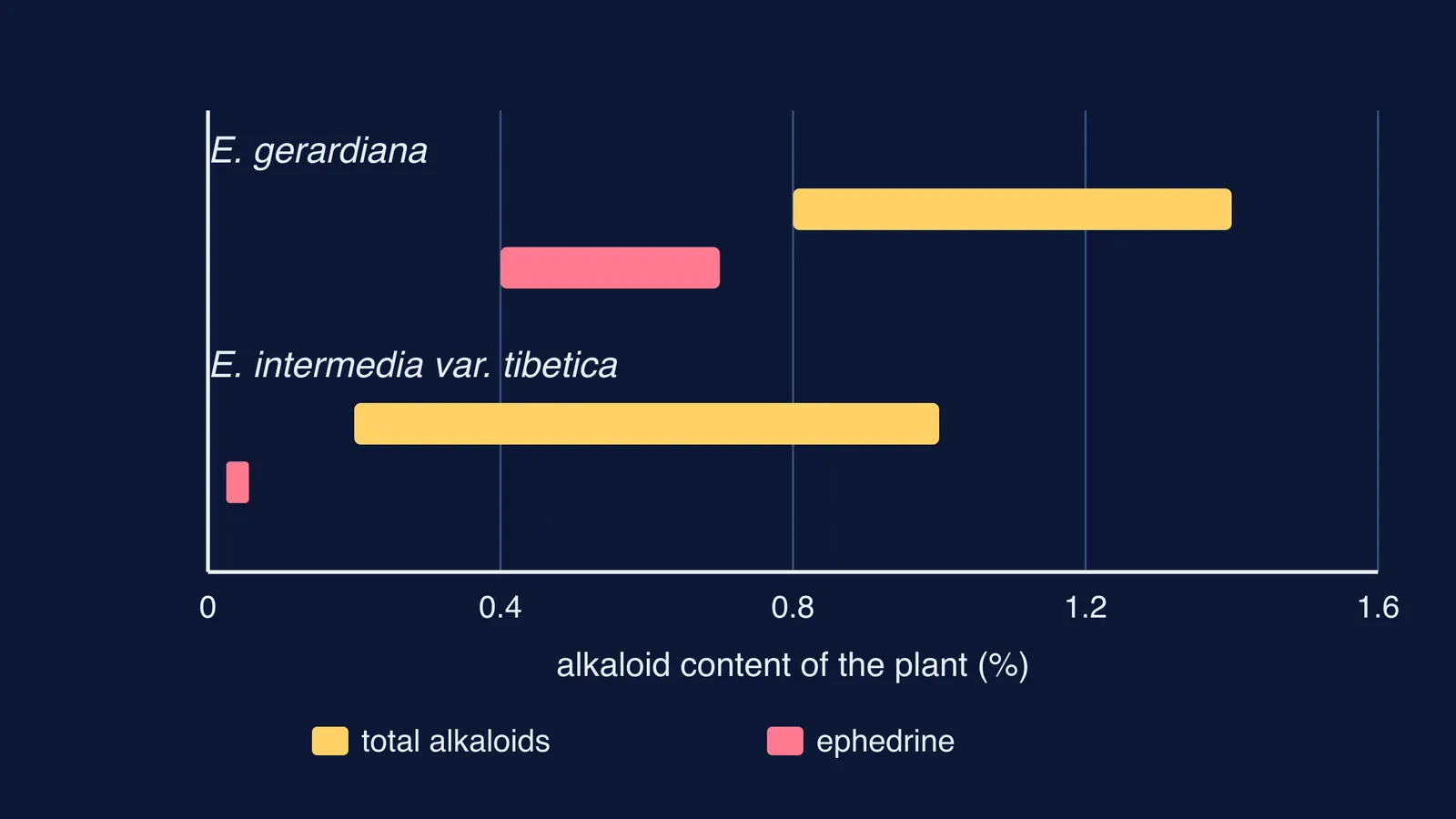
Several ephedra species grow in the dry Himalayas, so the team measured them. Ephedra gerardiana gave 0.8 to 1.4 per cent alkaloids, about half of it ephedrine, while the tibetica variety of E. intermedia gave 0.2 to 1.0 per cent, mostly the sister compound pseudo-ephedrine, according to the same paper. They also found that green twigs held four to six times as much alkaloid as stems and that yield peaked in autumn.
So they asked whether the "wrong" alkaloid could do the job. In cats, 2 mg of pseudo-ephedrine raised blood pressure for 20 to 35 minutes, and in an animal given the drug pilocarpine to narrow its airways, 2 mg relaxed the bronchioles. In asthma patients, it eased attacks within 15 minutes to half an hour. In their small series its side effects seemed less unpleasant than ephedrine's, though the authors said they had not tried it on enough patients to reach a definite conclusion.
How do you test a traditional remedy the Chopra way?
You can use his steps as a checklist whenever you meet a claim about a plant, in a textbook or a forwarded message.
Name the plant exactly. Which species, and which part? In the 1929 ephedra paper, green twigs held several times more alkaloid than stems.
Measure what is in it. Which compounds, how much, in which season?
Isolate the active principle. A pure compound can be dosed precisely; a crushed root varies from batch to batch.
Test the effect with a number. Blood pressure in mmHg, minutes of effect, a recorded tracing.
Test in people, carefully, and report the limits. Note how many patients, and the side effects.
Ask the practical question. Is it cheaper, safer or easier to supply than what we have now?
Worked example: a forwarded message says a leaf tea cures asthma. Step 1 asks which species and how much. Step 4 asks what was measured. Step 5 asks how many patients. If the message answers none of these, it is a hypothesis, not evidence. Change any asthma or blood pressure treatment only on a doctor's advice.
If words like alkaloid or bronchodilator are new to you, the Fermi Concept Library gives each concept in biology and chemistry its own lesson and its place in the map.
For the same idea in other labs, compare Asima Chatterjee's chemistry from India's medicinal plants and Tu Youyou's path from an old text to the malaria drug artemisinin.