

On this page
Qian Xuesen is one of the few scientists in history to hold a founding role in the aerospace programmes of two rival superpowers. After helping establish the United States' jet propulsion capabilities, a political panic forced him out of the country, inadvertently giving China the expertise it needed to launch its own space age. Born in Shanghai in 1911, he initially studied mechanical engineering and railroad administration before moving to the United States on a scholarship in 1935 1. This move set him on a path to becoming one of the most important aerodynamicists of the twentieth century.
How did Qian Xuesen help found JPL?
In the late 1930s, Qian was a brilliant mathematician and physicist at the California Institute of Technology (Caltech). He sought out advanced theoretical study under the renowned aerodynamicist Theodore von Kármán, who was immediately struck by Qian's mathematical aptitude and ability to visualise complex physical pictures 1. Qian soon joined a student rocket research group nicknamed the "Suicide Squad" because of their highly dangerous explosive experiments with solid and liquid propellants on the Caltech campus 1.
By 1943, Qian and two colleagues had drafted the first document that formally used the name "Jet Propulsion Laboratory" 1. His theoretical work on jet-assisted takeoff and missile aerodynamics was so valuable during World War II that he was given a high-level security clearance and served as a crucial consultant to the US military 1. After the war ended in 1945, he was even temporarily commissioned as a US Army Colonel and travelled to Germany alongside von Kármán to investigate Nazi rocket facilities and interrogate captured V-2 rocket scientists, including Wernher von Braun 1. His reports helped shape the future of the American missile programme.
Why was Qian Xuesen deported from the US?
During the height of the Red Scare in 1950, the FBI accused Qian of holding communist sympathies because his name appeared on a document from a 1930s social gathering 1. His security clearance was abruptly revoked, and he was detained at Terminal Island for two weeks before being placed under partial house arrest for five years 1. Confined to Los Angeles County, he pivoted his research to unclassified areas, writing a foundational text on engineering cybernetics.
Despite a lack of concrete evidence for espionage, the US government ultimately decided to deport him in 1955. Following secret diplomatic negotiations, they released him in exchange for 11 American pilots who had been captured during the Korean War 1. Dan Kimball, the US Under Secretary of the Navy who knew Qian's immense value, famously said of the deportation: "It was the stupidest thing this country ever did. He was no more a Communist than I was, and we forced him to go" 1.
What was his role in the Chinese rocket programme?
Returning to his home country in September 1955, Qian was immediately tasked with building China's aerospace industry from scratch. In 1956, he became the first director of the Fifth Academy of the Ministry of National Defense, which was China's first research institute dedicated to overseeing ballistic missile and nuclear development 1.
Qian spearheaded the rocket delivery systems for the "Two Bombs, One Satellite" strategic project 1. Under his leadership, China established the research and production pipelines that developed the Dongfeng series of ballistic missiles and the Long March space rockets 1. In 1970, his work culminated in the successful launch of *Dong Fang Hong I*, China's first artificial satellite, carried by a Long March rocket 1. The foundational rocket designs he established eventually powered the Shenzhou human spaceflight missions, and he lived to see China's first crewed spaceflight in 2003 1.
How does physics model a rocket's flight?
Learning the physics of rocketry — from the conservation of momentum to the orbital mechanics of satellites — involves wrestling with complex equations. When tackling a difficult mechanics problem, you can apply an engineer's approach:
Define the system: Identify the boundaries of the object you are studying (like a single rocket stage).
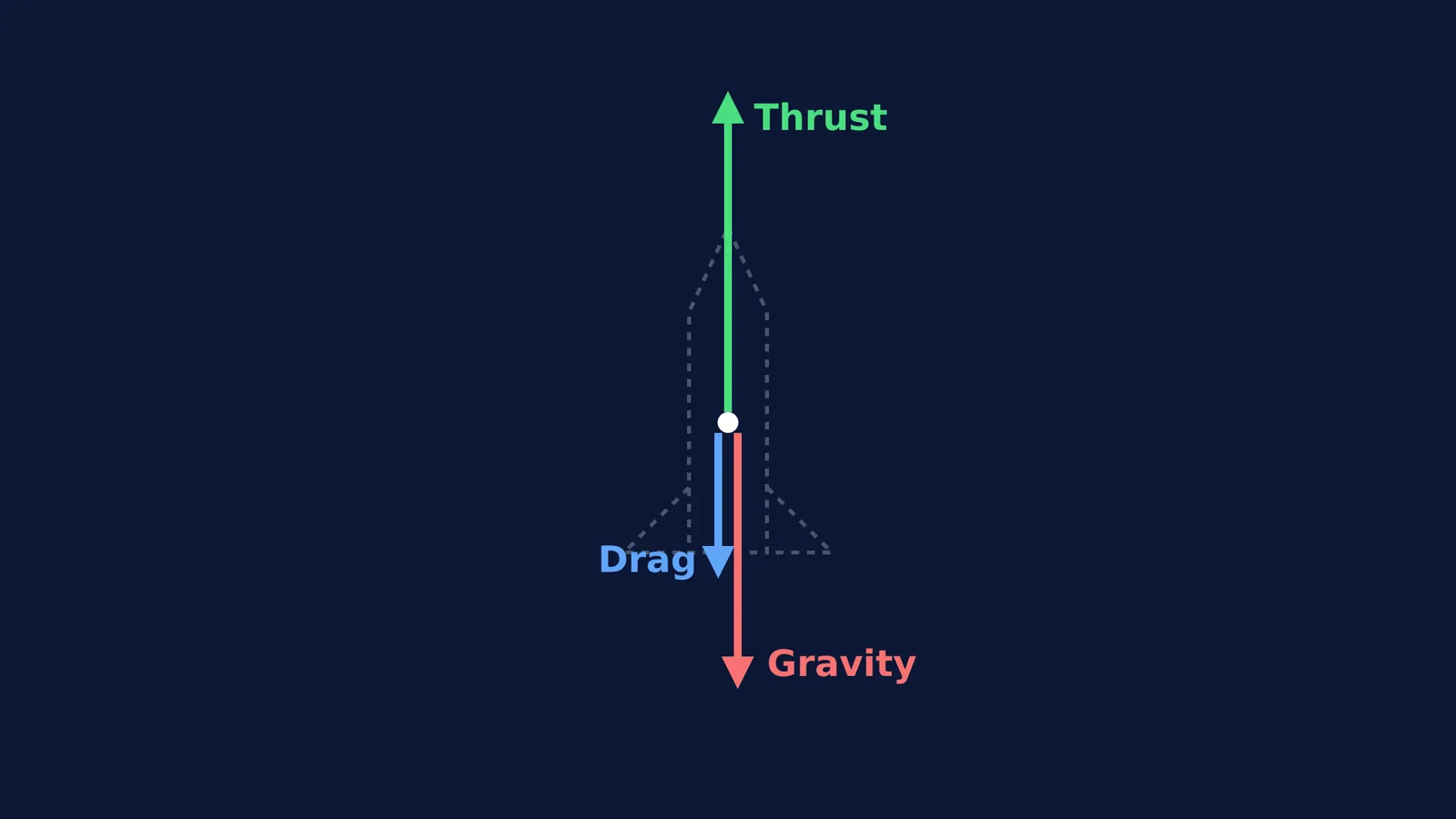
Map the forces: Draw a free-body diagram showing gravity, thrust and drag.
Conserve what you can: Use the conservation of momentum and energy to simplify the math before plugging in numbers.
If you are stuck on how to calculate an escape velocity or trace a trajectory, Fermi's AI tutor can work out what you already know and build a plan for the session, teaching through the concepts step by step.
Read more about the pioneers of space exploration:


