

On this page
The formal description of *Homo habilis* (literally "handy man") was a turning point in palaeoanthropology. It shifted the search for the earliest humans firmly to Africa and linked the dawn of our genus directly to tool-making.
Who named Homo habilis?
The name *Homo habilis* was published in April 1964 by a trio of researchers: Louis Leakey, Phillip Tobias, and John Napier. Their paper in *Nature* presented fossil evidence from Olduvai Gorge in Tanzania. The name itself, meaning "handy, mentally skilful, vigorous", was suggested to them by Raymond Dart, the South African anthropologist famous for his study of the Taung child skull.
The holotype specimen, known as OH 7, had been discovered by Jonathan Leakey in 1960. It consisted of a partial juvenile skull, lower jaw, and hand bones dating back about 1.75 million years. This discovery added to the rich findings of Louis and Mary Leakey in Africa. Before finding OH 7, the Leakeys had spent 29 years excavating the gorge, initially attributing the early stone tools they found to other hominins like *Paranthropus boisei*, simply because it was the only hominin known in the area at the time.
What did the 1964 Nature paper find?
Leakey, Tobias, and Napier argued that these fossils represented a new species belonging in the genus *Homo*, rather than *Australopithecus*. They based this conclusion on two main lines of anatomical and archaeological evidence.
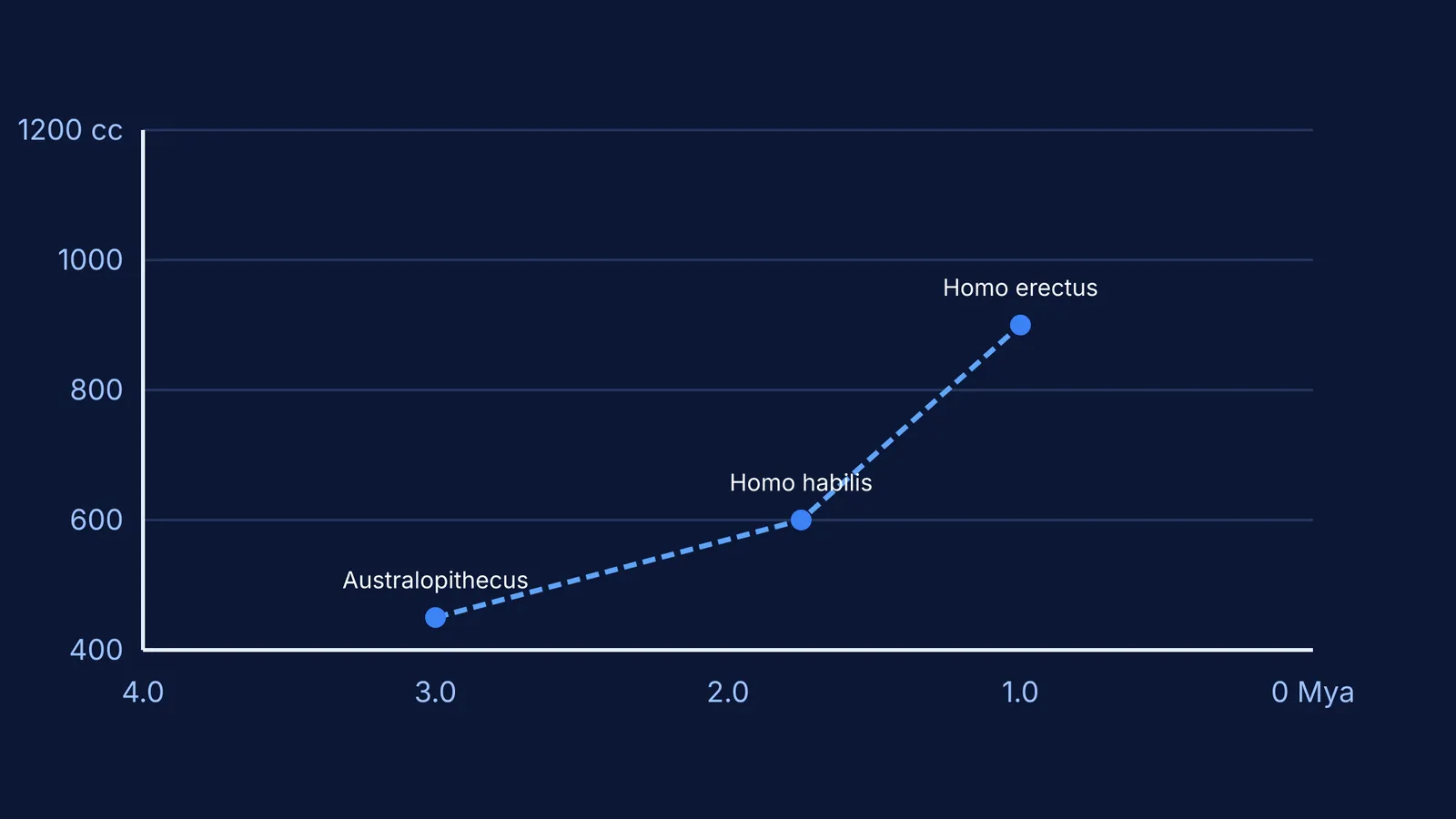
Brain size: Phillip Tobias led the anatomical analysis and estimated the cranial capacity of the OH 7 skull to be around 600 cc. He noted that this was significantly larger than the 400 to 500 cc range typical of earlier australopithecines. Tobias emphasised a major evolutionary leap, arguing that the brain size had expanded and showed new levels of cerebral organisation.
Dexterity and tools: Napier's analysis of the hand bones suggested precision gripping capabilities. Crucially, the fossils were found in the same geological layers as early Oldowan stone tools, which consisted of choppers and discoids used for butchering and skinning animals.
Why was Homo habilis highly contested?
When Leakey, Tobias, and Napier named the species, many scientists pushed back. At the time, it was widely presumed that the genus *Homo* evolved in Asia, making a 1.75 million-year-old African ancestor controversial. Furthermore, the specimen's brain size was smaller than the minimum threshold for *Homo* proposed by Wilfrid Le Gros Clark a decade earlier.
Critics, including prominent figures like Ernst Mayr, suggested the Olduvai fossils were simply a larger-brained variant of *Australopithecus africanus*. Some argued that the species was a "wastebasket taxon", mixing remains of *Australopithecus* and *Homo erectus*.
Over time, as more fossils emerged from East and South Africa with similar brain sizes and tool associations, the scientific community widely accepted *Homo habilis* as a distinct, early human species. If you are exploring the timeline of early humans, seeing how different species relate is crucial. The Fermi Concept Library holds interactive maps for every concept in biology, helping you trace evolutionary milestones like the emergence of *Homo habilis*.
What can we learn from Phillip Tobias's approach?
Phillip Tobias's work on *Homo habilis* is a masterclass in meticulous observation. While the Leakeys were famous field discoverers, Tobias spent years in the lab rigorously comparing the Olduvai bones with other primate and hominin fossils. He mapped the expansion of the cerebrum and identified patterns suggesting the lateralisation of brain function, which might be associated with tool use.
His exhaustive two-volume publication on the *Homo habilis* remains is still a standard reference in human anatomy. This shows that great science requires patient, structured analysis. When you are tackling complex biology topics, having a structured approach matters. Fermi's AI tutor teaches by holding a steady line of reasoning across a session, working out what you already know and building a plan to help you master the material.


