

On this page
On December 2, 1929, a 25-year-old Chinese paleontologist named Pei Wenzhong was excavating a cold, 40-metre crevasse at Zhoukoudian, a cave system roughly 50 kilometres southwest of Beijing (Wikipedia). Working by the dim light of a candle, he extracted a nearly complete skullcap. To protect the fragile bone from the freezing temperatures, Pei carried it back to his team.
This skullcap belonged to an extinct hominin that came to be known as Peking Man. At the time, the human evolutionary tree had significant gaps. The Zhoukoudian find provided solid proof that *Homo erectus* lived in East Asia, shifting the focus of paleoanthropology toward the continent and showing that early hominins had dispersed widely.
What did the Peking Man skullcap reveal?
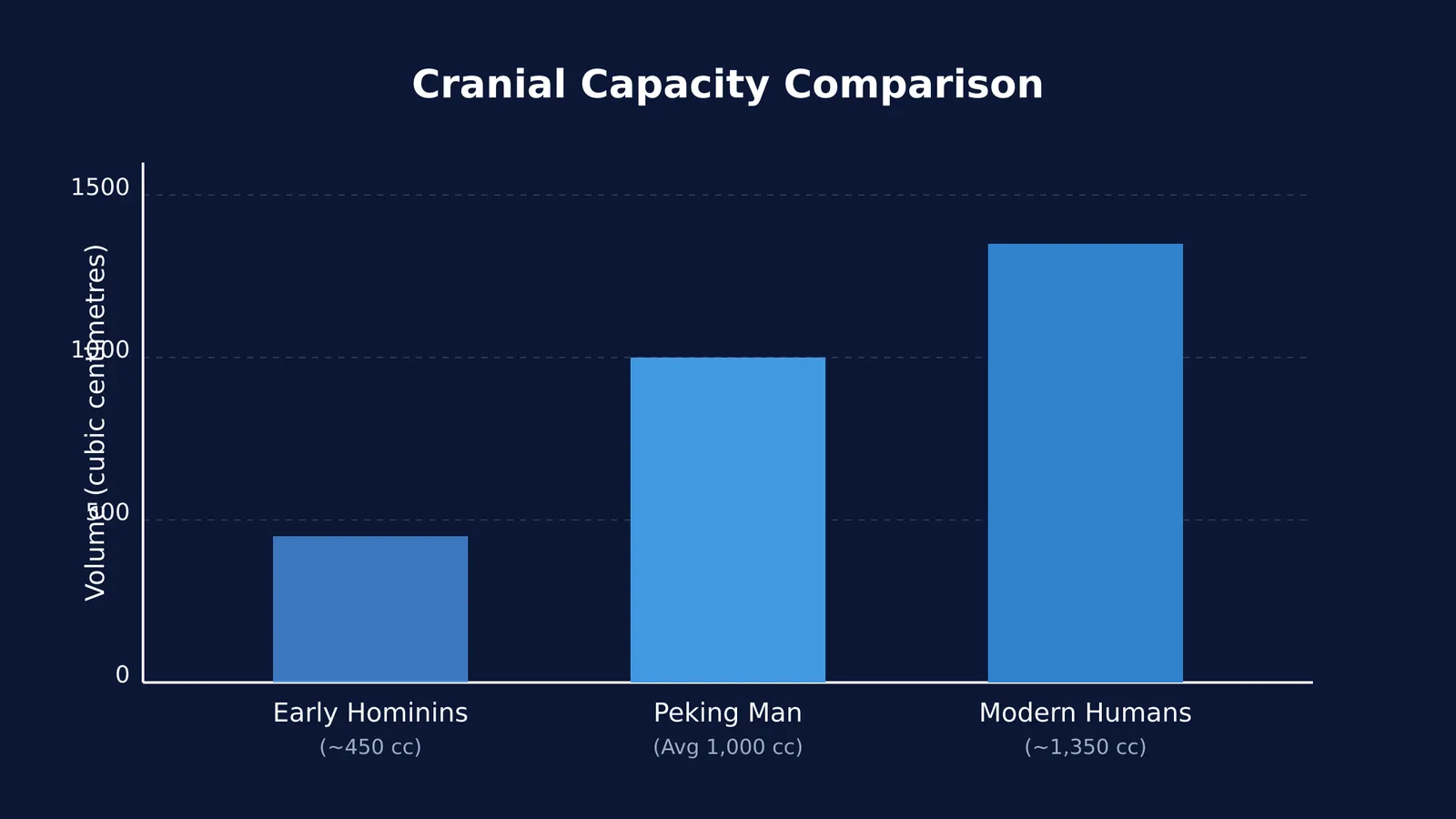
Peking Man lived between 750,000 and 230,000 years ago (Wikipedia). The fossils found at Zhoukoudian showed a cranial capacity that averaged about 1,000 cubic centimetres, with some reaching 1,300 cubic centimetres—approaching the size of a modern human brain (Britannica).
The skull had a flat profile, a receding forehead, heavy browridges, and exceptionally thick bones. A distinct "keel" ran along the top of the skull where powerful jaw muscles once attached. While the jaw was large and chinless, the limb bones were almost indistinguishable from those of modern humans.
This combination of primitive cranial features and modern limbs made Peking Man slightly more specialised than Java man, helping scientists piece together the evolutionary sequence from early apes to humans. (This work would later be complemented by finds on other continents, such as Raymond Dart and the Taung child skull of Africa.) Peking Man is estimated to have been roughly 150 centimetres tall (Wikipedia), a relatively short stature that was likely an adaptation to the cooler northern climate.
How did they live?
Pei Wenzhong was not only a fossil hunter; he was also the first to confirm the cultural practices of Peking Man at the Zhoukoudian site (Wikipedia). Zhoukoudian eventually yielded remains from at least 40 individuals and over 100,000 stone tools (Wikipedia).
Pei documented simple stone choppers and primitive flaked tools. More importantly, he discovered burned bones and ash, which indicated the controlled use of fire. This suggested a complex lifestyle for these early humans, proving they were not just anatomically advanced but also technologically capable. The discovery helped cement Pei's legacy; he went on to earn a doctorate in Paris and became a founding figure of Chinese anthropology.
What happened to the 1929 Peking Man fossils?
Despite the care Pei took to unearth and protect the skullcap, it is no longer in a museum. In 1941, during the Japanese invasion of China in World War II, an attempt was made to safely ship the original Peking Man fossils to the United States (Britannica).
Somewhere in transit—possibly on a train or at a port—the bones vanished. To this day, they have never been recovered. The mystery of their whereabouts has sparked decades of searches and countless theories, from being lost at sea to being buried under a car park. Modern researchers must rely entirely on the high-quality plaster casts and detailed descriptions made by anatomist Franz Weidenreich before the fossils were lost.
How to compare hominin fossils
When you are studying human evolution for an exam, you will need to compare species like *Homo erectus*, *Homo habilis*, and *Homo neanderthalensis* (often studied alongside the work of Louis and Mary Leakey and fossils of early humans in Africa). Rather than memorising random facts, build a comparison table using these four markers:
Cranial capacity: Note the brain volume in cubic centimetres. For example, earlier hominins had smaller brains, while the *Homo erectus* at Zhoukoudian averaged about 1,000 cubic centimetres (Britannica).
Skull shape: Look for the presence of a sagittal keel, the steepness of the forehead, and the size of the browridges.
Dentition and jaw: Check if the jaw protrudes and note the size of the teeth. Peking Man, for instance, had a large jaw but no chin.
Cultural evidence: Record whether the species is associated with stone tools or the controlled use of fire.
Paleontology asks us to build whole lineages from scattered fragments. It is a puzzle that requires understanding both the broad concepts and the tiny anatomical details, just as modern genetics later allowed researchers like Svante Pääbo and the genome of the Neanderthals to map out ancient ancestry.
If you are studying evolution for a biology exam and find the sheer volume of facts hard to organise, the Fermi Concept Library maps out every concept in biology. You can explore the relationships between hominin species, trace the timeline of human evolution, and see how traits like cranial capacity and tool use fit into the larger picture of our origins.


