

On this page
Before the incandescent light bulb arrived in homes, electric lighting meant the arc lamp. These lamps produced a blinding white light by forcing an electric current across a small gap between two carbon electrodes. They were bright enough for lighthouses, but notoriously difficult to keep running.
In 1876, a Russian engineer named Pavel Yablochkov patented a brilliant simplification that changed how cities were lit at night. By altering the geometry of the electrodes, he created the "electric candle" — a device that briefly gave Paris its reputation as the modern "City of Light" and pushed electrical engineering toward alternating current.
What was the problem with early arc lamps?
An electric arc is essentially a continuous spark. To start it, two carbon rods are touched together and then pulled slightly apart. The electricity tears electrons from the carbon, creating a plasma of glowing gas. The intense heat of this plasma emits a light far brighter than any candle or gas flame.
The problem is that the intense heat of the arc vaporises the carbon tips. As the rods burn away, the gap between them gets wider. If the gap becomes too large, the voltage can no longer push the current across, and the lamp goes out. Early arc lamps relied on complex clockwork mechanisms to slowly push the rods toward each other end-to-end to maintain the exact gap width. These regulators were expensive, fragile and prone to jamming.
If you are studying the physics of arcs, you can read more about the scientists who solved these problems in our post on Hertha Ayrton and the physics of the electric arc.
How did the Yablochkov candle work?
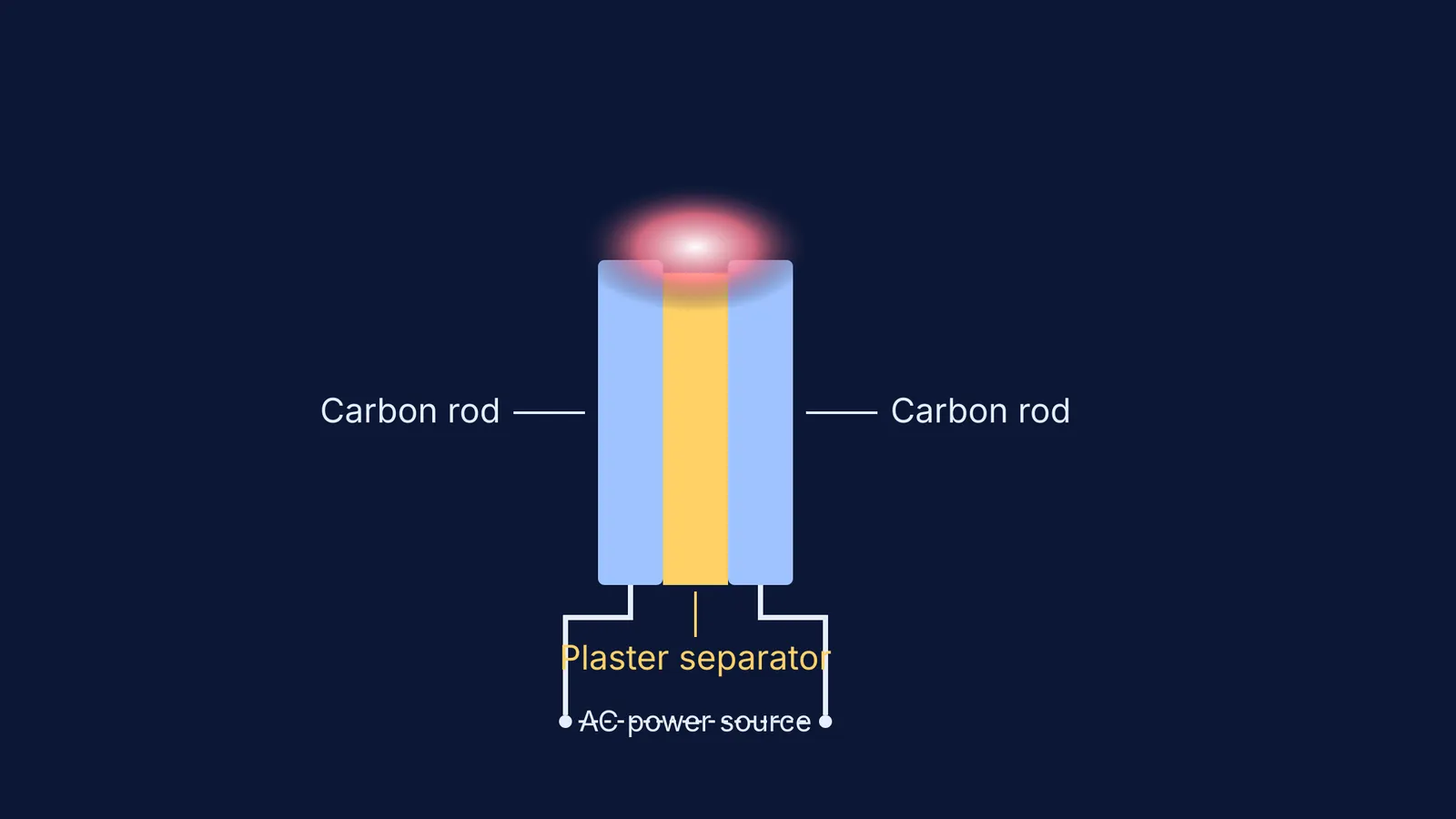
Yablochkov's insight was to stop trying to build a better mechanical regulator and instead change the arrangement of the rods. He placed two carbon rods parallel to each other, separated by a thin layer of insulating material — usually plaster of Paris or kaolin.
At the top of the candle, a small bridge of carbon paste connected the two rods. When the current was turned on, this fuse vaporised, striking the arc across the top of the plaster separator. As the carbon rods burned downwards, the intense heat of the arc melted the plaster at exactly the same rate. The device burned down from the top just like a wax candle, with no moving parts required.
This simple design posed a new physics problem. If the candle ran on direct current (DC), the positive electrode (the anode) burned away roughly twice as fast as the negative electrode (the cathode). The arc would quickly become lopsided and fail. Yablochkov solved this by running his candles on alternating current (AC). Because AC reverses direction many times a second, both rods acted as anode and cathode equally, burning down at the exact same speed.
For students trying to picture how AC behaves differently from DC in a circuit, Fermi's AI tutor can work out what you already know and build a plan for the session, running the simulation to show exactly why one rod would burn faster under steady direct current.
Why did it light up Paris?
The Yablochkov candle made its grand public debut at the 1878 Exposition Universelle in Paris. Sixty-four of these lamps were installed in large enamelled glass globes along the Avenue de l'Opéra and nearby squares. The effect was immediate. Compared to the dim, flickering yellow of traditional gas lighting, the electric candles bathed the street in a brilliant, steady white light. The installation was a global sensation, with visitors marveling at the sudden transformation of the night.
Why did it disappear?
Despite their elegance, Yablochkov candles had severe limitations. They were noisy, giving off a loud hum from the AC current, and they produced toxic fumes and UV radiation. More importantly, they were short-lived. Each candle burned for only about two hours. Once extinguished, it could not be relit because the starting fuse at the top was gone. Lamp posts had to be fitted with complex fixtures containing multiple candles that automatically switched the circuit to a fresh one when the old one burned out.
Within a few years, inventors developed cleaner, more durable alternatives, such as the indoor bulbs we cover in our post on Joseph Swan and the carbon filament light bulb. But the Yablochkov candle proved that large-scale electric street lighting was possible, and it drove the early adoption of alternating current networks that power our world today.


