

On this page
Every minute, cells in your body duplicate their chromosomes and divide. For over a century after Walther Flemming's discovery of mitosis, biologists could watch chromosomes separate under a microscope, but the biochemical clock triggering that division remained unknown. In the mid-1970s, British geneticist Paul Nurse identified the master switch in a single-celled yeast: the *cdc2* gene. His discovery that the same gene governs human cells earned him a share of the 2001 Nobel Prize in Physiology or Medicine.
Why did Paul Nurse choose fission yeast to study cell division?
In 1974, Paul Nurse joined Murdoch Mitchison's laboratory at the University of Edinburgh to study the cell cycle in the fission yeast *Schizosaccharomyces pombe*.
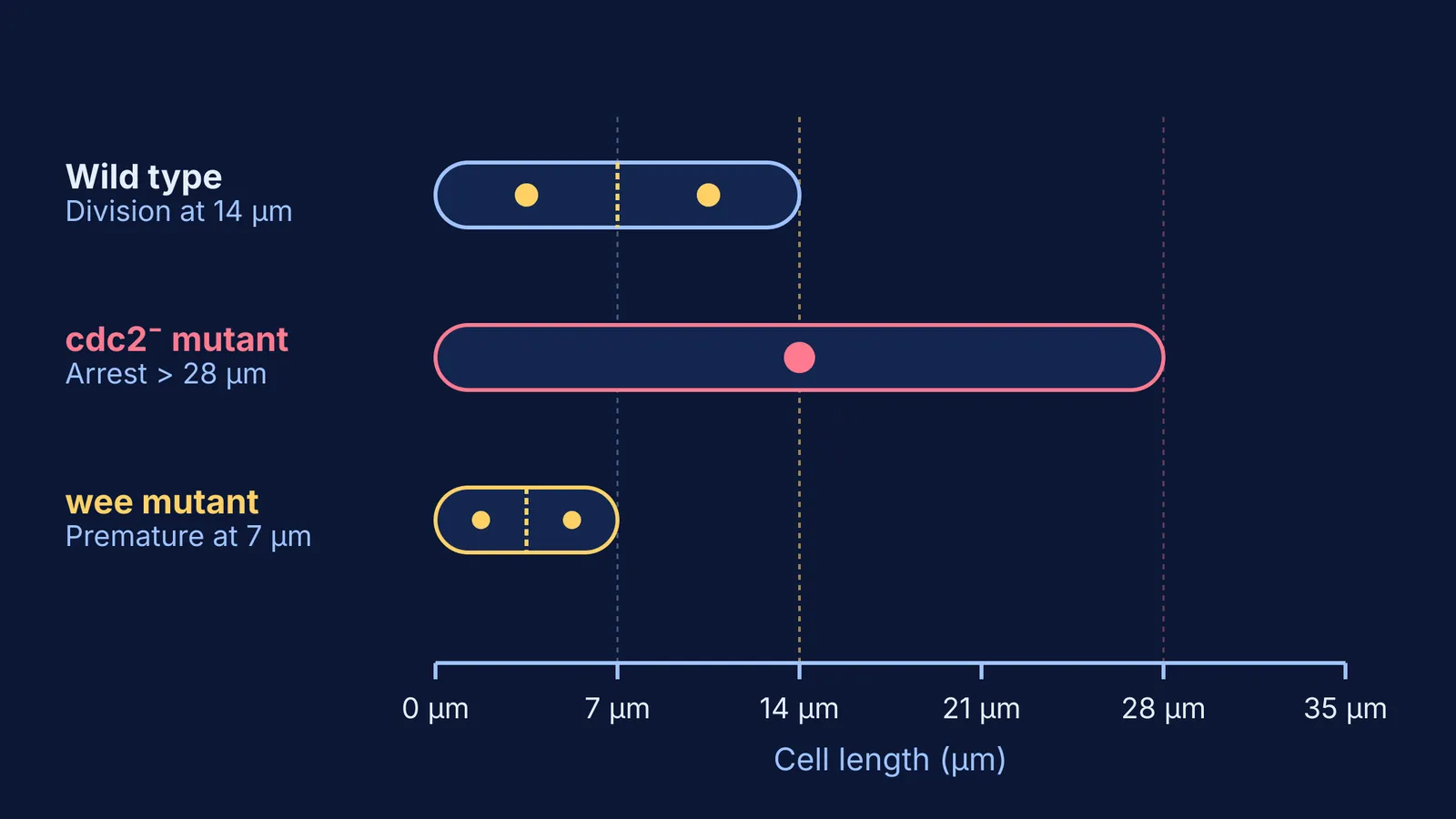
Fission yeast provided an ideal physical ruler. As detailed in Paul Nurse's Nobel lecture, *S. pombe* is a cylindrical rod that grows only by elongating at its tips while maintaining a constant diameter of roughly 3 µm. A wild-type cell divides symmetrically at a length of approximately 14 µm, cleaving into two 7 µm daughter cells. Because length tracks cell cycle progress, Nurse could gauge a cell's exact stage under a microscope with an eyepiece graticule.
How did Paul Nurse discover the cdc2 gene and wee mutants?
To identify regulatory genes, Nurse screened temperature-sensitive mutants that divided normally at a permissive temperature of 25 °C but failed at a restrictive temperature of 35 °C or 36 °C. In a 1976 study in Molecular and General Genetics, Nurse, Pierre Thuriaux and Kim Nasmyth mapped 14 cell division cycle (*cdc*) genes.
One gene, *cdc2*, proved exceptional. At 36 °C, *cdc2* mutants could not enter mitosis, but cellular growth continued. The cells elongated into giant filaments exceeding 28 µm without dividing.
Next, Nurse isolated tiny mutants that divided prematurely. He named them *wee* mutants, after the Scottish word for small, in a 1980 study in Genetics. These *wee1* mutants divided at only 7 µm, half the wild-type size. Crucially, dominant mutations in *cdc2* itself (*cdc2-w*) produced the same tiny phenotype, proving that *cdc2* was the rate-limiting accelerator of mitosis. Nurse also showed that *cdc2* acted twice: first at the G1/S commitment to DNA replication, and again at the G2/M trigger for mitosis.
How did a human gene rescue yeast cells that could not divide?
Because yeast and humans diverged roughly 1 to 1.5 billion years ago, most biologists assumed human cell cycle controls would be completely different.
In 1987, Melanie Lee and Paul Nurse tested whether human DNA could function in yeast. They introduced a human cDNA library into a temperature-sensitive *cdc2-33* yeast mutant unable to divide at 36 °C. As reported in Nature, human cDNA successfully rescued the mutant, restoring normal cell division at 36 °C. The cloned gene encoded a 297-amino-acid protein kinase sharing 63% amino acid identity with yeast cdc2, as documented in their 1987 Nature paper. That human gene, now named CDK1, proved the cell cycle engine is universal.
How does cdc2 regulation appear in NEET biology?
For students preparing for NEET-UG, cell cycle questions frequently test the biochemical logic connecting interphase to mitosis. (You can review phase sequences in our guide to cell cycle stages, mitosis and meiosis, or centromere dynamics in our guide to identifying chromosome structures).
Key regulatory principles highlighted by the Nobel Committee in 2001 include:
CDK concentration vs. activity: CDK levels remain constant throughout the cycle; its activity oscillates because its activating cyclin partners are periodically synthesised and destroyed.
Phosphorylation toggles: CDK1 is held inactive during G2 by Wee1-mediated phosphorylation until DNA replication completes, when Cdc25 phosphatase removes the phosphate to trigger mitosis.
Cancer connections: Unchecked CDK activation drives uncontrolled cell proliferation in human tumors.
A four-step framework for tracing cell cycle checkpoints
When tackling cell division and checkpoint questions, use this diagnostic framework:
Check the arrest phenotype: If cells arrest with continuous elongation (like *cdc2* mutants at 36 °C), cell growth is intact while checkpoint progression is blocked.
Separate engine from timer: Treat CDK as the stable engine and cyclins as the fluctuating timer.
Trace the phosphate switch: Inhibitory phosphorylation delays mitosis; dephosphorylation by Cdc25 triggers division. Inactivating Wee1 causes premature division (*wee* phenotype).
Apply evolutionary conservation: CDK1 mechanisms mapped in yeast apply directly to human somatic cells.
To master complex regulatory cascades in cell biology, the Fermi Concept Library maps every concept from basic mitosis to molecular signalling. For practice on genetics and cell cycle problems, the Fermi Problem Library explains each step of the reasoning rather than just printing an answer. And when you sit down to plan your weekly revision schedule, Fermi's AI tutor works out what you know and builds a plan for the session.


