On this page
Patricia Bath was a New York-born eye surgeon who looked at an old operation, cataract removal, and asked whether light could do the cutting. Her answer was the Laserphaco probe. She came up with the idea in 1981 and received US patent 4,744,360 in 1988, according to the National Inventors Hall of Fame, which inducted her in 2022 and describes her as the first Black woman physician to receive a medical patent.
Who was Patricia Bath?
Bath was born in Harlem, New York, on 4 November 1942. She earned a BA from Hunter College in 1964, studying chemistry and physics, and an MD from Howard University in 1968, according to the Lemelson-MIT Program.
Her career was full of firsts. The US National Library of Medicine says she was the first African American resident in ophthalmology at New York University, the first woman on the faculty of the ophthalmology department at UCLA's Jules Stein Eye Institute, and, in 1983, the first woman in the United States to chair an ophthalmology residency programme, at Drew-UCLA.
She also created a new field called community ophthalmology, which combines public health, community medicine and clinical eye care. In 1977 she and three colleagues founded the American Institute for the Prevention of Blindness, whose mission, in the NLM's words, is "to protect, preserve, and restore the gift of sight" (NLM). She died on 30 May 2019 (Lemelson-MIT).
How does the Laserphaco probe remove a cataract?
A cataract is a cloudy area in the lens of the eye, the clear part that helps focus light (National Eye Institute). In surgery, the doctor removes the clouded lens and puts in an artificial intraocular lens, an idea that goes back to Harold Ridley's intraocular lens.
Bath's patent is titled "Apparatus for ablating and removing cataract lenses". The patent text for US 4,744,360 describes how the parts work together:
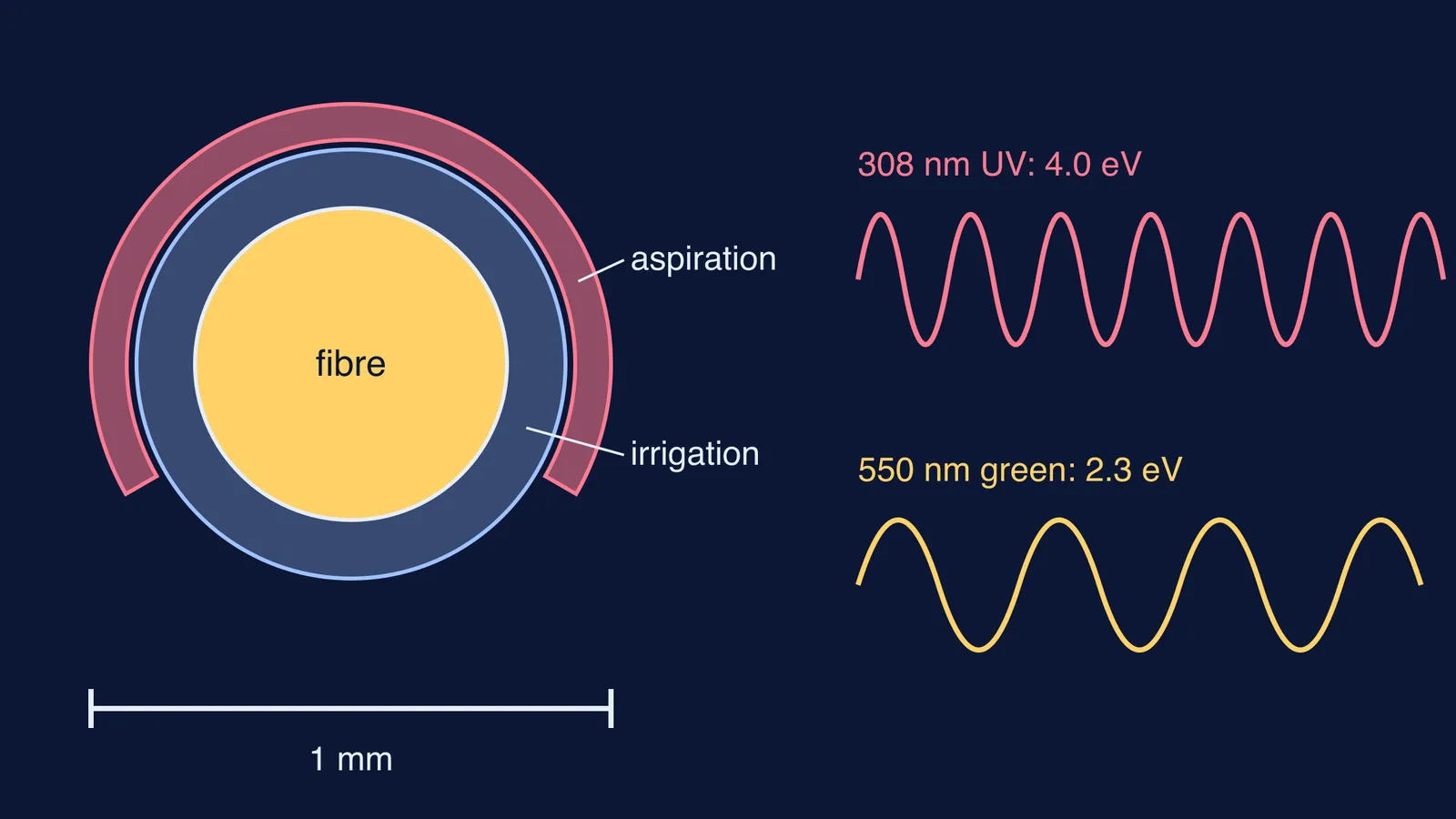
A flexible line, preferably 1 mm or less in diameter, goes through a small cut into the front chamber of the eye until its tip sits next to the cataract.
An optical fibre inside it, which can be made no more than 600 microns across, carries the laser light.
The laser breaks the cloudy lens into particles smaller than 0.1 mm.
An irrigation sleeve around the fibre washes liquid in, and an aspiration sleeve draws the fragments out by suction.
In the Hall of Fame's words, the device performed all the steps: "making the incision, destroying the lens and vacuuming out the fractured pieces" (NIHF).
Why did the probe use ultraviolet light?
The patent says radiation from 193 to 351 nm proved satisfactory, and 308 nm, from a xenon chloride excimer laser in its experiments, was the most effective experimental wavelength (US 4,744,360). You can see why short wavelengths matter with one Class 12 formula.
Photon energy is E = hc/λ. With hc ≈ 1240 eV·nm, you can work it out in your head:
308 nm (ultraviolet): E = 1240 / 308 ≈ 4.0 eV per photon
550 nm (green light): E = 1240 / 550 ≈ 2.3 eV per photon
Ratio: 4.0 / 2.3 ≈ 1.8, so each ultraviolet photon carries almost twice the energy of a green one
Now try the ends of the patent's range: you should get about 6.4 eV at 193 nm and 3.5 eV at 351 nm. Shorter wavelength, more energy per photon, the same relation as in the photoelectric effect.
If photons and wavelengths still feel abstract, the Fermi Simulation Lab has interactive simulations for ideas that are easier to see than to read.
Why does cataract surgery still matter?
The World Health Organization estimates that 94 million people have distance vision impairment or blindness caused by cataract (WHO fact sheet, February 2026). India's chapter in this story is told in our piece on Govindappa Venkataswamy and high-volume cataract surgery. The idea of removing a cataract through a hollow instrument is centuries older, as Ammar al-Mawsili's cataract needle shows.
What can students learn from how she worked?
Bath's dates show how real invention moves. She had the idea in 1981, when it was ahead of the technology available, and spent nearly five years on research and testing (NLM). She filed the patent in December 1986 and had it granted in May 1988 (patent record). You can borrow the pattern for a science project or an olympiad research question:
Start from a real problem, not from a gadget you want to build.
Write the physics in one line, such as E = hc/λ or Bernoulli's equation.
List the parts and what each must do, the way her patent separates fibre, irrigation and aspiration.
Test one part at a time and note what failed as well as what worked.
Plan in months, not days.
If you are not sure where to begin with a topic like optics, Fermi's AI tutor works out what you already know and builds a plan for the session, so you start with a clear next step.