On this page
In 1654, a French nobleman and gambler known as the Chevalier de Méré (Antoine Gombaud) posed a question to the mathematician Blaise Pascal (Wikipedia). The puzzle, known as the "problem of points", asked how to fairly divide the prize pot of an interrupted game of chance.
Pascal reached out to fellow mathematician Pierre de Fermat. Through a series of letters exchanged that summer, they solved the problem and, in the process, created the mathematical foundation of modern probability theory.
What is the problem of points?
Imagine two players flip a coin, and the first to win 10 rounds takes a pot of 100 coins. If the game is interrupted when Player A has 9 wins and Player B has 8, how should the 100 coins be split?
Earlier mathematicians had tried to solve this by looking at the past. In 1494, Luca Pacioli suggested dividing the pot based on the ratio of rounds already won (Wikipedia). By his logic, the pot would be split 9 to 8. However, another mathematician, Niccolò Tartaglia, pointed out the flaw in this method: if a game to 10 points is interrupted after just one round, giving the entire pot to the player leading 1-0 is clearly unfair.
Pascal and Fermat realised that a fair division must be based on the future, not the past. It depends on the probability of each player winning if the game had continued.
How did Fermat count the future?
Fermat approached the problem by listing all the ways the game could finish.
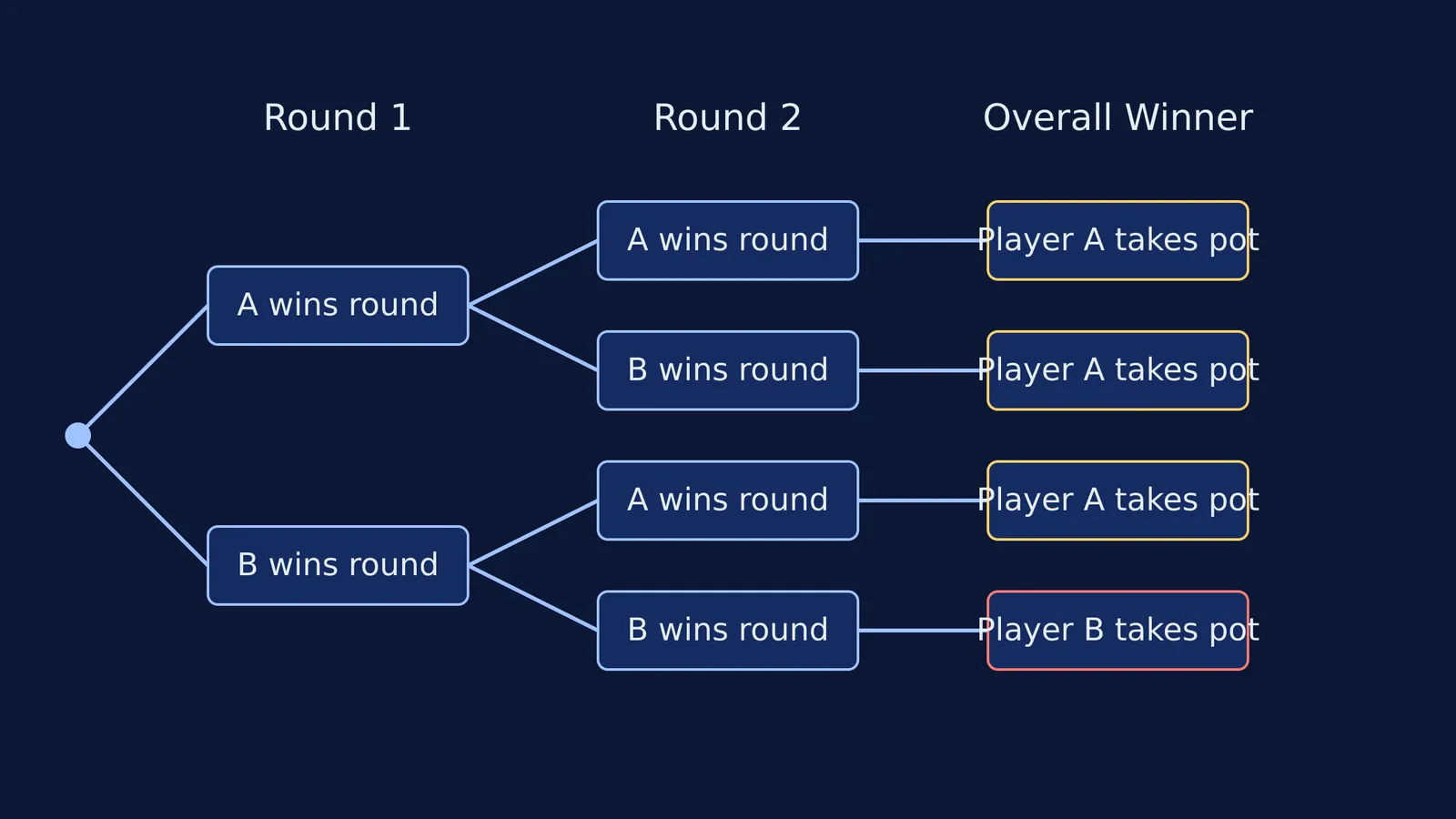
If Player A needs 1 more point to win and Player B needs 2, the game must end in at most 2 more rounds. Fermat imagined that the players always play exactly 2 rounds to make all outcomes equally likely (Wikipedia).
There are four possible sequences for the next two coin flips:
Player A wins, Player A wins (A needs 1, gets 2, so A wins the pot)
Player A wins, Player B wins (A needs 1, gets 1, so A wins the pot)
Player B wins, Player A wins (A gets 1, B gets 1, so A wins the pot)
Player B wins, Player B wins (B gets 2, so B wins the pot)
Out of the four equally likely futures, Player A wins the overall game in three of them. Player B wins in only one. Therefore, the fair way to divide the stakes is in a 3:1 ratio: Player A takes 75% of the pot, and Player B takes 25%.
How did Pascal use expected value?
Pascal reached the exact same 3:1 ratio using a different method. He reasoned about the "value" of the very next round—an early form of what we now call mathematical expected value (Wikipedia).
He broke it down one step at a time:
If Player A wins the next round, A hits the target and takes 100% of the pot.
If Player B wins the next round, the score is tied (A needs 1, B needs 1). At a tie, the fair split is 50% for A and 50% for B.
Since Player A has an equal chance of the next round leading to a 100% share or a 50% share, A's current fair share is the average of the two: 75%.
When the number of remaining rounds was large, Pascal used his Arithmetical Triangle (Pascal's Triangle) to count the combinations quickly.
If you are practicing these probability distributions for your exams and find yourself making wrong-method mistakes, the Fermi Problem Library has worked problems with a step-by-step solver that explains the reasoning rather than printing an answer.
How do you solve an interrupted game problem?
The Pascal-Fermat letters of 1654 established the mathematics that we use for these questions today. When you encounter a problem of points in your own studies, you can use Fermat's maximum rounds method.
Here is the framework:
Identify how many points Player A needs to win (r).
Identify how many points Player B needs to win (s).
Calculate the maximum number of rounds the game could possibly last: r + s - 1.
List all possible sequences of wins and losses for that number of rounds.
Count how many sequences result in a win for A, and how many for B.
Their work changed how we understand risk. Whether you are dividing stakes in a game, reading Andrey Kolmogorov and the three axioms behind every probability, or solving Probability in Class 10: cards, dice and coins worked step by step, you are relying on the logic built in the summer of 1654. You can also explore more about the man behind the math in Blaise Pascal: pressure, a mountain barometer and probability.