

On this page
What is the Aṣṭādhyāyī?
Between the 6th and 4th centuries BCE, the scholar Pāṇini authored the *Aṣṭādhyāyī* (meaning "Eight Chapters"), a comprehensive grammar text that describes the Sanskrit language. Instead of creating a dictionary of all possible words, Pāṇini wrote a system of nearly 4,000 algebraic rules that dictate how sounds and meanings combine.
When you apply these rules to base roots and suffixes in the correct order, they generate valid Sanskrit words and sentences. This approach—creating complex structures from a small set of foundational rules—makes the *Aṣṭādhyāyī* the world's first formal generative grammar. It is a powerful way of thinking that appears across the sciences today. For example, naming carbon compounds in Class 10: prefixes, suffixes, examples uses root words and specific modifiers in exactly the same way to build chemical names from a base set of rules.
How is Pāṇini's grammar like a programming language?
In 1959, computer scientists John Backus and Peter Naur developed a formal notation system to define the syntax of the ALGOL 60 programming language. Known as Backus-Naur form (BNF), it uses formal "rewrite rules" to show how certain symbols can be substituted for one another to create valid lines of code. BNF quickly became the standard metasyntax for nearly all modern programming languages, from C++ to Python.
However, researchers soon noticed that Backus and Naur were not the first to invent this specific mathematical structure. In 1967, computer scientist Peter Zilahy Ingerman published a letter in the *Communications of the ACM* suggesting that BNF should be renamed "Pāṇini-Backus Form". Ingerman pointed out that Pāṇini had independently developed an equivalent notation more than 2,000 years earlier. Both systems use "meta-symbols"—markers that guide the internal derivation process but disappear before the final output is produced—alongside context-sensitive replacements.
What does a Pāṇinian rule look like?
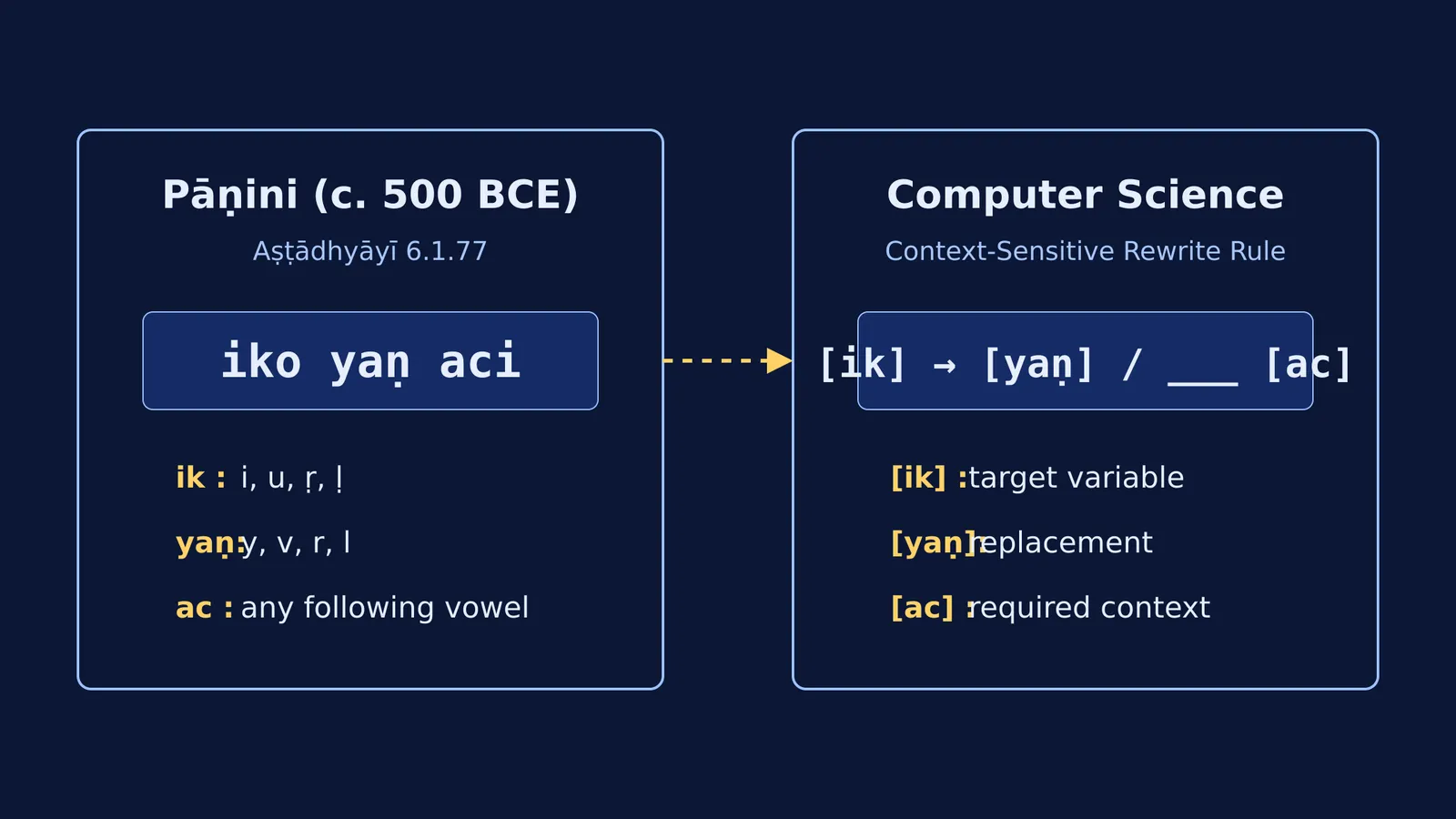
To see the algorithmic nature of the grammar in action, consider the famous rule *iko yaṇaci* (Aṣṭādhyāyī 6.1.77). This rule dictates how vowels transform when they meet other vowels during speech.
Pāṇini's rule acts exactly like a line of code using variables:
ik: A variable representing the specific vowels *i, u, ṛ, ḷ*.
yaṇ: A variable representing the semivowels *y, v, r, l*.
ac: A variable representing any following vowel.
The rule states: replace *ik* with *yaṇ* when followed by *ac*. In modern computer science, this is written as a context-sensitive rewrite rule: [ik] → [yaṇ] / ___ [ac].
If the input is the word *yadi* (ending in the *ik* vowel *i*) combined with *api* (starting with the *ac* vowel *a*), the conditional rule triggers. The *i* is transformed into a *y*, generating the final, correct word *yadyapi*. The logic operates as a perfect algorithm, requiring no human intuition to execute.
Why does this matter for modern students?
Because Pāṇini lived in an era before widespread writing, he had to memorise and transmit his work orally. To make the text as compact as possible, he designed a system that completely eliminated redundancy by establishing scope. Once a grammatical context (such as "in the future tense") is declared in a heading rule, it trickles down and applies to all subsequent rules until a new heading cancels it, functioning much like global variables in a software program.
Just as the Fermi Problem Library has worked problems with a step-by-step solver that explains the reasoning rather than printing an answer, Pāṇini's rules do not simply list vocabulary. They teach the logical steps required to derive any valid form yourself. Spotting and applying these deep structural patterns is a core analytical skill, whether you are studying linguistics, writing software, or finding Aⁿ for a matrix by spotting the pattern. Pāṇini saw language as an organic system driven by underlying mathematics, a perspective that mirrors how D'Arcy Thompson and the mathematics of growth and form modelled biology centuries later.


