

On this page
In 1721, a severe smallpox epidemic struck Boston, devastating its population of roughly 11,000 residents (Wikipedia)).
During this crisis, an enslaved African man named Onesimus shared a medical procedure from his homeland that would change the course of immunology in America.
By introducing variolation—an early precursor to modern vaccination—Onesimus provided the crucial knowledge needed to run one of history's first recorded clinical trials.
What caused the 1721 Boston Epidemic?
The outbreak began in April 1721 when the HMS *Seahorse* arrived in Boston harbor carrying the variola virus. As the disease spread rapidly, it threatened to overwhelm the entire colony and its fragile healthcare system. Smallpox was a highly contagious and exceptionally lethal disease, characterised by high fevers, body aches and fluid-filled blisters.
Cotton Mather, a prominent Puritan minister, recalled a conversation he had years earlier with Onesimus, an enslaved Akan man he had purchased in 1706. When Mather asked if Onesimus had ever had smallpox, Onesimus explained that he had undergone an operation in West Africa that gave him a mild case of the disease, leaving him immune for life. The practice, although foreign to European settlers in America, was already widely understood and applied in parts of Africa and Asia.
How did Onesimus describe the inoculation?
Onesimus described a procedure known as variolation. It involved taking fluid or pus from an active smallpox pustule and rubbing it into a small scratch on a healthy person's arm. This deliberate exposure usually triggered a mild, non-fatal infection that resolved within a few weeks.
Biologically, this process relies on active immunity. By introducing a live antigen into the body, the immune system is forced to produce its own antibodies and memory cells. Once the memory cells are established, the body can mount an overwhelming defence if exposed to the pathogen again. If you want to dive deeper into the cellular mechanisms behind this, Human health and disease for NEET: pathogens, immunity, vaccines breaks down how your body mounts this defence.
Did the 1721 inoculation experiment work?
Mather began campaigning for the public to adopt Onesimus's method, but he faced violent, racially motivated opposition. Critics argued that accepting medical advice from an enslaved African was dangerous, and they feared that intentional infection would only spread the epidemic further. One opponent even threw a small bomb through Mather's window.
Only one local physician, Dr. Zabdiel Boylston, agreed to test the procedure. He inoculated his own son and two enslaved people in his household, eventually expanding the trial.
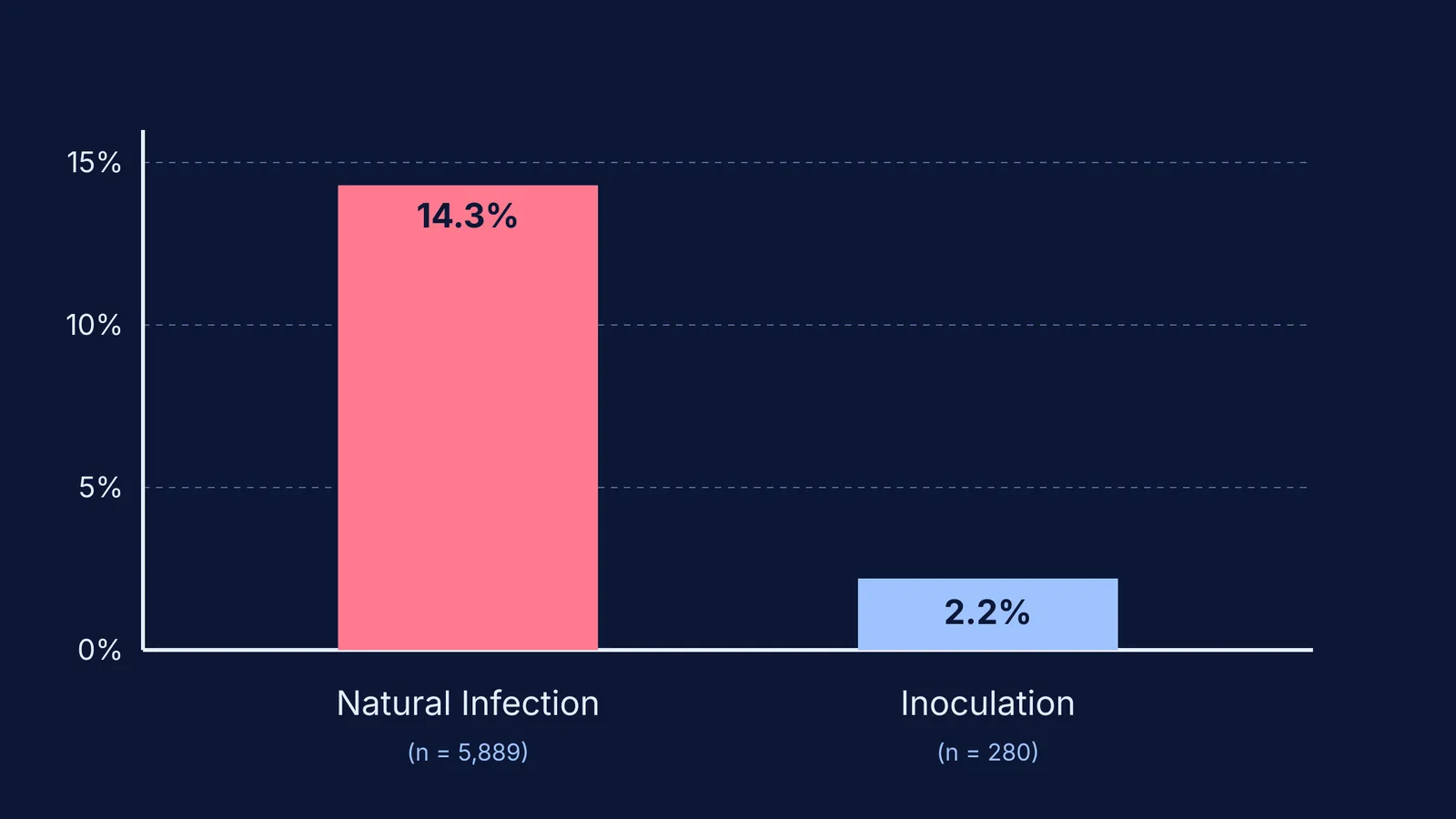
The results provided the first statistical evidence for immunisation in the colonies. Out of 5,889 naturally infected cases, 844 died, yielding a 14.3% mortality rate (Wikipedia)). Out of roughly 280 inoculated cases, only 6 died, yielding a 2.2% mortality rate (Wikipedia)).
By drastically reducing the death rate, this success laid the groundwork for Edward Jenner’s development of the safer cowpox vaccine in 1796, which ultimately led to the global eradication of smallpox.
How do we analyse historical biology experiments?
Understanding historical discoveries requires linking the macro events of history to the micro cellular mechanisms they revealed. The story of T-cells and adaptive immunity took another two centuries to unfold, a journey you can trace in the work of Jacques Miller and the role of the thymus in immunity.
If you struggle to connect historical case studies to modern immunology concepts, Fermi's AI tutor can work out what you already know and build a plan for the session, so you sit down to a clear next step.
Framework: Analysing medical breakthroughs
When reviewing historical discoveries for biology exams, test your understanding with this three-step framework:
The mechanism: Does the method introduce an antigen to trigger active immunity, or pre-made antibodies for passive immunity? Variolation is a prime example of generating artificial active immunity.
The evidence: What were the control and experimental groups? In Boston, the 5,889 naturally infected people served as a grim control group against Boylston's inoculated patients. Modern clinical trials still rely on this comparative structure.
The legacy: How did this shape modern understanding? Variolation directly inspired later vaccine development, demonstrating that exposing the body to a controlled dose of a pathogen builds lasting immune memory.
To explore every concept in biology and its place in the map, try the Fermi Concept Library.


