

On this page
At its heart, a metal-organic framework (MOF) extends transition metal coordination into infinite three-dimensional architecture. In traditional coordination chemistry, as explored in Alfred Werner's coordination theory, metal ions bind ligands to form isolated complexes. In contrast, reticular chemistry stitches metal clusters with organic linkers through strong coordinate covalent bonds. On 8 October 2025, Omar M. Yaghi was awarded the Nobel Prize in Chemistry alongside Susumu Kitagawa and Richard Robson for developing metal-organic frameworks, as announced by the Nobel Foundation.
What makes a metal-organic framework so porous?
The defining hallmark of these frameworks is their extraordinary internal porosity. While a teaspoon of kitchen salt has an external surface area of less than 0.1 m², a single gram of an engineered MOF crystal contains an intricate labyrinth of nanoscale pores with internal surface areas spanning 2,000 to over 7,000 m². In a study published in Science, Hiroyasu Furukawa, Omar Yaghi, and their colleagues reported that MOF-210 achieved a Brunauer-Emmett-Teller (BET) surface area of 6,240 m²/g and a Langmuir surface area of 10,400 m²/g, approaching the theoretical physical limit for solid-state adsorption.
When visualising 3D unit cells, coordination spheres, and gas diffusion in solid-state chemistry feels abstract, the Fermi Simulation Lab provides interactive simulations for ideas that are easier to see than to read.
How did Omar Yaghi create permanent crystal pores?
According to the Nobel Foundation, Omar Yaghi was born in Amman, Jordan in 1965 to a refugee family. At age 10, he discovered drawings of molecular models in his school library, sparking a fascination with chemical symmetry. After moving to the United States at age 15, he completed his studies and set out to challenge a prevailing assumption in materials science: that linking metal ions with organic struts would inevitably produce fragile powders or disordered gels.
In 1995, Yaghi showed in Nature that coordination networks could selectively bind and release guest molecules. Yet early coordination polymers collapsed when solvent was evacuated. Yaghi solved this fragility in 1999 with MOF-5, reported in Nature.
His breakthrough was introducing Secondary Building Units (SBUs). Instead of single metal ions that could twist, Yaghi assembled rigid multinuclear clusters—such as octahedral [Zn₄O(CO₂)₆] nodes—locked by rigid 1,4-benzenedicarboxylate struts. This created a robust cubic lattice that remained crystalline up to 300 °C in air, maintaining permanent open pores with a Langmuir surface area of 2,900 m²/g, measured by gas sorption following Irving Langmuir's surface adsorption model. Atomic coordinates of these crystals are confirmed using X-ray crystallography, grounded in Lawrence Bragg's X-ray diffraction law.
How do crystal sponges pull drinking water from desert air?
Most commercial atmospheric water generators chill humid air below its dew point. As documented in Science, while refrigeration systems operate effectively at relative humidity above 60%, they fail in arid regions where humidity drops below 20%. Reaching the dew point in desert air requires cooling below freezing, consuming excessive electrical power and choking coils in ice.
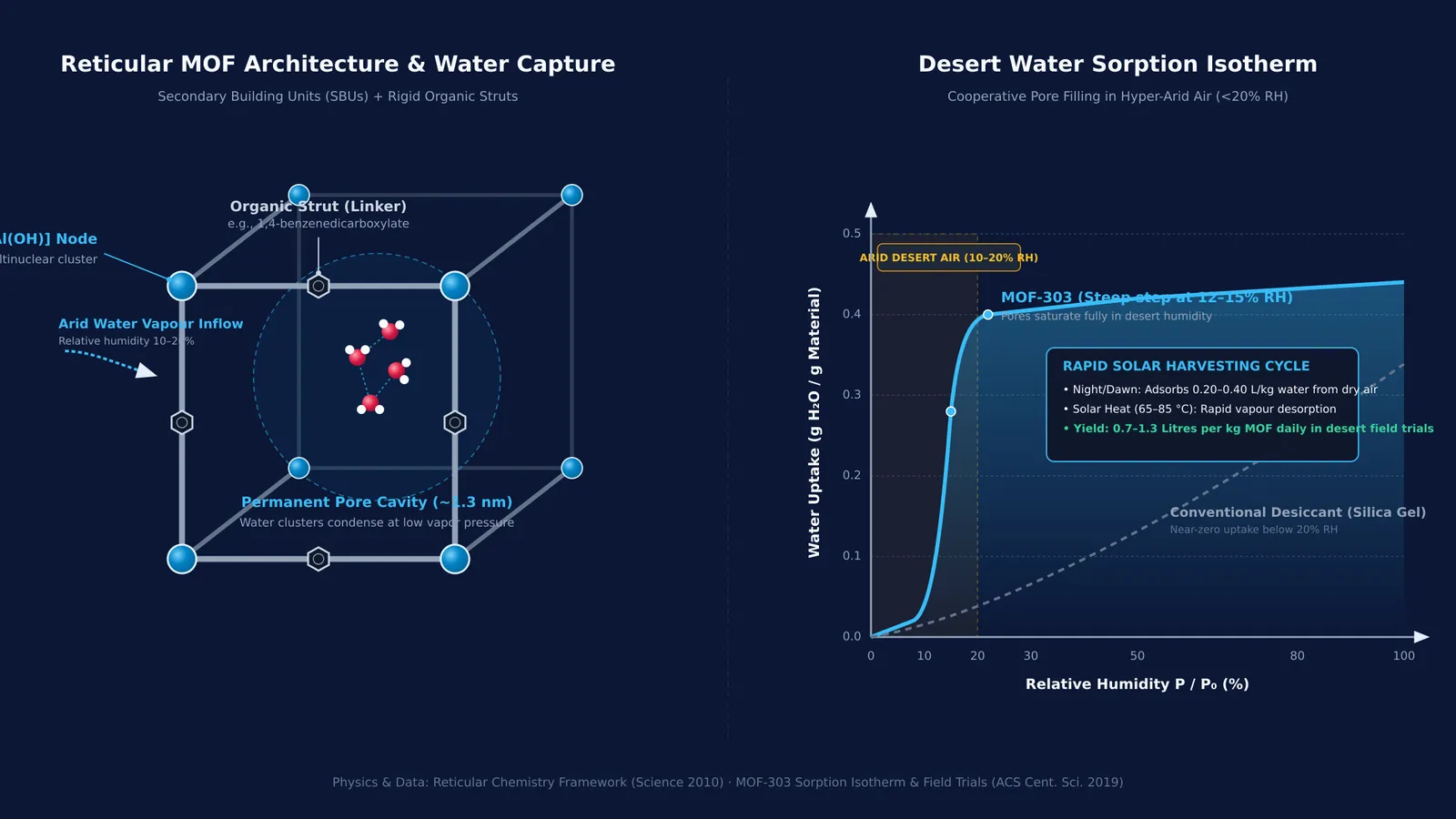
Metal-organic frameworks harvest water through chemical adsorption instead of refrigeration. By tuning pore sizes and adding hydrophilic groups, chemists create cavities that capture water vapour at low partial pressures. Once inside, water molecules cooperatively condense into liquid clusters. Because the framework binds water through moderate hydrogen bonds, mild heat from natural sunlight releases it as vapour, which condenses into liquid water at ambient temperature.
In 2017, a team led by Hyunho Kim, Evelyn Wang, and Omar Yaghi demonstrated a solar-powered harvester in Science. Using MOF-801, the device extracted 2.8 litres of water per kilogram of MOF daily at 20% relative humidity, powered by sunlight at a flux under 1 sun.
Yaghi's team conducted field trials in Scottsdale, Arizona, reporting in Science Advances that MOF harvesters produced water in desert air with humidity down to 10%. In 2019, Nikita Hanikel, Omar Yaghi, and colleagues reported in ACS Central Science that an aluminium framework, MOF-303, delivered 0.7 litres of water per kilogram of MOF daily in the Mojave Desert at 10% relative humidity, and 1.3 litres per kilogram daily indoors at 32% humidity.
To understand how this operates in practice, consider a solar-powered harvester carrying 2.5 kilograms of MOF-303:
Active surface area: At 1,400 m²/g, 2.5 kg of MOF powder provides 3.5 million square metres of adsorption surface—equivalent to 500 football pitches in a tabletop device.
Rapid thermal cycling: Operating with solar heat, the harvester completes 6 adsorption-desorption cycles over 24 hours. At 15% relative humidity, each cycle captures 0.20 litres of water per kilogram of sorbent.
Daily water yield: Total production reaches:
Yield = 2.5 kg × 0.20 L/kg/cycle × 6 cycles = 3.0 litres of pure water daily.
This output satisfies the daily drinking water requirement for an adult in an arid climate with zero grid electricity.
When designing reticular materials for gas storage or water harvesting, chemists apply a three-step framework:
SBU geometry: Select multinuclear metal nodes that fix coordination angles and resist collapse.
Pore aperture tuning: Tailor linker length so pores admit target molecules while excluding larger gases.
Mild regeneration energetics: Balance adsorption energy so molecules bind at low humidity but release under solar heat below 80 °C.
For students working through coordination complexes, lattice geometry, and equilibrium numericals, the Fermi Problem Library provides worked problems with a step-by-step solver that explains the reasoning rather than printing an answer.


