

On this page
Why did Nikolai Vavilov build the first global seed bank?
In the early twentieth century, recurrent crop failures devastated farming communities across Eurasia. Agronomist Nikolai Ivanovich Vavilov (1887–1943) recognised that modern crops relied on dangerously narrow genetic foundations. Whenever droughts or pathogens struck, uniform crops failed.
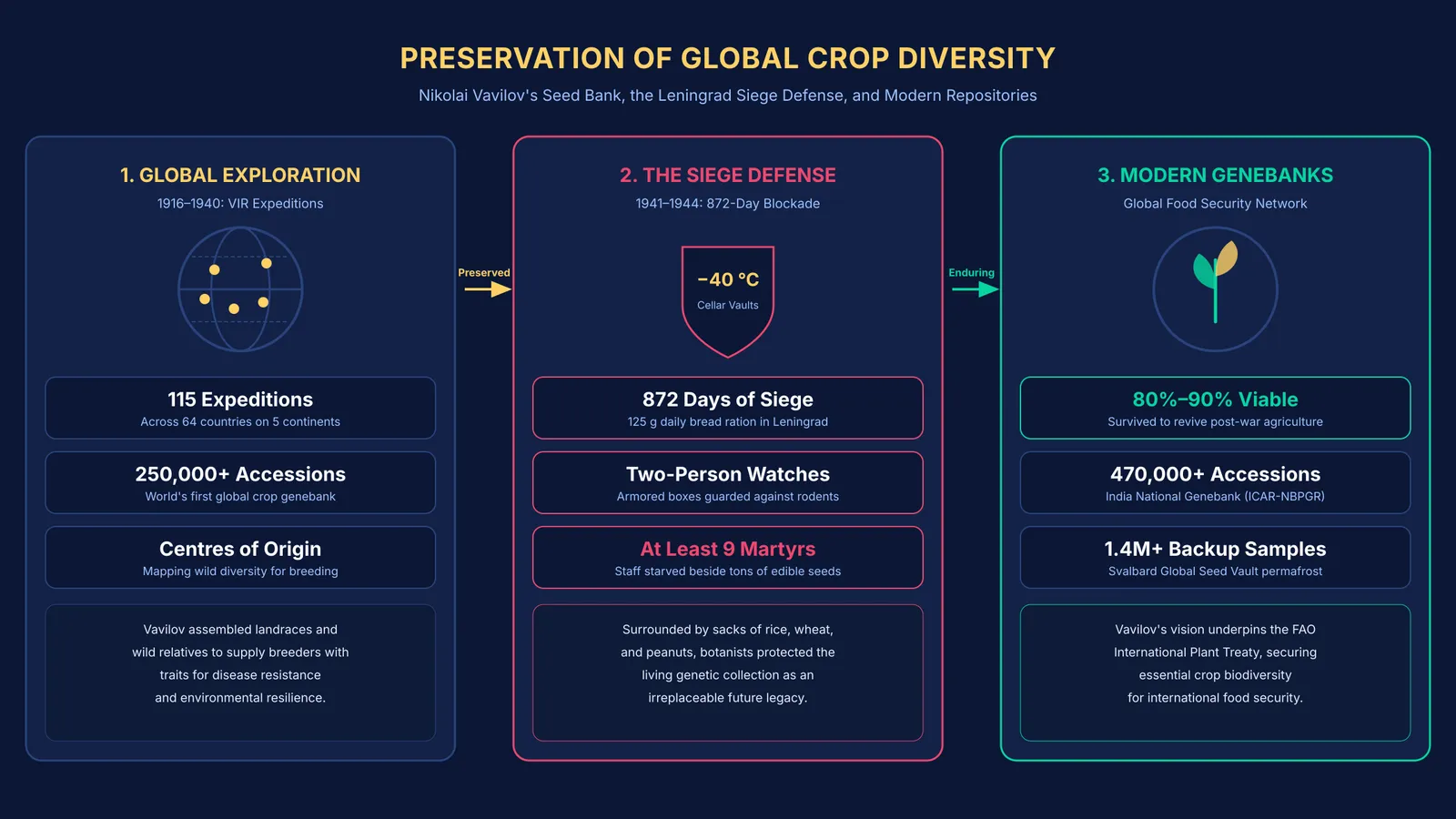
After studying genetics under William Bateson's pioneering genetics, Vavilov led the All-Union Institute of Plant Industry (VIR) on St. Isaac's Square in Leningrad. As analyzed by Janick (2015), Vavilov organized 115 scientific expeditions across 64 countries between 1916 and 1940. He gathered wild relatives in their evolutionary centres of diversity, articulating the concept of centres of origin of cultivated crops.
By 1940, the institute held more than 250,000 accessions of seeds, roots, and tubers. It was the world's first systematic global seed bank—a living genetic repository built to supply breeders with traits for disease resistance and climate resilience.
How did botanists protect the Leningrad seed bank during the siege?
When Axis forces encircled Leningrad in September 1941, the city began an 872-day military blockade. Food supplies stopped and winter temperatures dropped to −40 °C. As documented by Cohen and Loskutov (2016), roughly 30 botanists and technicians stayed at VIR to safeguard the collection.
The hazards were severe. Artillery shells shattered institute windows, exposing seeds to freezing air. Staff moved duplicate seed sets into reinforced basements. To fend off starving city rats, botanists bound wooden boxes with sheet metal, sealed glass jars, and maintained traps.
Living potato tubers required continuous care. In August 1941, potato specialists Abram Kameraz and Olga Voskresenskaya dug up experimental varieties under artillery fire at the suburban Pavlovsk station, carrying sacks back to Leningrad. During the bitter winter, staff burned broken floorboards in small stoves to prevent tubers from freezing solid. In spring 1942, they planted surviving tubers in vacant urban plots to produce fresh seed stock.
Why did scientists starve beside tons of edible seeds?
As detailed in Crow (1993), by winter 1941–1942, daily bread rations for non-combatant Leningrad residents fell to 125 grams. Inside VIR, staff were surrounded by pure food: sacks of rice, bins of wheat, maize, beans, and high-protein peanuts.
To prevent anyone from succumbing to delirium, staff adopted a strict rule: no one was permitted in storage rooms alone. Watches were stood in pairs. Despite severe emaciation and cold, the scientists refused to consume a single grain.
At least nine staff members starved to death at their posts. Rice specialist Dmitry Ivanov died in January 1942 surrounded by thousands of packets of rice. Peanut specialist Alexander Stchukin collapsed at his desk holding seed samples he refused to eat. The researchers regarded the collection not as food, but as the irreplaceable inheritance of future generations.
Tragically, Vavilov himself was unable to protect his team. Targeted by Trofim Lysenko, who rejected Mendelian genetics with state backing, Vavilov was arrested in August 1940. He died of starvation in Saratov prison on 26 January 1943.
What is the legacy of Vavilov's collection for global agriculture?
According to Cohen and Loskutov (2016), when the siege was broken in January 1944, more than 80% of the collection remained viable. These landraces helped breed disease-resistant crops that revived post-war agriculture across Eurasia, paralleling B. P. Pal's work on wheat rust resistance in India.
Today, Vavilov's vision underpins global food security under the FAO International Treaty on Plant Genetic Resources. Major repositories continue this work:
The ICAR National Bureau of Plant Genetic Resources in New Delhi preserves over 470,000 crop accessions in India's National Genebank at −18 °C.
The Svalbard Global Seed Vault in Norway holds more than 1.4 million backup seed samples in Arctic permafrost.
The original VIR institute in Saint Petersburg maintains over 320,000 accessions.
As Ilya Zakharov emphasized in Zakharov (2005), crop diversity is humanity's primary buffer against ecological and climatic shocks.
How can students apply Vavilov's preservation mindset to exam prep?
The botanists endured starvation because they understood the distinction between immediate relief and permanent capital. In academic preparation, students often face the reverse temptation: trading conceptual understanding for temporary shortcuts. Skipping derivations leaves knowledge fragile, collapsing when an exam presents an unfamiliar problem.
To cultivate durable mastery, students can adopt a structured preservation approach:
Curate Core Principles: Maintain a dedicated ledger of foundational laws, derivations, and mechanisms rather than memorising isolated trick shortcuts.
Test Through Retrieval: Revisit core concepts every two to three weeks through unassisted problem-solving to protect retention against decay.
Analyze Reasoning Errors: When practice tests reveal mistakes, document the exact misconception rather than simply reading the solution key.
When organizing core biology or science principles, the Fermi Concept Library arranges every concept in physics, chemistry, biology, mathematics and computing, each with its own lesson and its place in the map.
If you hit challenging quantitative problems and need to see where your reasoning failed, the Fermi Problem Library offers worked problems with a step-by-step solver that explains the reasoning rather than printing an answer.
When structuring a study session without a clear roadmap, Fermi's AI tutor can work out what you already know and build a plan for the session, holding a line of reasoning across the topic so you make steady progress.


