

On this page
In the 1860s, a Spanish engineer named Narcís Monturiol faced the ultimate problem of early submarine design. A vessel could either use human muscle, which exhausted the crew, or a steam engine, which burned up the limited oxygen in the cabin. Monturiol's solution, launched in 1864, was the Ictíneo II, a vessel that pioneered air-independent propulsion (Wikipedia).
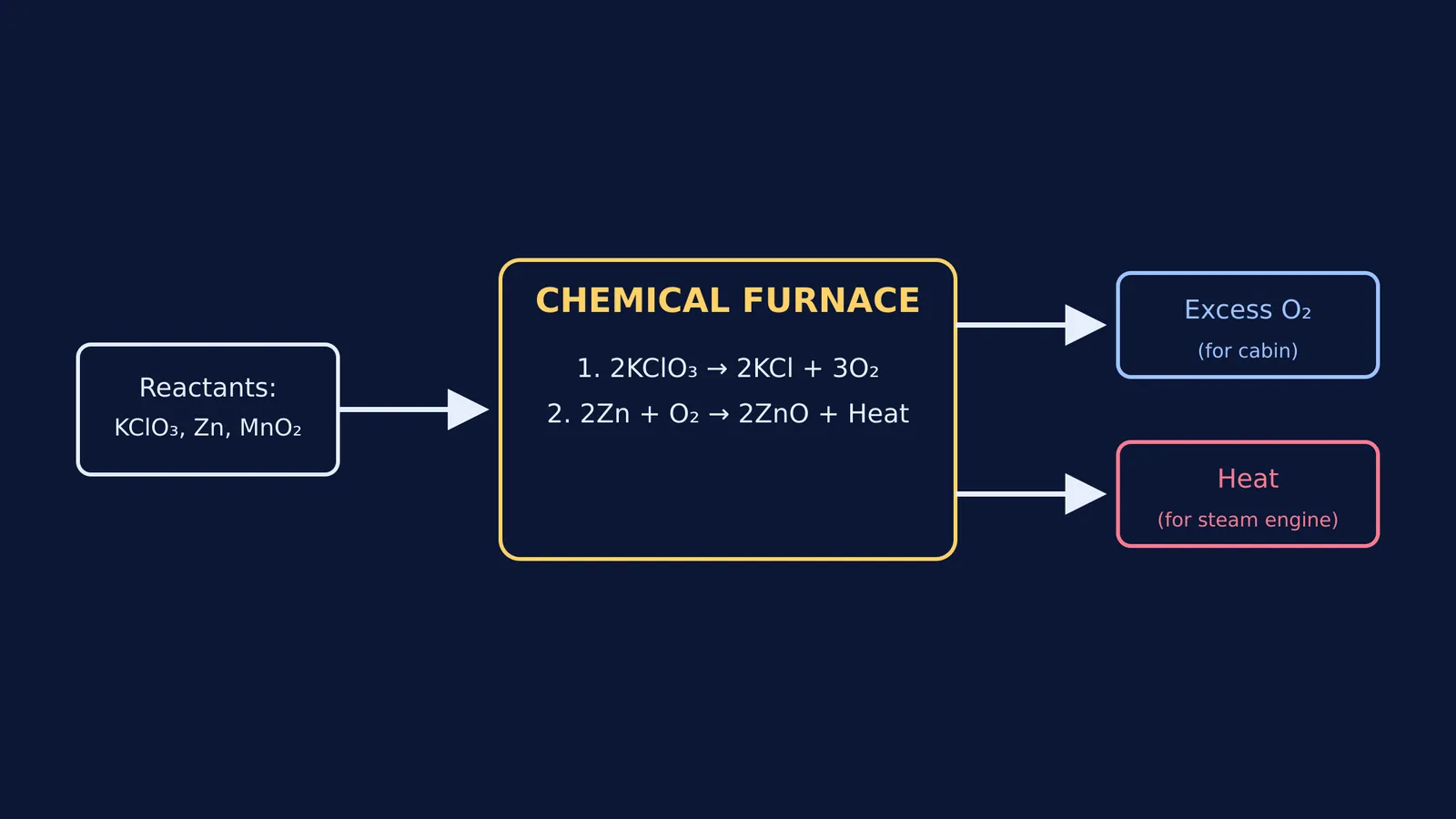
What made the submarine work was a "chemical furnace" that produced both power and breathable air without taking anything from the cabin's atmosphere.
What was Narcís Monturiol's Ictíneo II submarine?
The Ictíneo II was an experimental submarine designed with two separate propulsion systems. On the surface, it ran on a conventional coal-burning boiler that gave it a top surface speed of 4.5 knots (Wikipedia). But when it submerged to its test depth of 30 metres, burning coal was impossible. Instead, it relied on a steam engine powered by a bespoke chemical reactor.
Because the massive steam engine and chemical furnace took up so much space inside the 14-metre-long and 3-metre-high hull, there was only room for a crew of two. However, the system allowed the Ictíneo II to stay submerged for seven to seven and a half hours — a feat of endurance that other navies would not match until the 20th century.
How did the Ictíneo II make oxygen and heat?
Monturiol's genius was choosing a chemical reaction whose by-products solved both the propulsion and life-support problems simultaneously (Wikipedia). He mixed three solid powders in his reactor: potassium chlorate (KClO₃), zinc (Zn) and manganese dioxide (MnO₂).
The process happened in two stages. First, the potassium chlorate decomposed to release oxygen gas: 2KClO₃ → 2KCl + 3O₂
Second, the zinc underwent exothermic combustion, reacting with a portion of that newly released oxygen to produce zinc oxide and intense heat: 2Zn + O₂ → 2ZnO + Heat
The heat was directed to a separate boiler to generate steam for the engine, an early answer to the problem of finding mechanical work from heat (see James Watt's separate condenser and the physics of wasted heat). Because Monturiol carefully balanced the mixture to ensure there was more oxygen released than the zinc could consume, the excess pure oxygen was captured, filtered and released into the cabin. This supplied the two crew members with breathable air and even allowed them to burn a candle for illumination.
Students studying thermodynamics or equilibrium often struggle to picture how simultaneous reactions share reactants. If you find stoichiometry difficult to visualise, the Fermi Problem Library breaks down chemical equations step by step and explains the reasoning behind the mole ratios.
Why did the chemical furnace need a catalyst?
If you heat pure potassium chlorate on its own, it must reach high temperatures before it begins to release oxygen. Such high temperatures were dangerous and difficult to initiate inside a small wooden submarine hull.
To solve this, Monturiol added manganese dioxide (MnO₂). In this mixture, manganese dioxide acts as a catalyst. It provides an alternative reaction pathway with a lower activation energy, allowing the potassium chlorate to decompose rapidly at a much lower temperature. The catalyst itself is not consumed; it merely accelerates the first step so that the exothermic zinc combustion can take over and sustain the heat.
Today, you still see this exact catalytic reaction in high school laboratories when preparing oxygen gas (Learning inorganic chemistry with retrieval, not rote lists). It is a classic example of how a catalyst changes the conditions of a reaction without changing the final products (Thermodynamics sign conventions: physics vs chemistry, explained).
By mastering the thermodynamics and kinetics of this mixture, Monturiol built a life-support system that was decades ahead of its time.


